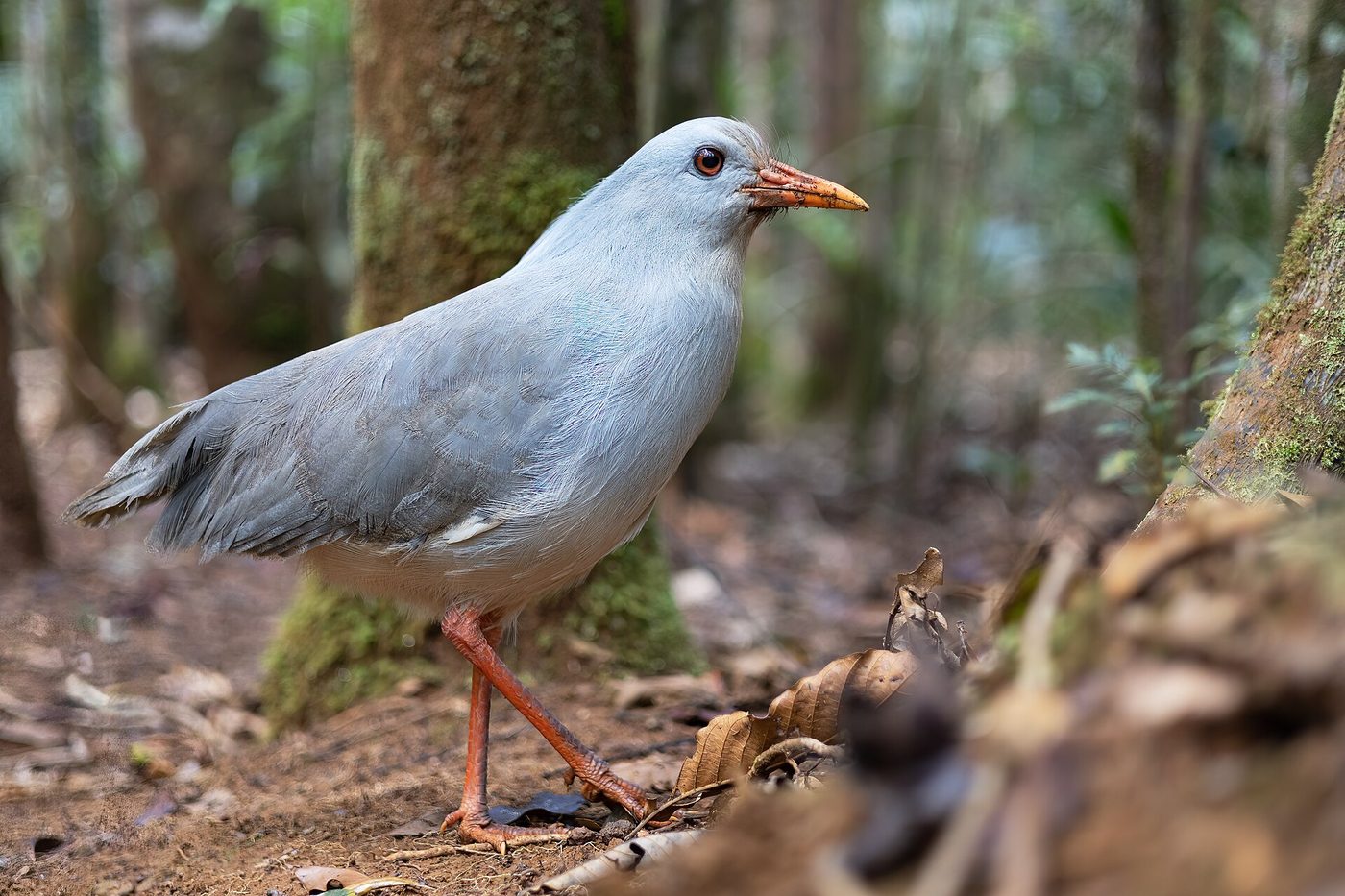
Photo: JJ Harrison · CC BY-SA 3.0
Kagu
Rhynochetos jubatus
The kagu is a curious bluish-grey, flightless bird endemic to New Caledonia, the only surviving member of its family.
Characteristics
Temperament
Ground-dwelling, slow and silent; monogamous and territorial.
Diet
Insectivore/carnivore: earthworms, snails, insects and spiders.
The ghost of the forest
The kagu (Rhynochetos jubatus) is a ground-dwelling, bluish-grey bird about 55 cm long, with long red legs and an orange bill. It weighs a little over a kilogram. (Note: the body-mass value listed on Wikidata, 50 kg, is clearly an error — the kagu weighs about 0.7–1.1 kg.) On its head it bears a prominent crest that it raises like a fan in display. Though its wings are of normal size, it is effectively flightless: it uses them only to glide briefly and to flash bold black-and-white bands during displays. It is the only living member of the family Rhynochetidae.
Habitat and range
It is endemic to New Caledonia in the southwestern Pacific, where it inhabits dense mountain forests. It lives almost entirely on the ground, moving with a slow, silent gait through the leaf litter and undergrowth.
Behaviour and diet
It feeds on soil invertebrates — earthworms, snails, insects, spiders — which it finds by probing the litter. It often stands motionless, waiting, then strikes suddenly. It is monogamous and territorial: the pair builds a simple ground nest and lays a single egg, raised by both parents. It gives loud, barking calls at dawn.
Did you know?
It has a rare anatomical feature: small flaps (nasal corns) covering its nostrils, perhaps to keep out soil while it digs. It has become a national symbol of New Caledonia and appears on its coins and stamps.
Conservation
The IUCN lists it as Endangered. Being flightless and ground-nesting, it is extremely vulnerable to predators introduced by people — especially dogs, cats, rats and pigs — as well as to forest loss. Predator-control and protection programmes are under way.
Pros
- The only living member of its family
- A national symbol of New Caledonia
- Striking crest and displays
Cons
- Endangered
- Flightless: vulnerable to introduced predators
- Slow breeding, a single egg per clutch