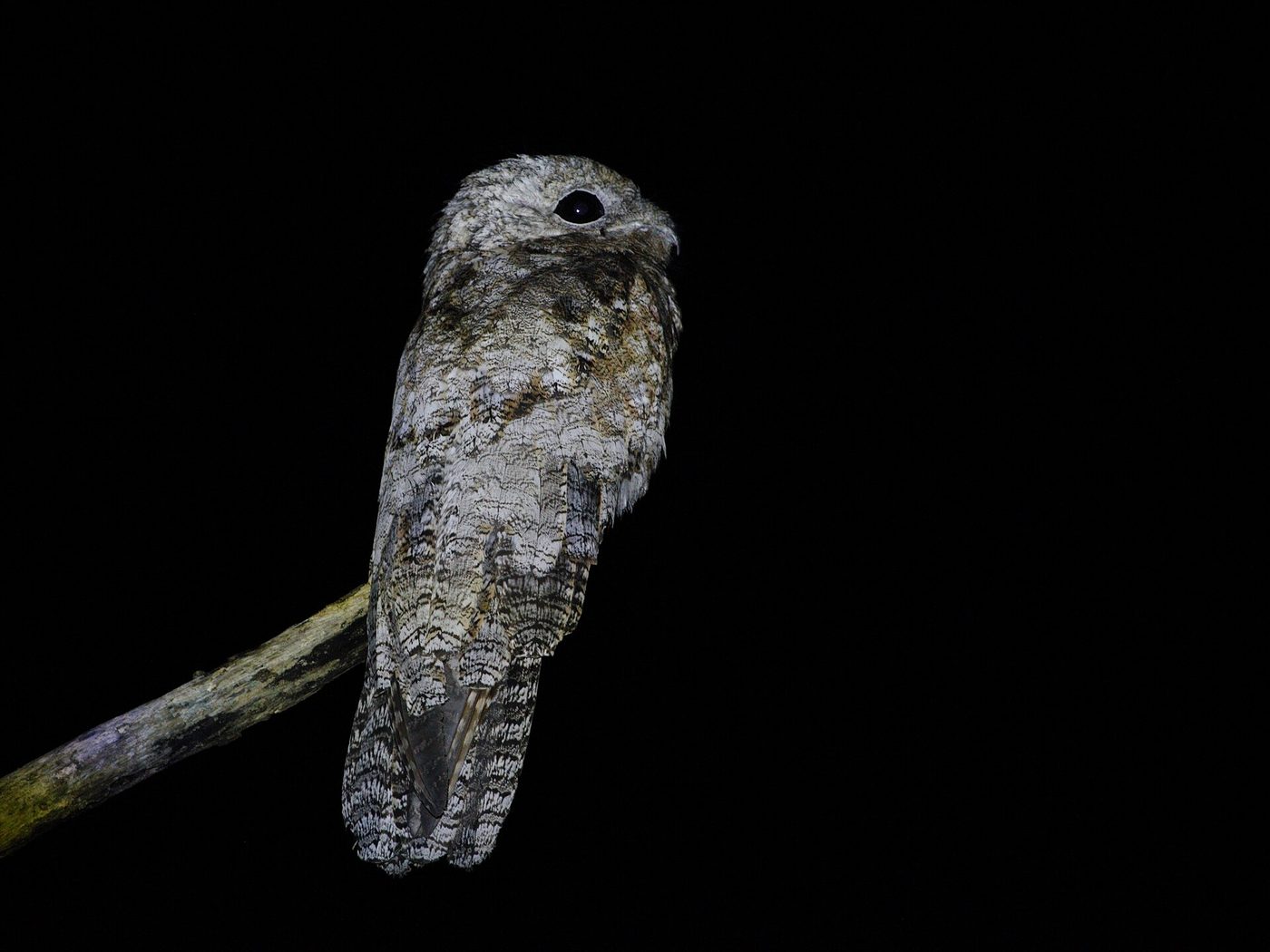
Photo: Hector Bottai · CC BY-SA 4.0
Great potoo
Nyctibius grandis
An absolute master of camouflage, the great potoo spends the day motionless, pretending to be a tree stump, only to become a skilful nocturnal hunter.
Characteristics
Temperament
Nocturnal, motionless by day, ambush hunter
Diet
Carnivore: large insects and sometimes small vertebrates
A bird that pretends to be a branch
The great potoo is the largest of the potoos, a group of tropical nocturnal birds of unusual appearance. It has a relatively slender body, a large, broad head, enormous eyes and a huge mouth that opens like a very wide slit. Its plumage is a refined mosaic of grey, brown and black, finely patterned. But its true masterpiece is its camouflage: by day it perches on top of a broken trunk or branch, in an upright position, its neck stretched and its eyes half-closed, becoming practically indistinguishable from a stump of dead wood.
Habitat and distribution
It is widespread across much of Central and South America, where it inhabits tropical forests and wooded areas. It spends the day resting, motionless and camouflaged, among the branches, and becomes active as night falls, when it comes out to hunt.
Behaviour and hunting
It is an ambush hunter. Perched on a branch, it stays motionless, scanning the darkness, then launches into short flights to catch large insects and sometimes even small vertebrates, such as bats, before returning to its perch. Its enormous mouth is perfect for swallowing prey in flight. An extraordinary curiosity is that its eyelids have small slits that allow it to perceive movements even with its eyes apparently closed, without betraying its presence.
Conservation and curiosities
The great potoo is classified as a species of least concern, with still widespread populations. Its nocturnal call, deep and mournful, resounding in the darkness of the forest, has fuelled legends and beliefs in various cultures. It nests without building a true nest, laying its egg in a small depression or fork of a branch.
Pros
- Extraordinary master of camouflage
- The largest of the potoos
- Enormous mouth to catch prey in flight
- Unthreatened populations
Cons
- Very hard to spot
- Tied to the tropical forests
- Active only at night