Photo: Fitzinger, Leopold Joseph · Public domain
Standard-winged nightjar
Caprimulgus longipennis
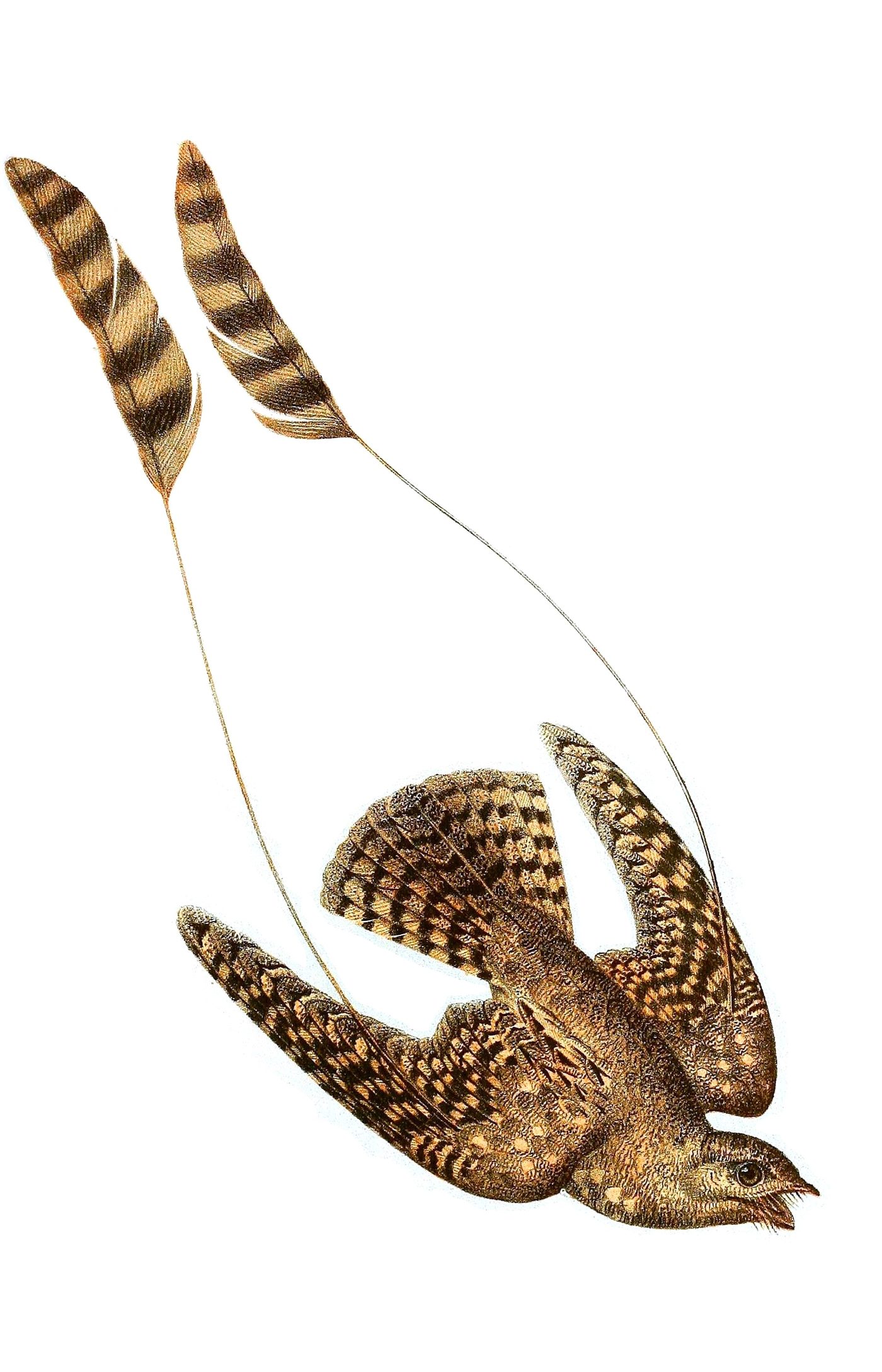
The standard-winged nightjar is a nocturnal African bird: in the breeding season the male sports two very long wing feathers, carried aloft like standards in flight.
Characteristics
Temperament
Nocturnal and cryptic; males with spectacular courtship flights.
Diet
Insectivorous: insects caught in flight at dusk.
The bird with wing standards
The standard-winged nightjar (Caprimulgus longipennis) is a nocturnal bird of the nightjar family, famous for an extraordinary sexual dimorphism. Its plumage is cryptic, in shades of brown, grey and black — perfect camouflage against ground and leaf litter. Its peculiarity appears in the breeding season: the male grows two huge inner wing feathers, longer than its whole body, with a long bare shaft ending in a striking "flag" of feathers. It usually weighs between 55 and 70 grams. (Note: the body-mass value listed on Wikidata, 5.1 kg, is clearly an error — this is a bird of a few tens of grams.)
Habitat and range
It lives in the savannahs and open woodlands of Africa, south of the Sahara. It is active at night, while by day it rests motionless on the ground, nearly invisible thanks to its cryptic plumage.
Behaviour and courtship
It feeds on insects caught in flight with its very wide mouth, darting through the dusk. During courtship the male performs slow, wavering flights while holding up its long standard feathers, which flutter above it like banners to impress females. Once the breeding season ends, those feathers are shed.
Did you know?
Like all nightjars, it owes its curious name to an old folk belief — quite unfounded — that these birds suck milk from goats at night. In reality they merely hunt the insects attracted to grazing livestock.
Conservation
The IUCN lists it as Least Concern. It is still widespread in African savannahs, but like many nocturnal birds it depends on the health of open habitats and an abundance of insects.
Pros
- Unique standard-like wing feathers (male)
- Perfect camouflage on the ground
- Least Concern, still widespread
Cons
- Depends on open savannahs and insects
- Strong dimorphism: only the male has the standards
- Nocturnal and hard to observe