Golden Jackal
Canis aureus
Characteristics
Temperament
Social but discreet, intelligent and highly adaptable. The basic unit is the lasting monogamous pair, which defends a territory; family groups include "helpers" that assist in raising the pups. Mainly crepuscular and nocturnal, especially near people. Communicates with howling choruses. An opportunist par excellence, it owes its success to flexibility rather than strength. Not a pet: a wild canid in full expansion.
Diet
An opportunistic omnivore with a very flexible diet. Staple: small mammals (rodents, hares, rabbits). Also birds, reptiles, amphibians and insects, carrion (an important scavenger), seasonal fruit and plants, and refuse near human settlements; occasionally small ungulates hunted in pairs. It hunts in pairs, supplements with scavenging and switches diet by season. Like the coyote, it is this flexibility that makes it so hard to stop.
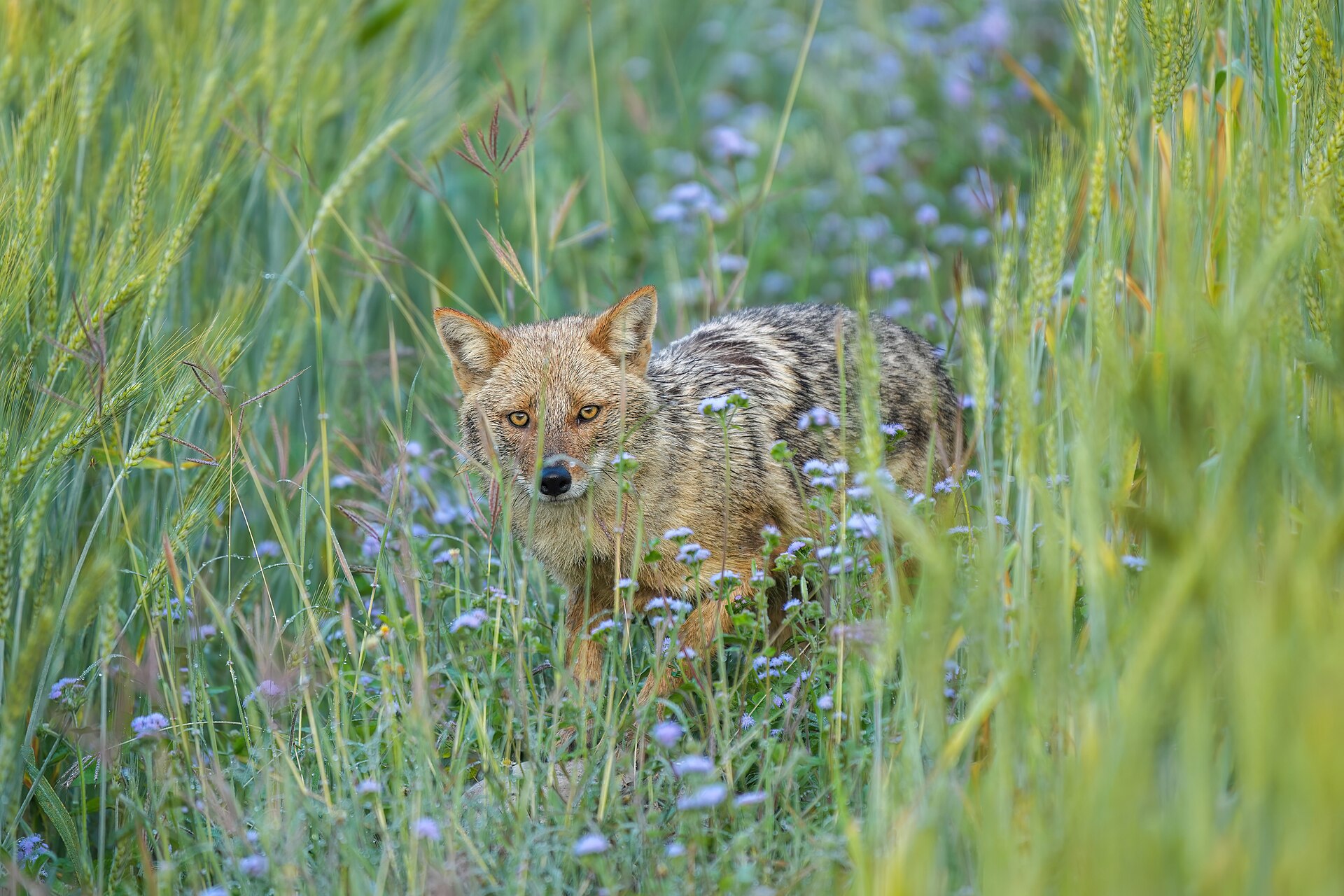
The Golden Jackal (Canis aureus) is a medium-sized Eurasian wild canid, midway between a wolf and a fox. Famous for:
- Its great expansion in Europe: in recent decades it has colonized much of the continent, including Italy, where it is now firmly established and increasing
- Opportunistic adaptability: an omnivore able to live in very different habitats, from wetlands to farmland to the edges of towns
- Pair living: it forms lasting monogamous bonds, with a family structure that includes "helpers"
- Howling choruses: characteristic nocturnal vocalizations, often "contagious" between neighbouring groups
- Its golden-yellow coat: the tawny livery that gives it its name, varying with the season
- Its link to myth: the jackal is a recurring figure in Old World fables and mythologies
IUCN status: Least Concern (LC), with an increasing and expanding population. It is one of the few European large carnivores whose range is growing — a phenomenon it shares, though on another continent, with a canid like the North American Coyote, another expanding opportunist.
Classification and category
Order Carnivora, family Canidae, genus Canis — the same as the grey wolf, the coyote and the domestic dog, of which it is a close relative. A medium-sized canid, smaller than the wolf but sturdier than a fox. An important, recent distinction concerns the African "golden" jackals: until a few years ago the golden jackals of Africa and Eurasia were considered a single species, but genetic studies showed the African populations to be a separate species, the African golden wolf (Canis lupaster); today the name Canis aureus refers only to the Eurasian golden jackal, the one found in Europe and Asia. It should not be confused with the other African jackals (the black-backed and side-striped jackals), which belong to a different genus. Etymology: "Canis" is Latin for "dog"; "aureus" means "golden", for the coat colour; the word "jackal" comes, via Turkish and Persian, from a Sanskrit root evoking its howl. Parameters: Body 70-85 cm. Tail ~25 cm. Shoulder height 45-50 cm. Weight 7-15 kg (males a little larger than females). Longevity 8-9 years in the wild, up to about 16 in captivity. A monogamous, lasting pair; gestation ~63 days; litters of 4-6 pups, raised by the pair and often by "helpers" (offspring from previous litters).
Habitat and distribution
The Golden Jackal has a vast and rapidly growing range: historically from southeastern Europe (the Balkans) through the Middle East, the Caucasus and Central Asia to the Indian subcontinent and Southeast Asia; in a recent expansion, starting from the Balkans, it has colonized Central and Western Europe — in Italy it is now firmly present especially in the northeast (Friuli-Venezia Giulia, Veneto) and spreading. Preferred habitats — very varied: wetlands, reedbeds and riverine areas; grasslands, steppes and farmland; open woodland, scrub and hill country; and the edges of villages and human areas, where it exploits resources linked to people. It is a territorial animal, mainly crepuscular and nocturnal, especially near humans. Its extraordinary ecological plasticity — a flexible diet, adaptation to modified landscapes, the ability to fill the "mesopredator niche" — explains how quickly it is conquering new European ground. IUCN: Least Concern, increasing. Its spread is also favoured by the historic reduction of the wolf (its competitor) in many areas and by the abundance of food resources in agricultural landscapes.
Diet
An opportunistic omnivore with an extremely flexible diet, one of the keys to its success: small mammals (rodents, hares and rabbits, the staple in many areas); birds, reptiles, amphibians and insects; carrion (an important scavenger of carcasses); fruit and plant matter (seasonal berries and fruit); refuse and scraps near human settlements; and occasionally small ungulates or game young, hunted in pairs. Feeding strategies: pair hunting (the stable pair cooperates in finding food and catching slightly larger prey); scavenging (like many canids, it supplements its diet with carrion and scraps, reducing hunting effort); and seasonal opportunism (switching from small mammals to fruit, from insects to refuse, depending on what is abundant). Just as with the coyote in America, it is the generalist diet that makes the Golden Jackal so hard to stop: it can live anywhere there is something to eat, and Europe's farmland, rich in prey and scraps, offers ideal conditions.
Physical features
Looks like a slender, elegant canid, intermediate between a fox and a small wolf. Coat: golden-yellow/tawny, shading from sandy to greyish-brown; paler on the belly and throat, darker and grizzled on the back; changing slightly with the season (thicker and greyer in winter). Body: a slender, lean build for endurance; a pointed muzzle and erect ears; long legs suited to prolonged trotting; and a bushy, medium-length tail carried low. To tell it from the "other canids": it is larger and longer-legged than the red fox (and lacks its very bushy white-tipped tail), but clearly smaller and lighter than the wolf, with a finer muzzle and a more gracile build. Performance: trotting endurance (it covers long distances seeking food); acute senses (excellent hearing and smell); a rich vocal repertoire of howls and yips, with the famous group choruses; and adaptability — its true "weapon", more than strength or speed.
Behaviour and curiosities
A social but discreet animal. The basic unit is the monogamous pair, which defends a territory and stays together for a long time. Family groups may include "helpers" — young from previous litters that postpone their own breeding to help the parents raise the new pups, a form of cooperative breeding.
The European expansion: the Golden Jackal is the star of one of the fastest recent expansions of a mammal in Europe; starting from the Balkans, in a few decades it has reached Central Europe, Germany, the Baltic states, and pushed on to France, the Netherlands and beyond; in Italy it is now firmly present in the northeast and slowly spreading toward the rest of the country, helped by its adaptability, the abundance of food in farmland, and the historic scarcity of the wolf, its main competitor. The nocturnal choruses: like many canids it communicates by howling; its group choruses, often at dusk or by night, mark territory and keep family contact, and a chorus can erupt "in a chain" in response to a sudden sound — another group, a siren, barking dogs — making the animals sound more numerous than they are. The "don't confuse it with...": the jackal's arrival in new areas often causes confusion; it is mistaken for a wolf (but is much smaller), a fox (but is bigger, longer-legged and different-tailed), or a stray dog; this resemblance to the domestic dog, and the possibility of hybridization, are among the challenges of its management and monitoring. The "helpers": the Golden Jackal's cooperative breeding is a classic example studied by ethologists; young that stay in the group as "helpers" bring food to the pups, guard them and defend the territory, and their presence raises litter survival — a form of altruism that makes evolutionary sense, because the helpers are close relatives of the pups they protect. The cultural symbol: the jackal is a recurring figure in Old World fables and mythologies, often as a cunning, deceitful animal — a role that in many Asian traditions (for example in Indian collections such as the Panchatantra) recalls that of the fox in European fables; in ancient Egypt the god Anubis was depicted with the head of a black canid often identified with the jackal, linked to the world of the dead.
Pros
- Canide adattabilissimo, in espansione naturale in Europa e in Italia
- IUCN Least Concern: popolazione in aumento
- Utile mesopredatore: controlla roditori e ripulisce le carogne
- Allevamento cooperativo con 'aiutanti': caso etologico affascinante
Cons
- Non è un animale domestico (canide selvatico)
- Può ibridarsi con i cani domestici, complicandone la gestione
- Occasionali conflitti con allevatori (pollame, piccolo bestiame)
- Spesso confuso con lupo, volpe o cane randagio