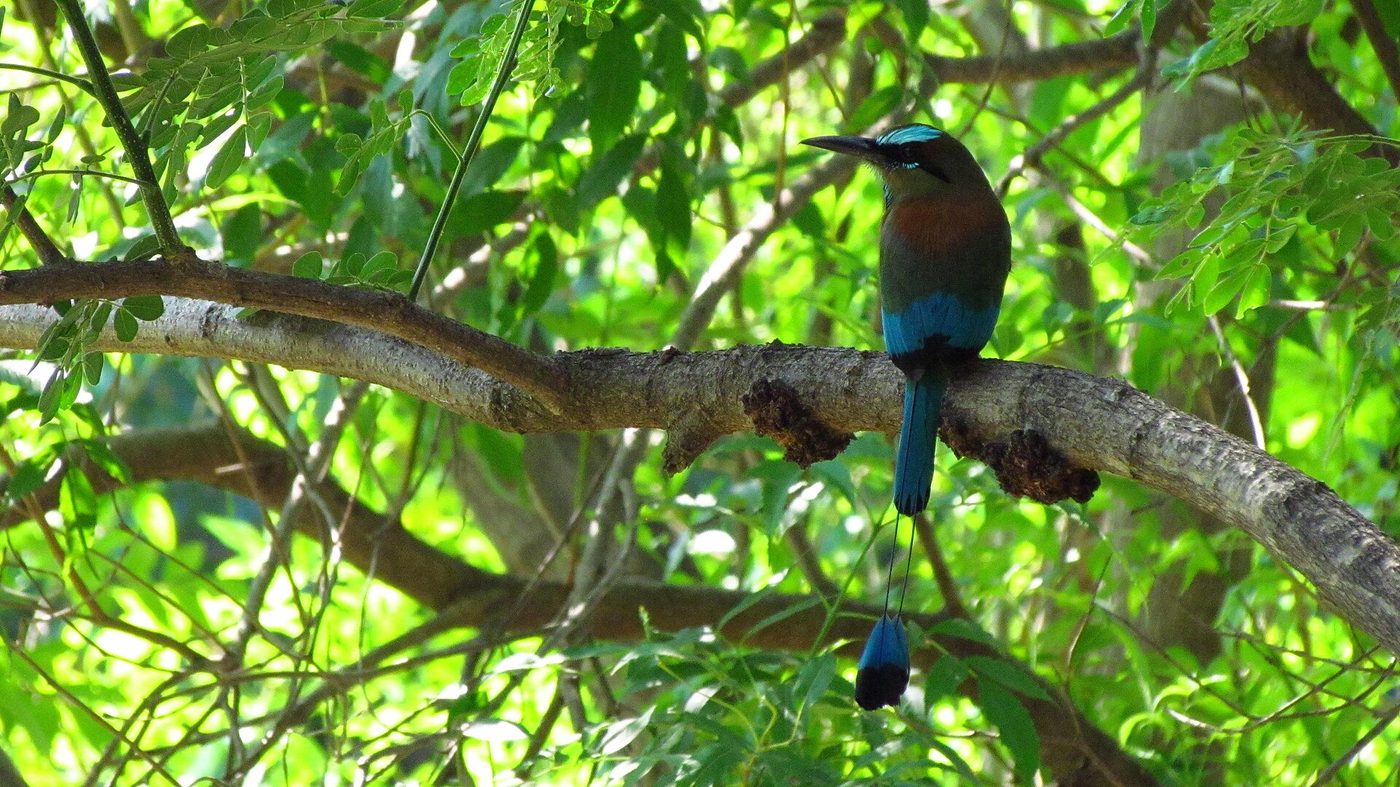
Turquoise-browed motmot
Eumomota superciliosa
The turquoise-browed motmot is a dazzling Central American bird famous for its racket-tipped tail that swings back and forth like a pendulum.
Characteristics
Temperament
Lively, conspicuous, often perched in the open
Diet
Insectivorous and carnivorous: insects, small reptiles and invertebrates
The bird with a pendulum tail
The turquoise-browed motmot is a medium-sized bird of striking colours: olive-green and rust upperparts, a black throat edged in blue and, above all, a bright turquoise brow that gives it its name. Yet its most famous feature is the tail: two long central feathers stripped of barbs for part of their length, ending in a racket-shaped tip. The bird swings this tail slowly from side to side, like a clock's pendulum, earning it the Spanish name "pájaro reloj" (clock bird).
Habitat and range
It lives in Central America, from south-east Mexico down to Costa Rica and Panama. It favours fairly open habitats: forest edges, scrubland, gallery forest along watercourses and brushy areas. It is more conspicuous than other motmots and often perches in the open on wires and fences.
Behaviour and nesting
From prominent perches it scans the ground for prey — insects, small reptiles and other invertebrates. It nests by digging long tunnels into earth banks, road cuttings or even wells and quarries, where it lays 3 to 6 white eggs. The tail-wagging appears to double as a signal to predators — "I have seen you" — discouraging an attack.
Notable facts
Two nations claim it as their national bird: in El Salvador it is called torogoz, and in Nicaragua guardabarranco. The racket shape of the tail is not innate: the central barbs of the feathers are weak and drop off through ordinary wear, leaving the bare shaft and paddle tip.
Conservation
The species is listed as Least Concern by the IUCN and is common across much of its range. Its tolerance of semi-open and human-modified habitats makes it less vulnerable than many forest birds.
Pros
- Unique and spectacular racket tail
- National bird of El Salvador and Nicaragua
- Adapts well to semi-open habitats
Cons
- Depends on earth banks for nesting
- Sensitive to destruction of forest edges