Loggerhead Sea Turtle
Caretta caretta
Characteristics
Temperament
A wild, solitary and migratory sea turtle: it is NOT a pet, but a great traveller of the oceans that spends almost its whole life at sea. It is calm and silent, but equipped with very powerful jaws and an extraordinary navigational ability: it travels thousands of kilometres and returns to lay on its natal beach thanks to its perception of the Earth's magnetic field. Only females return periodically to land, at night, to nest. It is a long-lived, late-maturing species, which makes it particularly vulnerable to threats. Classified as Vulnerable by the IUCN, it is a symbol of marine conservation and must be protected, not kept in captivity.
Diet
Mainly carnivorous, especially as an adult: its powerful jaws and large head are adapted to crushing hard-shelled prey. It feeds above all on molluscs (shells, bivalves, gastropods) and crustaceans (crabs) of the coastal seabed, as well as sea urchins, sponges, jellyfish and occasionally fish and plant material. The young, in the open sea, have a more varied, opportunistic diet. Its very capture of gelatinous organisms like jellyfish exposes it to a serious risk: the ingestion of plastic mistaken for prey is today one of the main threats to the species.
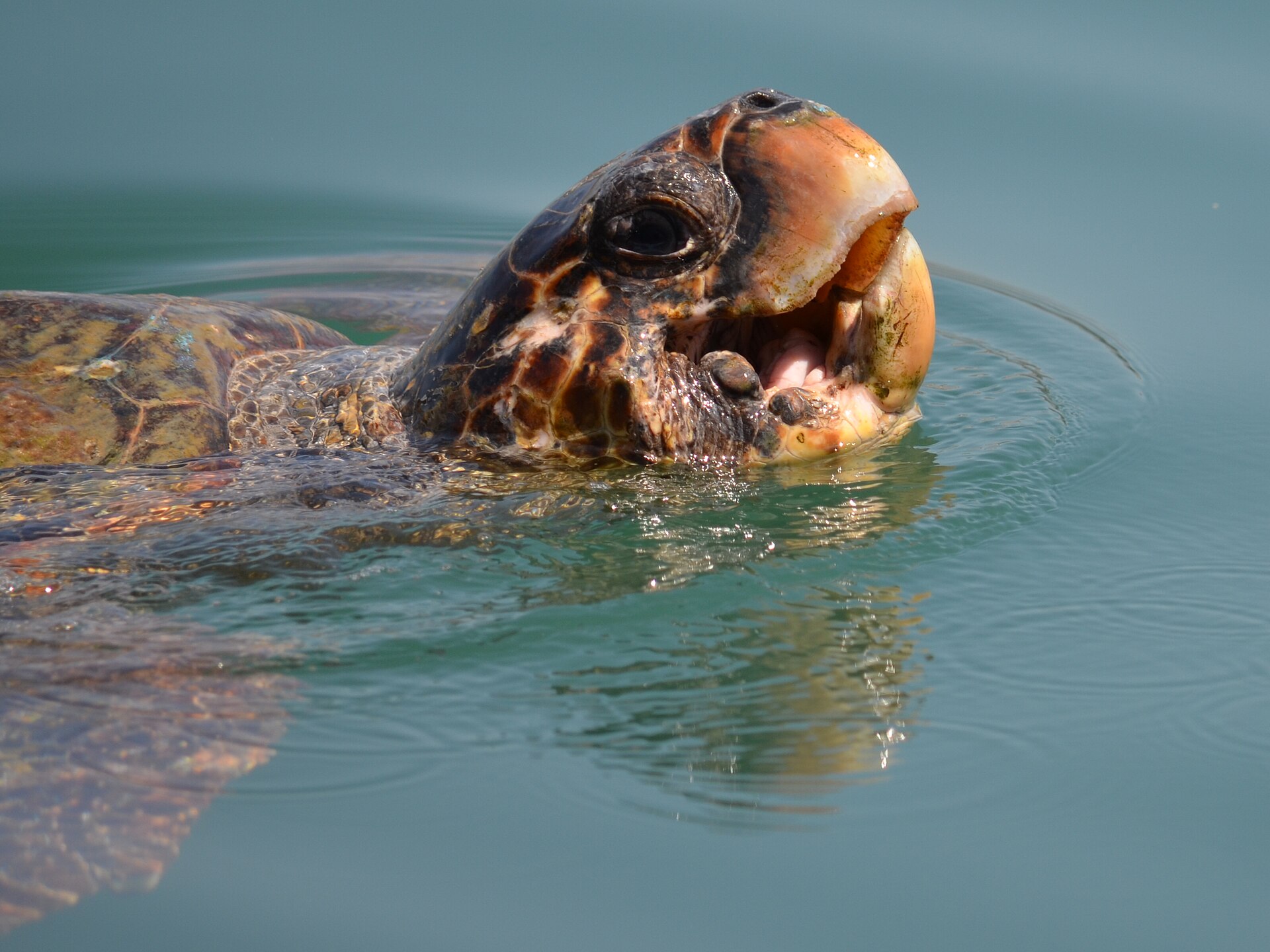
The Loggerhead Sea Turtle (Caretta caretta) is the most widespread sea turtle in the Mediterranean Sea and one of the best known and most studied on the planet. An ancient ocean navigator, it is famous for:
- The large head: the head is proportionally the largest among sea turtles, hence the name "loggerhead"
- The powerful jaws: very strong, able to crush the shells of molluscs and crustaceans
- The heart-shaped carapace: reddish-brown in colour, with five pairs of side scutes
- The great migrations: it travels thousands of kilometres across the oceans
- The return to the natal beach: females return to lay where they were born, guided by the Earth's magnetic field
- The bond with the Mediterranean: it also nests on our coasts
IUCN status: Vulnerable (VU). It enters the portal among the sea turtles, alongside the green sea turtle: with it, it represents the great turtles of the oceans, completing the picture of the portal's turtles together with the land tortoises and freshwater turtles.
Classification and category
The Loggerhead belongs to the order Testudines, family Cheloniidae (the hard-shelled sea turtles), genus Caretta, of which it is the only living species: Caretta caretta. In the portal it is placed among the sea turtles. It is useful to tell it apart from the portal's other sea turtle and from turtles in general: the green sea turtle (Chelonia mydas) — has a smaller, rounder head, a beak suited to grazing algae and is herbivorous as an adult; it has four pairs of side scutes on the carapace; the loggerhead instead has a much larger, more massive head, powerful predator's jaws and five pairs of side scutes; the carapace is reddish-brown; unlike land tortoises (column-like legs) and freshwater turtles, sea turtles like the loggerhead have their limbs transformed into flippers and cannot retract head and legs into the shell. The combination of large head + powerful jaws + heart-shaped reddish-brown carapace + flipper limbs is the loggerhead's "identity card". Etymology: the genus and species name, Caretta, comes from the French "caret", in turn from a term used for sea turtles; the English name "loggerhead" means "big head", referring to its most obvious trait. Parameters: Carapace length usually about 80-110 cm. Weight on average around 90-135 kg, but the largest specimens can exceed 180-200 kg. Appearance a large sea turtle with a hydrodynamic body and sturdy swimming flippers. Longevity: a very long-lived species, which can live several decades; it reaches sexual maturity late, after many years (often over 17-30 years). Reproduction: females lay in holes dug in the sand of beaches, usually over a hundred eggs per clutch; the hatchlings' sex depends on the incubation temperature.
Habitat and distribution
The Loggerhead is a cosmopolitan species, present in temperate and tropical seas and oceans worldwide: its range covers the Atlantic, Pacific and Indian Oceans, and in particular the Mediterranean Sea, where it is the most common sea turtle. Preferred habitats — different marine environments at the various stages of life: coastal waters and continental shelves, where adults seek food on the seabed; the open sea, especially in the juvenile stages (the "lost years" spent in the open sea); and sandy beaches, essential for egg-laying (in the Mediterranean: Greece, Turkey, Cyprus, and also Italy). It is a marine, solitary and migratory animal. It spends almost its whole life at sea, and only females return periodically to land to lay. It makes extraordinary migrations, travelling thousands of kilometres between feeding areas and nesting beaches, and has the surprising ability to return to lay on the very beach where it was born, navigating thanks to its perception of the Earth's magnetic field (a kind of internal "compass"). IUCN status: Vulnerable (VU). The loggerhead is threatened by numerous factors linked above all to humans: accidental capture in fishing nets and longlines (bycatch), plastic ingestion (often mistaken for jellyfish), the loss of nesting beaches to coastal development, light pollution that disorients newly hatched young, collisions with boats and egg poaching. Its protection is a symbol of marine conservation in the Mediterranean.
Diet
The Loggerhead is mainly carnivorous, especially as an adult, and its powerful jaws are perfectly adapted to crushing hard-shelled prey. Its diet includes: molluscs (shells, gastropods and bivalves, crushed with the sturdy beak); crustaceans (crabs and other seabed crustaceans); other marine invertebrates (sea urchins, sponges, jellyfish); and occasionally fish and plant material. Features of its feeding behaviour: a seabed predator (as an adult it seeks food above all on coastal seabeds, where molluscs and crustaceans abound); "crushing" jaws (the large head and powerful jaws let it break shells that other turtles could not even dent); and a diet that changes with age (the young, in the open sea, have a more varied, opportunistic diet, including floating organisms). Unfortunately its very habit of feeding on gelatinous organisms like jellyfish exposes it to a serious danger: the ingestion of plastic bags and fragments, mistaken for prey, is today one of the main threats to the species.
Physical features
The Loggerhead is a large sea turtle with a sturdy, hydrodynamic body. The head and jaws — the distinguishing trait: a very large, massive head, the most voluminous among sea turtles; powerful jaws with a sturdy horny beak, suited to crushing shells. The carapace: a heart shape, elongated at the rear; a reddish-brown or orange colour, often with encrustations of marine organisms; five pairs of side (costal) scutes, useful for distinguishing it from the green turtle. The limbs and the adaptation to the sea: limbs transformed into flippers (the front ones, long and sturdy, act as "oars"; the rear ones as a rudder); a hydrodynamic body, perfect for swimming and long migrations; the inability to retract head and limbs into the shell, unlike land and freshwater turtles.
Curiosities and conservation
The Loggerhead is an animal of ancient charm, a true traveller of the oceans whose life is marked by epic migrations and the mysterious call of the natal beach.
The big head: the English name "loggerhead" literally means "big head" and describes this turtle's most obvious trait; its voluminous head houses extremely powerful jaw muscles, which let it crush shells and crustacean shells with remarkable force, exploiting a food niche closed to other turtles. The magnetic compass: one of the loggerhead's most surprising abilities is to navigate by the Earth's magnetic field; it is thought that the young "memorize" the magnetic signature of the beach where they are born and that, as adults, females use it as a reference to return to lay in that area, after years and thousands of kilometres at sea; it is an extraordinary example of natural navigation. The "lost years": after hatching, the young reach the sea and disappear offshore for a long period, spent in the open sea carried by the currents; this juvenile phase, hard to study, is known as the "lost years", during which the young grow far from the coasts before returning to more coastal waters as subadults. The race to the sea: as soon as they leave the egg and emerge from the sand, the young must reach the sea as fast as possible, usually at night, orienting toward the brightest horizon over the sea; it is a dramatic and very dangerous moment: many are preyed upon, and today coastal light pollution can disorient them, leading them away from the water; this is why protecting nesting beaches is crucial. The sex decided by the sand: as in many turtles, the hatchlings' sex is not determined by chromosomes but by the temperature at which the eggs develop in the sand: warmer temperatures tend to produce more females, cooler ones more males; global warming, by altering beach temperatures, therefore represents an additional threat to the balance of populations. Conservation: classified as Vulnerable by the IUCN, the loggerhead is at the centre of numerous protection projects, especially in the Mediterranean; the main protective measures include reducing accidental capture with safer fishing gear, fighting plastic pollution, monitoring and securing nesting beaches, curbing light pollution and caring for injured specimens in rescue centres; the loggerhead has become a symbol of marine conservation, and protecting it means protecting the health of entire marine ecosystems.
Pros
- Tartaruga marina iconica e simbolo della conservazione del Mediterraneo
- Viaggiatrice straordinaria: migrazioni di migliaia di km e bussola magnetica
- Mascelle potenti, adattate a una nicchia alimentare unica
- Completa nel portale il gruppo delle tartarughe marine (con la tartaruga verde)
Cons
- Specie selvatica e protetta: NON è un animale da compagnia
- Classificata come Vulnerabile (IUCN), con popolazioni in difficoltà
- Molto minacciata da reti da pesca (bycatch), plastica e perdita delle spiagge
- Maturazione tardiva e lunga vita la rendono lenta a riprendersi