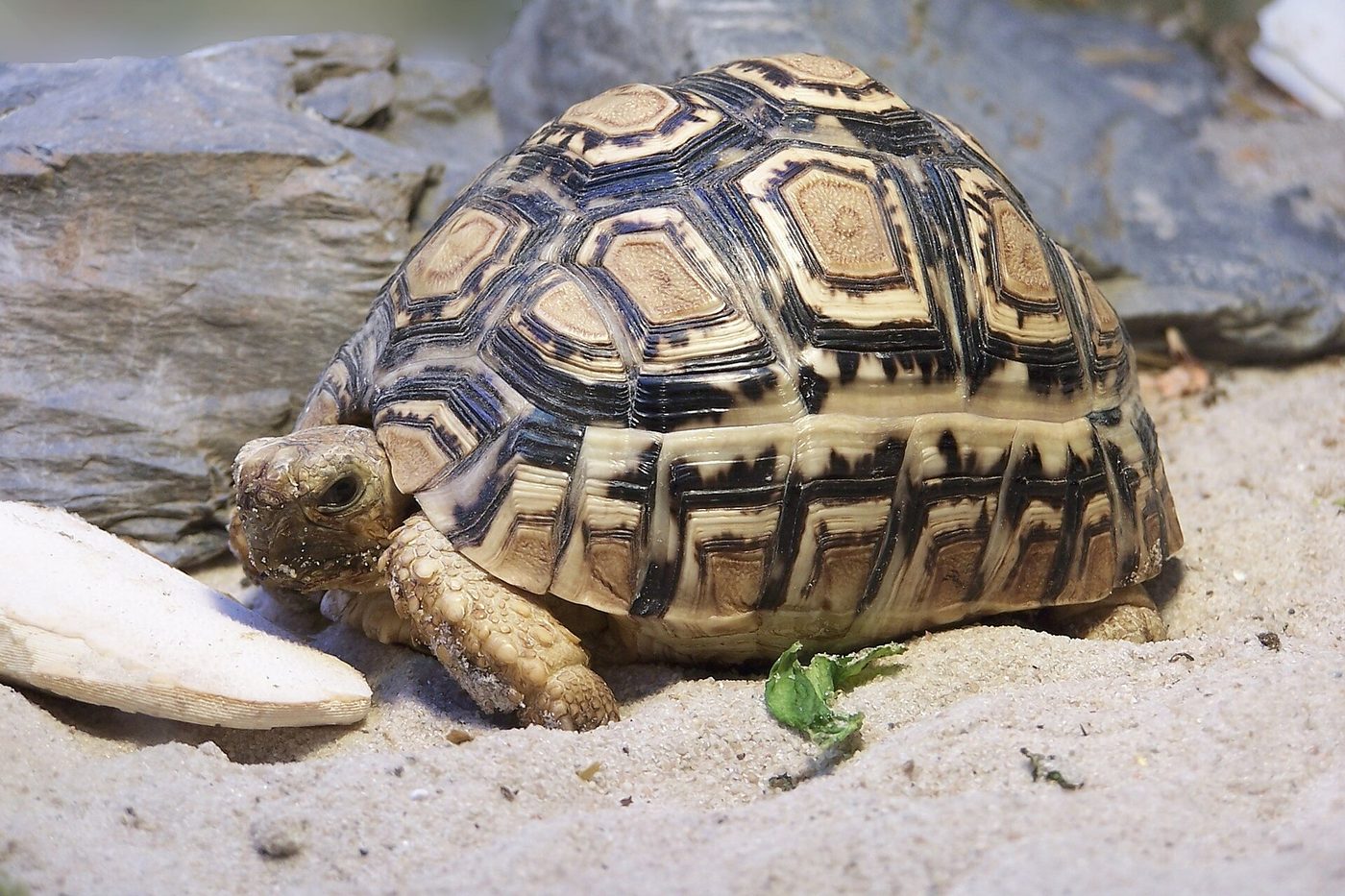
Photo: Berthold Werner · CC BY-SA 3.0
Leopard tortoise
Stigmochelys pardalis
The leopard tortoise is a large, beautifully marked African land tortoise, with a high domed shell patterned in dark markings like a leopard's coat.
Characteristics
Temperament
Calm, resilient, long-lived
Diet
Herbivorous: grasses, succulents and thistles
A shell like a leopard's coat
The leopard tortoise is one of the largest land tortoises in the world: adults often reach 40 cm in shell length and can exceed 30 kilograms. The shell is tall and domed, cream-yellow with bold black spots and streaks recalling a leopard's coat, hence the name. It is the only species of the genus Stigmochelys.
Habitat and range
It lives in the savannas of eastern and southern Africa, from Sudan to South Africa. It favours semi-arid habitats, grasslands and thorny bush. In extreme heat or cold it shelters in abandoned fox, jackal or aardvark burrows, since it does not dig except to lay eggs.
Behaviour and diet
It is a grazing herbivore: it feeds on a wide variety of grasses, as well as succulents and thistles, which also provide it with water. It is a calm, resilient animal, adapted to long dry spells. It is very long-lived, able to live for decades.
Notable facts
Unlike many tortoises, it does not withdraw fully into its shell by folding the neck into an S, but draws the head straight back. Its tall, domed shell helps it resist predators and high temperatures. It lays its eggs in holes dug in the ground, where it leaves them to incubate in the sun.
Conservation
The species is listed as Least Concern by the IUCN and remains widespread. Locally it is affected by habitat loss, overgrazing and collection for the pet trade and for meat.
Pros
- Spectacular leopard-spotted shell
- Very long-lived, suited to arid climates
- Still widespread and unthreatened
Cons
- Locally declining through grazing and collection
- Needs space and warmth in captivity