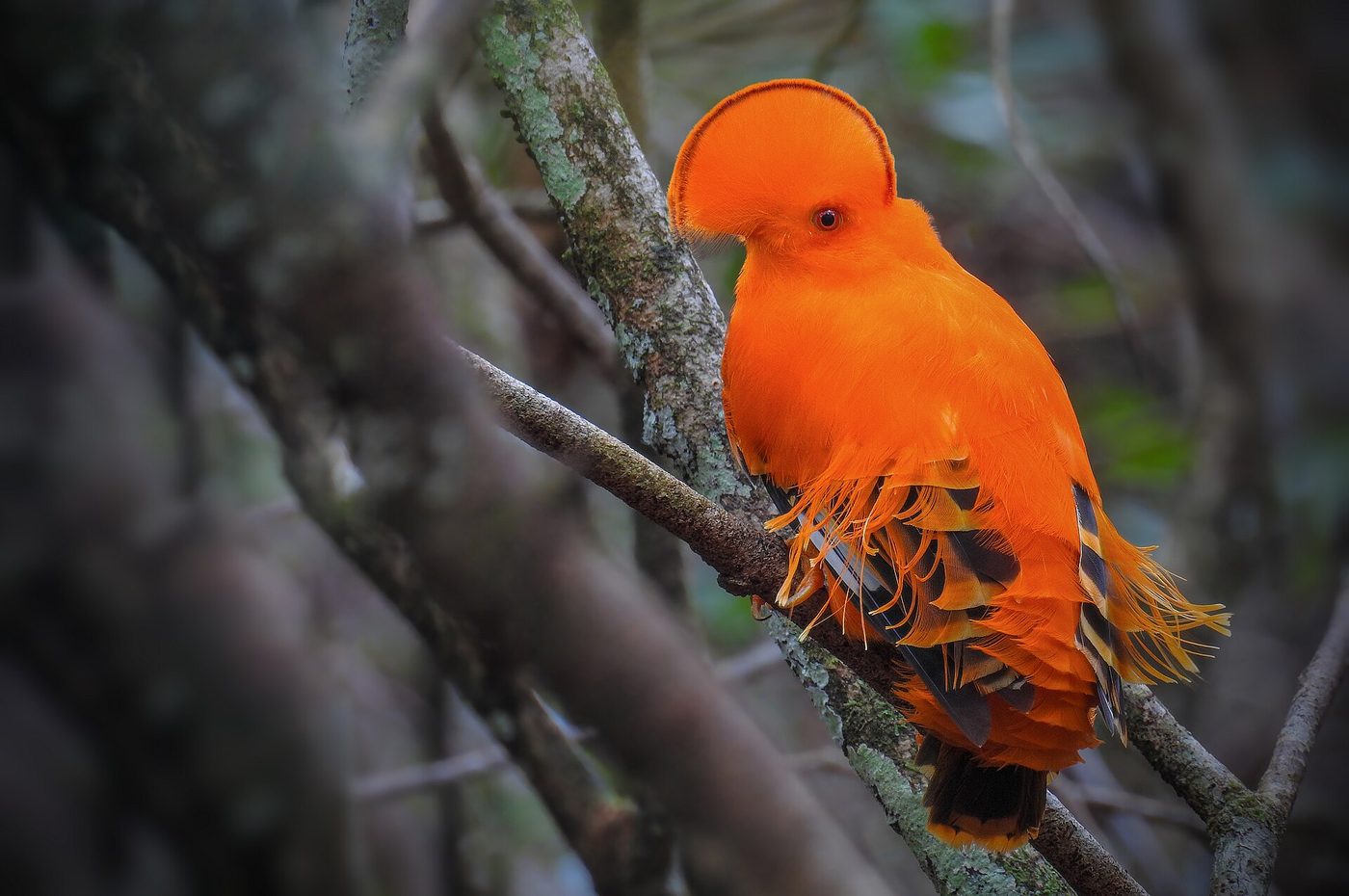
Photo: AISSE GAERTNER · CC BY-SA 4.0
Guianan cock-of-the-rock
Rupicola rupicola
The Guianan cock-of-the-rock is a brilliant orange bird of South America, with a striking half-moon crest and spectacular group courtship displays.
Characteristics
Temperament
Diurnal and social; males in spectacular group displays.
Diet
Frugivorous: mainly fruit, sometimes small reptiles.
A flash of orange in the forest
The Guianan cock-of-the-rock (Rupicola rupicola) is a passerine of the cotinga family, famous for the male's plumage: a brilliant, glowing orange, adorned with a peculiar half-moon disc-shaped crest that almost covers the bill. About 30 cm long and weighing between 200 and 220 g, it has a heavy body and silky feathers. The female, by contrast, is brownish-grey and cryptic, suited to nesting sheltered among rocks — hence the species' name.
Habitat and range
It lives in the rainforests of the Guiana Shield and the northern Amazon basin, from Brazil to Colombia, through Guyana, Suriname and French Guiana. It favours rugged forest areas with rocky outcrops, where the female builds her nest.
Behaviour and courtship
It feeds mainly on fruit but occasionally takes small snakes and lizards. Its fame rests on communal courtship: males gather in arenas (leks) on the forest floor, where they display together with postures, jumps and wing-vibrations to attract females, who choose the most conspicuous males.
Did you know?
The male's silky feathers and vivid colours have drawn comparisons with the birds-of-paradise. After mating, the females alone build the mud nest and tend the young.
Conservation
The IUCN lists it as Least Concern. It is still widespread across its range, but capture for the cage-bird trade and forest loss are local pressures.
Pros
- Brilliant orange plumage and half-moon crest (male)
- Spectacular communal courtship
- Least Concern, still widespread
Cons
- Captured for the cage-bird trade
- Depends on forests with rocky outcrops
- Strong dimorphism: the female is drab