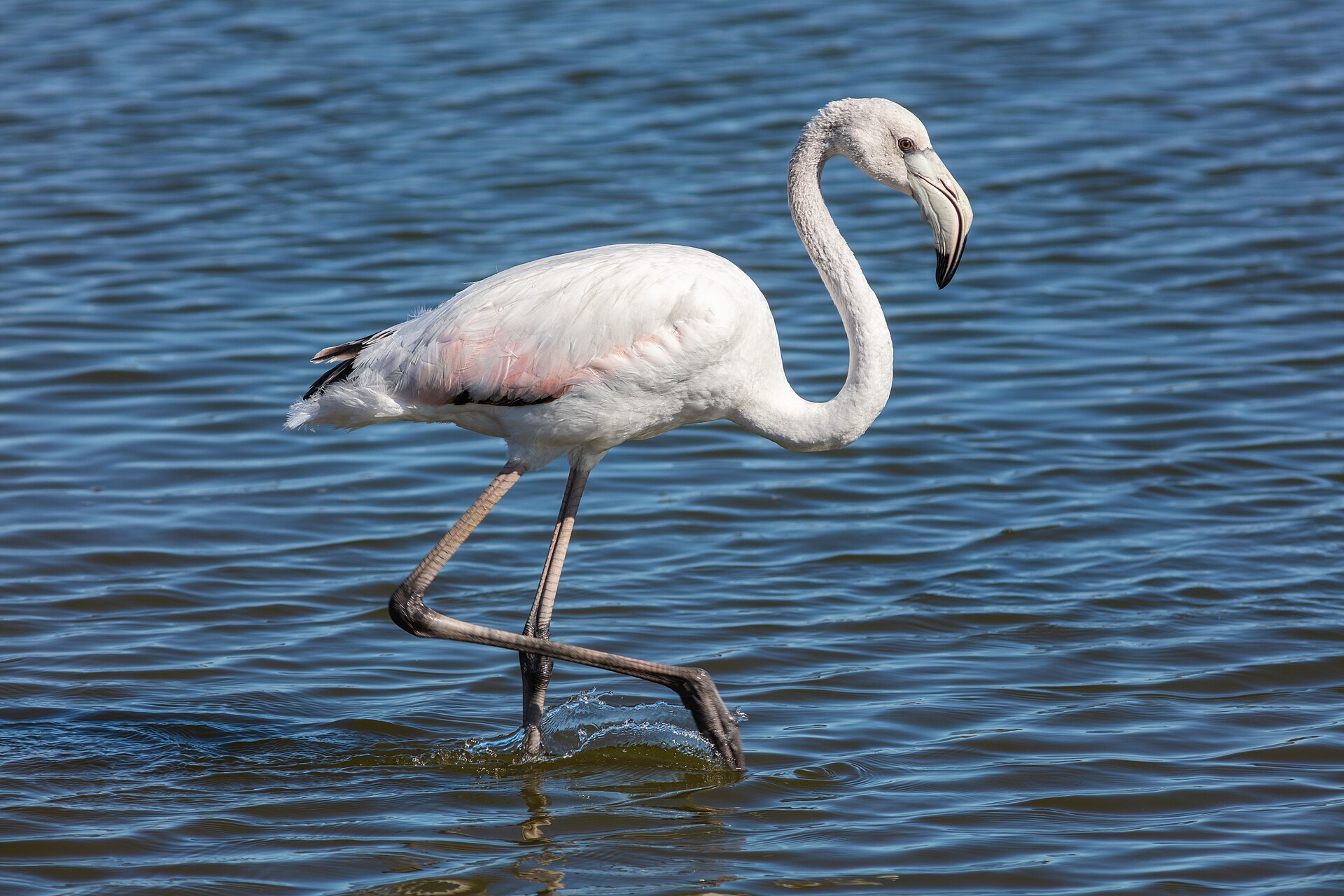
Greater Flamingo
Phoenicopterus roseus
Characteristics
Temperament
Highly social and gregarious. Lives in colonies of thousands. Spectacular synchronised courtship rituals. Filters food with its specialised beak.
Diet
Filter feeder: Artemia salina, copepods, larvae, microscopic algae (Spirulina), molluscs. The pink colour comes from dietary carotenoids.
The Greater Flamingo (Phoenicopterus roseus) is the largest and most widespread of the six living flamingo species in the world. Iconic for its rosy plumage, very long legs and characteristic down-curved beak, it is one of the symbolic birds of the saline wetlands of the Mediterranean, Africa, the Middle East and southern Asia. Its biology is among the most peculiar in the bird kingdom: it filters food like a whale and owes its colour exclusively to what it eats.
Classification and category
The Greater Flamingo belongs to the order Phoenicopteriformes, family Phoenicopteridae. The family today comprises only six living species, distributed between Europe-Africa-Asia (greater, lesser) and the Americas (American, Chilean, Andean, James's). Among all, the greater is the largest: standing height ranges from 110 to 150 cm, wingspan reaches 140-165 cm and average adult weight is between 2 and 4 kg, with males noticeably larger than females.
Habitat and distribution
The Greater Flamingo's habitat consists of brackish lagoons, salt pans, alkaline lakes, river deltas and coastal wetlands, where high salinity and scarcity of predators favour breeding in large colonies and the abundant presence of its main prey (microorganisms and small crustaceans).
Its range is vast and includes the Mediterranean (French Camargue, south-western Spain — Doñana, Fuente de Piedra — Sardinia, Sicily, Apulia), all of sub-Saharan and northern Africa, the Middle East, Iran, southern Kazakhstan and western India. In recent decades the species has notably expanded its Italian range: since 1993 it has been breeding regularly in the Molentargius salt pans (Cagliari) and today it also reproduces consistently in Sicily (Stagnone di Marsala) and in Apulia (Margherita di Savoia salt pans). Its conservation status is listed as Least Concern (LC) by the IUCN, and it is a species strictly protected under the European Union Birds Directive (Annex I).
Diet
The Greater Flamingo is a filter feeder: its beak is a highly specialised structure, similar in principle to that of baleen whales. It feeds by dipping its head upside down in shallow water and actively filtering mud and water through internal lamellae, which trap food particles.
Its diet consists mainly of Artemia salina (a brine shrimp adapted to hypersaline waters), copepods, insect larvae, microscopic algae (cyanobacteria such as Spirulina) and small molluscs. The pink-orange colour of the plumage is derived entirely from carotenoid pigments taken in with food, in particular canthaxanthin: a flamingo fed on a carotenoid-poor diet gradually turns white. This is why flamingos in zoological parks are supplemented with carotenoid-enriched feed to maintain the typical colouration.
Physical features
The Greater Flamingo has an aerodynamic body, a long "S"-shaped neck and extremely long, slender legs with three webbed front toes and a reduced hind toe. Plumage colouring is pale pink on the body, with black primary flight feathers and bright pink-orange wing coverts particularly visible in flight. The beak is curved downward, pink with a black tip: the upper mandible is smaller than the lower one (the opposite of what is usual in birds) and closes like a lid onto the lower mandible.
Juveniles are greyish-brown and take 3-4 years to acquire full adult plumage. A remarkable physiological feature: flamingos can sleep on a single leg for hours without effort, thanks to a passive tendon-locking mechanism that keeps the limb rigid without expending energy.
Behaviour and curiosities
The Greater Flamingo is a highly social and gregarious species: it lives in colonies that can exceed 20,000 pairs, particularly impressive during the breeding season (February-August in Europe). Courtship rituals are spectacular: hundreds of individuals march in synchrony, turning their heads from right to left and opening their wings to display the colours of the coverts. The dance serves to synchronise the reproduction of the entire colony.
Nests are characteristic mud mounds 20-40 cm high, built by the pair in shallow water. A single egg is laid, incubated for 28-32 days alternately by both parents. Chicks are born with white-grey down and a straight beak, and are fed for the first months with so-called "crop milk": a reddish secretion produced by the digestive system of both parents, extremely rich in protein, fat and carotenoids. Lifespan is remarkable: 30-40 years in the wild, over 60 in captivity. The oldest documented flamingo, "Greater", lived at Adelaide Zoo (Australia) until 2014, reaching 83 years of age.
Pros
- Specie iconica e fotografata in tutto il mondo
- Estremamente longevo (60+ anni in cattività)
- Indicatore di salute degli ecosistemi salmastri
- Colonie spettacolari da osservare
Cons
- Specie selvatica, NON è un animale da compagnia
- Sensibile al disturbo umano nei siti di nidificazione
- Protetta a livello europeo (no detenzione senza autorizzazione)
- Dipende da habitat salmastri molto specifici