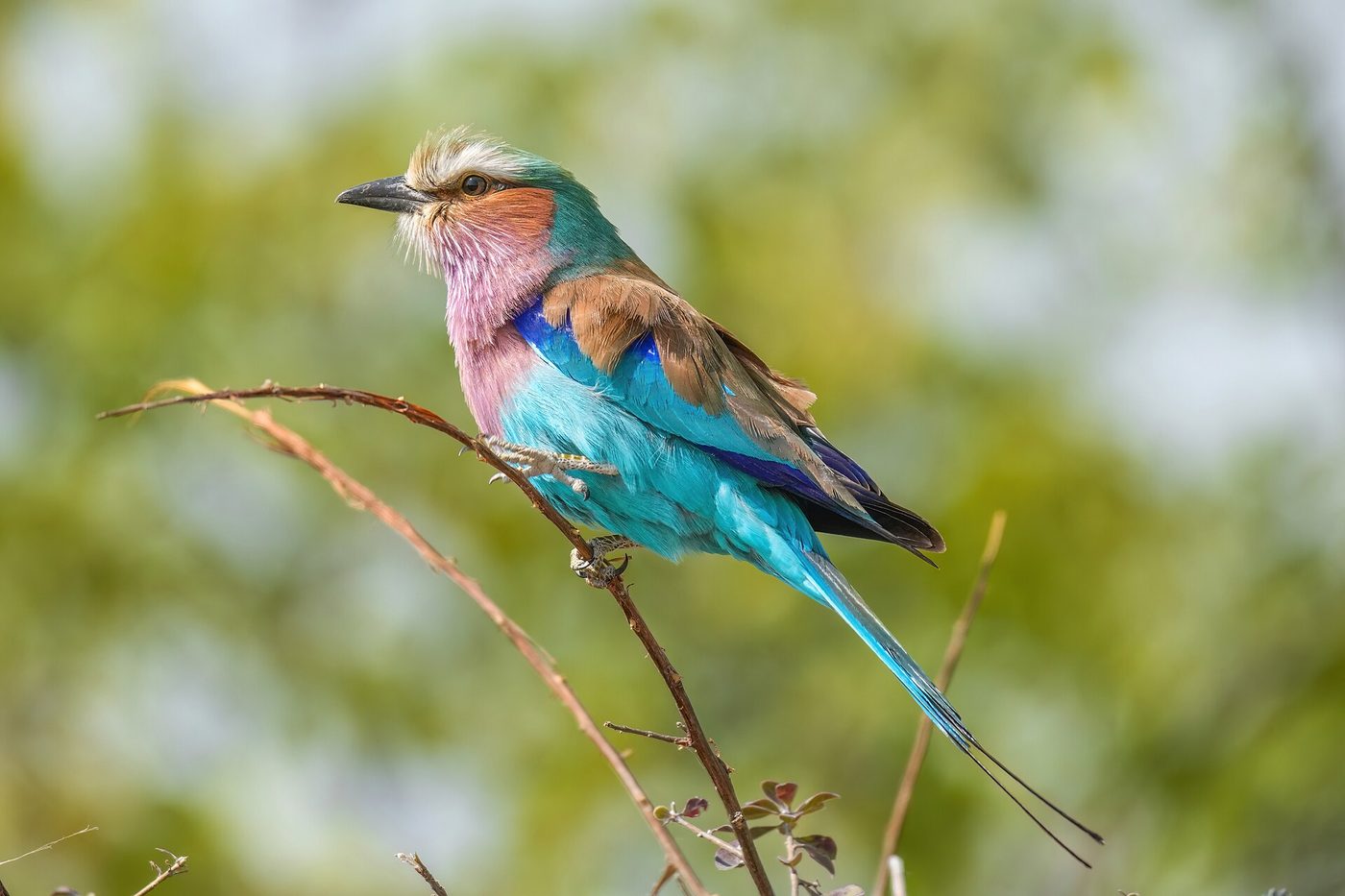
Photo: Giles Laurent · CC BY-SA 4.0
Lilac-breasted roller
Coracias caudatus
The lilac-breasted roller is one of Africa's most vividly coloured birds, famed for its lilac chest and tumbling courtship flight.
Characteristics
Temperament
Territorial, watchful and extraordinarily pugnacious in nest defence
Diet
Insectivorous and carnivorous: grasshoppers, beetles, small reptiles, amphibians and small birds
A rainbow on the wing
The lilac-breasted roller is perhaps the most photographed bird on African safaris, wearing a plumage that looks hand-painted: throat and breast a soft lilac, belly and wings turquoise-blue, back an olive-brown, and long outer tail feathers trailing like slender streamers. The sexes are identical in colour, while juveniles still lack the elongated tail streamers. It is a robust, medium-sized bird with a strong, hooked bill.
Habitat and range
It lives in wooded savanna and open bushland across eastern and southern Africa, from Kenya to South Africa, with occasional strays reaching the southern Arabian Peninsula. It avoids treeless country because it needs high perches — the top of a tree, a pole or a termite mound — from which to survey its territory.
Behaviour
It is an ambush hunter: sitting motionless on a high branch, it scans the ground and drops in a swift stoop onto insects, small reptiles, amphibians and even small birds. It nests in natural tree holes, where both parents incubate 2–4 eggs and defend the nest with remarkable ferocity, taking on raptors far larger than themselves. The name "roller" comes from the male's spectacular display flight, in which he climbs high and then plunges in rolling, swooping dives while uttering harsh cries.
Notable facts
It is unofficially regarded as the national bird of Kenya and is one of the emblematic birds of Botswana too. Despite its bright colours, in flight the flashing turquoise of the wings acts almost like a strobe that confuses predators.
Conservation
The species is listed as Least Concern by the IUCN and remains widespread. It benefits from protected areas and its adaptability, though locally it can suffer from the loss of the mature trees it needs for nesting.
Pros
- One of the most spectacular plumages in the bird world
- Natural control of grasshoppers and pest insects
- Easy to watch, often perched in pairs in the open
Cons
- Depends on mature trees with cavities for nesting
- Very aggressive toward other birds during the breeding season