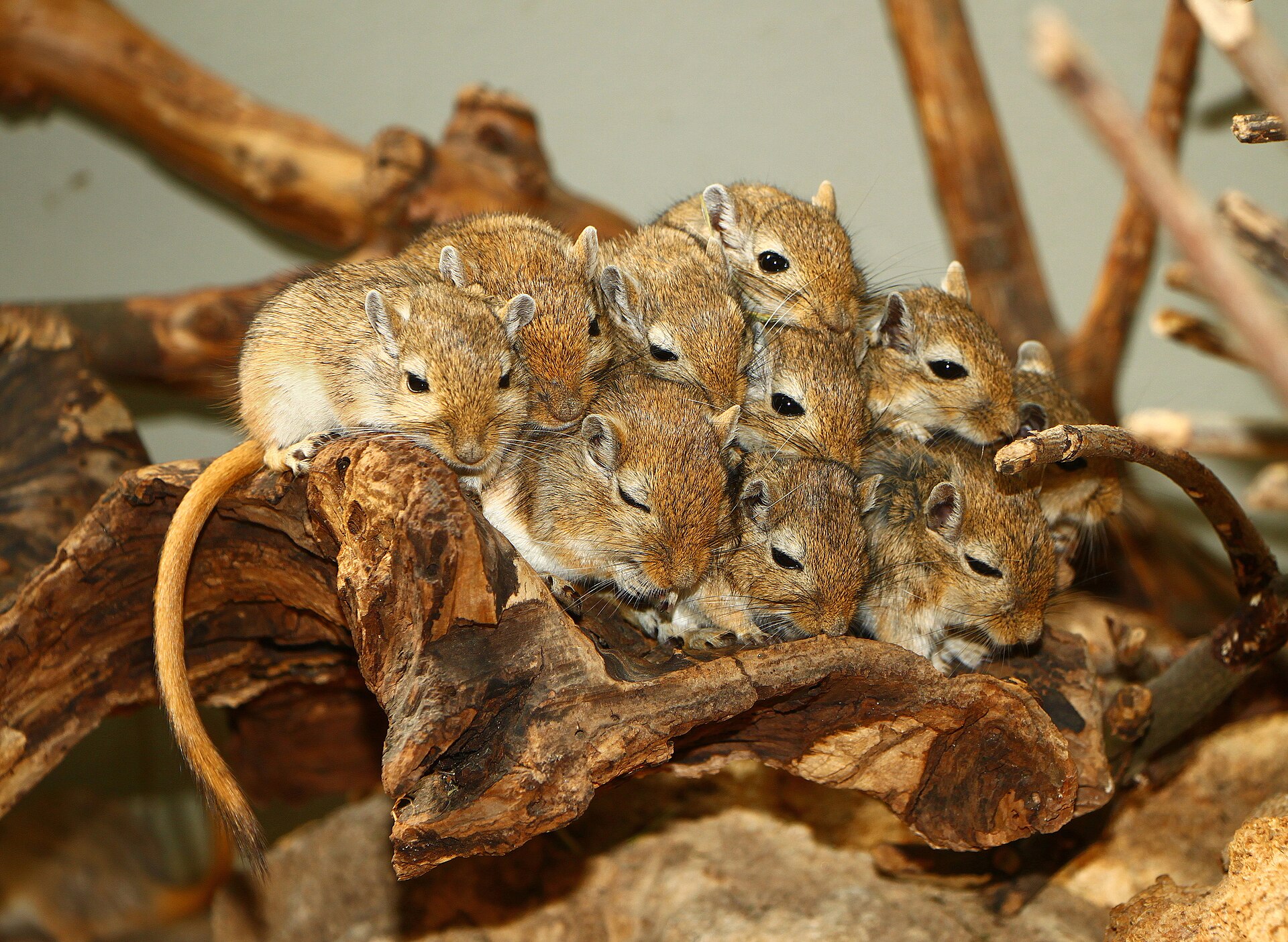
Mongolian Gerbil
Meriones unguiculatus
Characteristics
Temperament
Social (matriarchal colonies 10-30), diurnal-crepuscular, intelligent. NEVER keep alone (must live in pairs/groups). Communicates with thumping (hind leg drumming). Recognises name. Voracious, fills cheek pouches to hide food.
Diet
Omnivore with herbivorous tendency. Seeds (sunflower, millet, oats), specific pellets, small green vegetables, occasional insects. 5-7 g/day dry. DO NOT give sweet fruit (diabetes). Survives without free water for weeks (desert adaptation).
The Mongolian Gerbil (Meriones unguiculatus), also known as Jird, is a small rodent native to the semi-arid steppes of Mongolia and Northern China, particularly the Gobi Desert. It is one of the most popular "exotic" pets in the world for its diurnal activity (unlike nocturnal hamsters), social nature, ease of management and charismatic appearance: small brown-sand body, large black eyes, long bushy tail with terminal tuft, ability to stand on its hind legs to scrutinise the environment. It lives in matriarchal social colonies and absolutely needs companions of its own species (never to be kept alone). Imported in Europe and North America from the 1950s as a laboratory animal, it is today widespread throughout the world as a domestic pet.
Classification and category
The Mongolian Gerbil belongs to the order Rodentia, family Muridae, subfamily Gerbillinae (gerbils), genus Meriones. The genus comprises over 17 species of gerbils distributed from northern Africa to central Asia; M. unguiculatus is the most known species and the only one significantly diffused as a pet. Body length is 10-12 cm, plus a tail of 9-11 cm with characteristic terminal tuft. Average adult weight is 50-130 g (males slightly larger than females). The scientific name Meriones derives from Greek and refers to the Homeric warrior Meriones (Iliad); unguiculatus means "with small claws" (from Latin unguis). The first specimen was brought to Europe in 1867 by naturalist Père Armand David, Lazarist missionary in China; introduced as a domestic pet in the USA in 1954 (medical research laboratories). There are numerous colour variants selected in the last 50 years: agouti (original: brown-sand with white belly), black, silver, gold, cinnamon, siamese, pied (bicolour), satin (shiny hair).
Habitat and distribution
The natural habitat of the Mongolian Gerbil consists of semi-arid steppes, sandy deserts, grasslands of low grasses of Mongolia, Northern China (Inner Mongolia, Hebei, Shanxi), south-eastern Russia (Transbaikalia). The climate is extreme continental: very cold winters (-30 °C) and hot dry summers (35-40 °C). The Gerbil lives in subterranean colonies of 10-30 individuals in complex burrows with multiple exits, common chambers, dormitories and food stores. The tunnel network can extend for 10-20 metres in length with depth up to 1.5 m.
The natural population is abundant and the species is not considered threatened: the conservation status is listed as Least Concern (LC) by the IUCN. Local threats in Mongolia include: agricultural control (the species is considered a parasite of some cereal crops), predation by foxes and raptors, climate change (desert expansion). Gerbils were introduced as laboratory animals from the 1950s in USA, Europe, Japan, and from laboratory animals they passed to domestic pets from the 1970s. Today they are widespread globally, with concentrations in North America, Europe, Australia, Russia. Prohibited as a pet in some US states (California, Hawaii) due to the risk of colonisation of local arid habitats (potentially invasive species). In Italy the price of a Gerbil in a specialised shop is 10-25 euros, but it is obligatory to buy them at least in pairs (preferably of the same sex to avoid explosive reproduction).
Diet
The Mongolian Gerbil is an omnivore with herbivorous tendency. The natural diet includes: seeds (main prey: grass seeds, legumes, composites), roots and tubers, barks, dry fruit, insects and larvae (rarely, 5-10% of diet), occasionally green leaves (rare in the desert). The digestive system is adapted to a diet poor in water: the Gerbil gets most of its water needs from seed digestion, and can survive for weeks without drinking free water. However, in captivity it is recommended to provide water always available.
The correct diet in captivity must be: specific mix for gerbils (sunflower seeds, millet, oats, corn, legumes; never containing refined cereals or sugar), pellets for gerbils/hamsters (balanced, 50% of diet), small portions of green vegetables (lettuce, parsley, celery, broccoli — 2-3 times a week, never more than 10% of diet), occasional live insects (mealworms, once a week). To be absolutely avoided: sweet fruit (bananas, grapes — causes diabetes as in Degu), onions, chocolate, citrus fruits, salted nuts. Daily requirement is 5-7 g of dry food. Gerbils are voracious tasters: they tend to fill the cheek pouches (surprising capacity for the size) and hide food for later. It is important NOT to overfeed them: sunflower seeds are very fatty and cause obesity.
Physical features
The Mongolian Gerbil has a stocky, compact, well-proportioned body, with soft and thick hair. The original wild colour is brown-sand agouti (mix of brown and black hairs on the back that provide camouflage in the desert), cream white belly, light ears and tail. In captivity there are numerous selected variants (over 25): black, silver, gold, cinnamon, siamese (colorpoint), pied, satin, lilac, sapphire. The head is large in proportion to the body, rounded, with short muzzle. The eyes are large, black, protruding — adaptation to diurnal vigilance in open environments. The ears are small, round, well spaced, covered with short hair.
The most recognisable characteristic is the tail: 9-11 cm long (less than the body, but proportionally large), covered with soft hair (unlike rats and mice which have hairless-scaly tail), with characteristic "tuft" of longer hairs at the end (in the form of "whip with knob"). The tail has the ability of "skin slipping": if grabbed abruptly, the skin easily detaches, leaving the vertebrate exposed. The tail never regrows after this traumatic loss of skin. The incisors are of white-yellow colour (unlike Degu which are orange), with continuous growth. The Gerbil must have continuous access to materials to gnaw (willow wood, mineral blocks) to avoid malocclusion. The forelegs are short and dexterous, the hindlegs longer (for jumping). A unique feature is the presence of a scent gland on the abdomen (area of bare skin of yellow-orange colour in males, smaller in females): it is rubbed on objects and fellows to mark territory (behaviour of "rolling").
Behaviour and curiosities
The Mongolian Gerbil is a social, diurnal-crepuscular, intelligent animal. It lives in matriarchal colonies of 10-30 individuals with complex hierarchical structure: a dominant female, several subordinates, adult reproductive males, shared offspring. Communication includes acute vocalisations (alarm squeaks, social "chirps"), hind leg drumming on the ground (territorial alarm signal communicated through vibrations — behaviour of "thumping" also shown by rabbits), olfactory marking through the ventral gland.
Gerbils are highly intelligent: they learn to recognise their own name, show active exploration behaviours, can be trained to exit the cage when the door opens and return on call. The average life in captivity is 2-4 years (record 6 years), exceptionally good for a rodent of only 80 g. In nature life is shorter (1-2 years) due to predation. Sexual maturity is reached at 2-3 months. The female gives birth to 4-12 young per litter, up to 6-7 litters per year: fertility is explosive, which is why Gerbils must be kept in same-sex pairs if reproduction is not desired.
Scientifically, Gerbils are important models for research on: epilepsy (a percentage of Gerbils naturally develop epileptic crises due to stress, unique model among rodents); diabetes and obesity (sensitive to sugars but less than Degu); parasitology (natural reservoir of some protozoa such as Leishmania, important for studies of antiparasitic drugs). In the USA Gerbils are used in the Mongolian Gerbil Pseudo-Penicillin Test for quality control of some drugs. Historical curiosity: the introduction of the Gerbil as a domestic pet in the USA was involuntary: Dr. Victor Schwentker (laboratory breeder of Tumblebrook Farm, New Hampshire) started selling surplus specimens from his laboratories as pets to employees in the 1950s; the success was so explosive that by 1960 they were available in all pet stores. Prohibited in some US states (California, Hawaii) for fear of colonisation: the climate of these regions is too similar to the Mongolian Gobi, and escapes could establish invasive populations.
Pros
- Attività diurna (a differenza di criceti)
- Pet sociale e affettuoso (in coppia)
- Longevità eccellente (2-4 anni, fino 6)
- Facile da gestire, niente odori sgradevoli
Cons
- MAI da tenere singolo (necessita coppia/gruppo)
- Fertilità esplosiva (6-7 covate/anno con 4-12 piccoli)
- Coda fragile (autotomia da stress)
- Vietato come pet in California, Hawaii (rischio invasivo)