Photo: Serhanoksay · CC BY-SA 3.0
Wilson's bird-of-paradise
Diphyllodes respublica
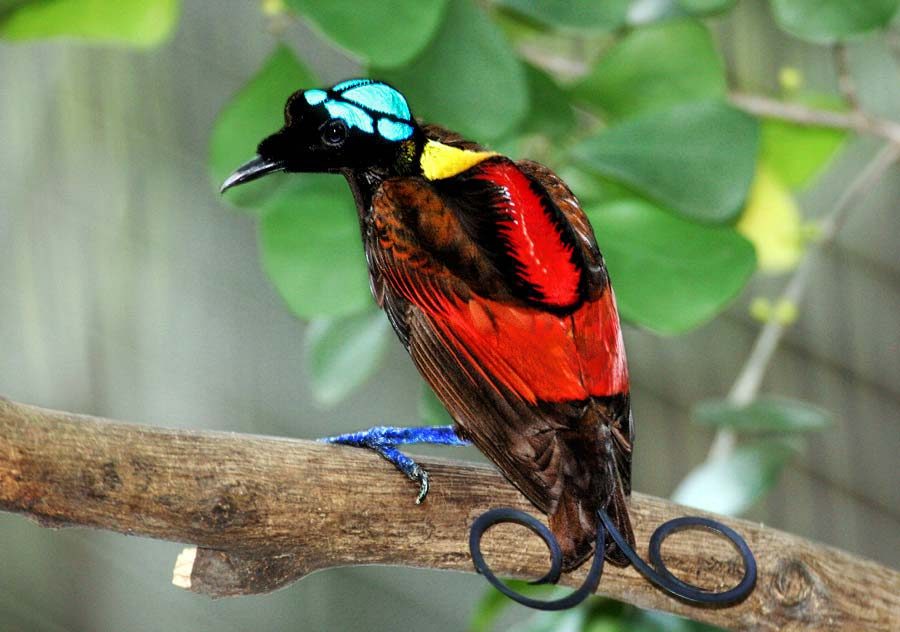
With its crown of bright turquoise bare skin and its spirally curled tail feathers, the male Wilson's bird-of-paradise is one of the most extraordinary birds on the planet.
Characteristics
Temperament
Territorial, dancer in courtship
Diet
Frugivore: fruit and small insects
A small masterpiece of colours
Wilson's bird-of-paradise is a small bird of spectacular colours, among the most astonishing in its family. The male is a riot of vivid hues: a bright red back, a yellow nape, a shield of green feathers on the breast and, above all, a bald crown covered with bare skin of a brilliant turquoise crossed by thin dark lines. Its tail bears two long feathers curled into a spiral, of a metallic violet. The female, by contrast, is much more subdued, a dull brown with only a hint of blue on the head.
Habitat and distribution
It has a very restricted range: it lives exclusively on the islands of Batanta and Waigeo, in the Raja Ampat archipelago, off western New Guinea, where it inhabits the hill forests up to about 1,200 metres in altitude. It is precisely its limited distribution that makes it a precious and vulnerable species.
The courtship dance
Its most fascinating behaviour is the male's courtship. On the forest floor, he carefully prepares a small 'arena', clearing the ground and the low vegetation of leaves and debris to create a clearly visible space. On this stage he then performs an elaborate dance, showing off his brilliant colours to the female perched above him, so that she can admire from above the green shield of his breast and the turquoise crown, which stands out even more in the dim light.
Feeding and conservation
It feeds mainly on fruit and small insects, which it finds in the depths of the forest. Because of its beauty and its limited range, Wilson's bird-of-paradise is considered a species of great conservation value: the protection of the Raja Ampat forests is essential to secure its future.
Pros
- Among the most spectacular colours in the world
- Crown of bare turquoise skin
- Fascinating courtship dance
- Tail with spirally curled feathers
Cons
- Extremely restricted range
- Depends on the Raja Ampat forests
- Only the male is colourful