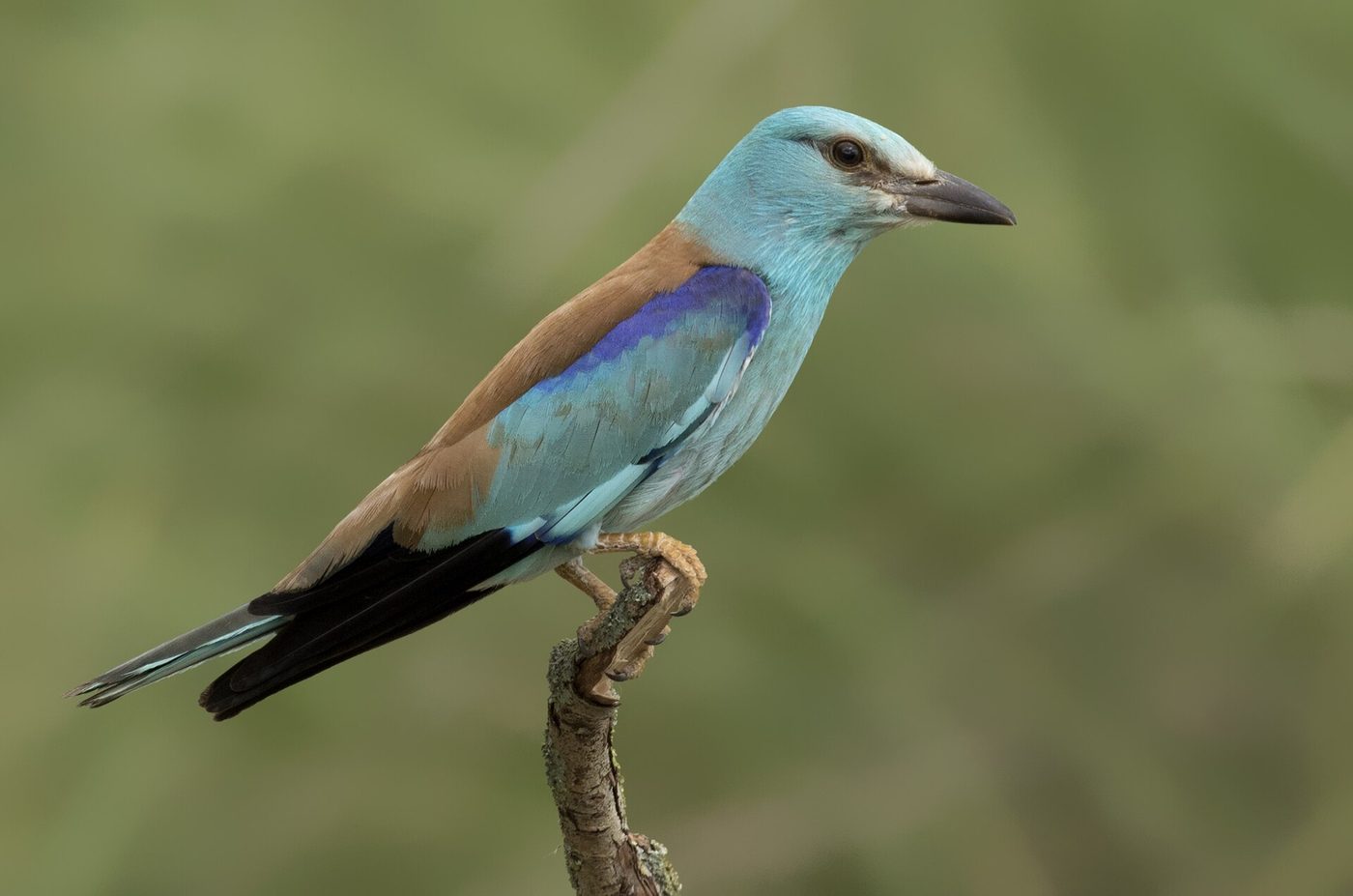
Photo: Zeynel Cebeci · CC BY-SA 4.0
European roller
Coracias garrulus
The European roller is a brilliantly coloured bird, the only member of its family to breed in Europe, with a dazzling turquoise and blue plumage.
Characteristics
Temperament
Territorial, ambush hunter, migratory
Diet
Insectivorous: grasshoppers, beetles, small reptiles
A turquoise flash over the countryside
The European roller is a spectacularly coloured coraciiform bird, roughly the size of a jay. Its plumage is dominated by an intense blue-turquoise on the head, neck and underparts, with an orange-brown back and bold dark-blue wing patches, especially striking in flight. It is the only member of the roller family to breed in Europe. Its name comes from the display flight, with the acrobatics and tumbling in the air typical of the group.
Habitat and range
It breeds in Europe, the Maghreb and western and central Asia, in warm, open habitats that still have trees: wooded savanna, open woodland, farmland with hedges and old trees. It avoids treeless plains. It is a long-distance migrant: in late summer it leaves its breeding areas to winter in southern Africa.
Behaviour and diet
It is an ambush hunter, watching from prominent perches and dropping to the ground to catch large insects such as grasshoppers and beetles, as well as small reptiles and other invertebrates. It nests in natural tree holes or in holes in banks and old walls.
Notable facts
The bright colours are not merely ornamental: during courtship the male performs diving and rolling flights that show off the turquoise of the wings. In German it is also called Mandelkrähe (almond crow).
Conservation
The species is listed as Least Concern globally, but in many European regions it has declined sharply due to habitat loss, intensive agriculture and a shortage of nesting sites, so much so that it is the focus of protection programmes.
Pros
- Spectacular turquoise and blue plumage
- Natural control of large insects
- Distinctive acrobatic courtship flight
Cons
- Strongly declining in many European regions
- Depends on trees with cavities for nesting