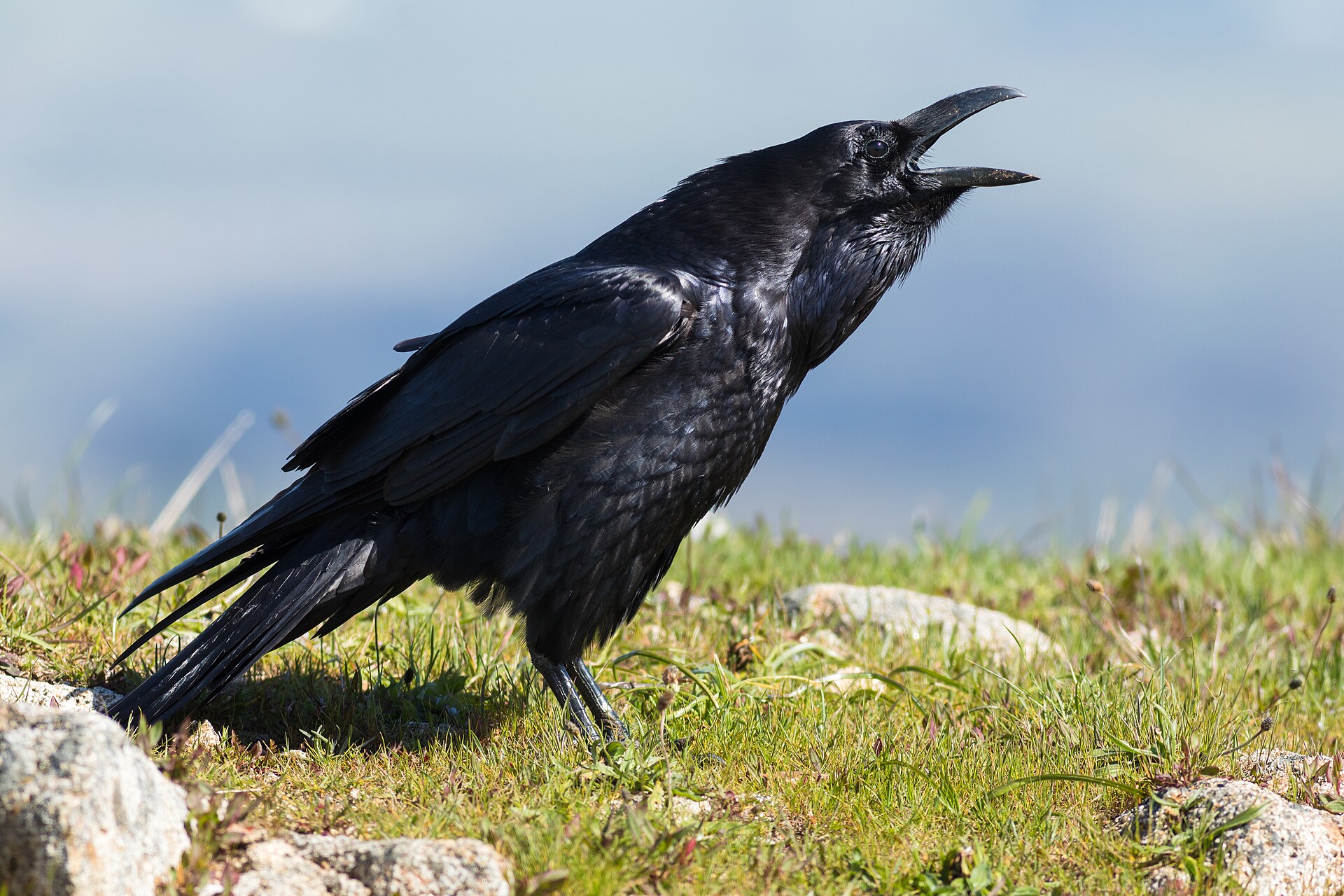
Common Raven
Corvus corax
Characteristics
Temperament
Social, playful and of prodigious intelligence, among the highest in the animal kingdom: it uses tools, solves problems, plans ahead and mimics sounds and voices. Pairs are monogamous and lasting and defend a territory all year; youngsters form flocks and communal roosts. Curious, bold and opportunistic, it flies with spectacular acrobatics, even in play. Highly adaptable, it lives almost anywhere. Not a pet: a large wild bird, though its intelligence makes it fascinating and "trainable".
Diet
An opportunistic omnivore and scavenger with a very broad diet. It eats carrion (a key resource, an important clean-up role), small animals (rodents, birds, eggs, nestlings, reptiles, amphibians, insects), plant matter (seeds, grain, fruit) and human refuse. It exploits any food source through intelligence, solving problems to reach it, follows wolves and other predators to feed on their kills, and caches surplus food, remembering the hiding places and deceiving onlookers.
The Common Raven (Corvus corax) is the largest corvid and the largest songbird (passerine) in the world, as well as one of the most intelligent animals of all. Famous for:
- Size and absolute black: large, massive, with entirely black, metallic-sheened plumage and a powerful bill
- Exceptional intelligence: it uses tools, solves complex problems, plans for the future and shows cognitive abilities comparable to those of great apes
- Acrobatic flight: it performs rolls, tumbles and upside-down flying, apparently for play
- A deep voice: a characteristic croaking "kronk", and a very rich vocal repertoire, including imitations
- An extraordinary distribution: it lives across half the Northern Hemisphere, from deserts to Arctic tundra
- Its weight in myth: one of the most symbol-laden birds in human history
IUCN status: Least Concern (LC), common and widespread. It is the second corvid in this portal after the Eurasian Jay: together they represent the family of the most "brainy" birds on the planet, from the small colourful jewel of the woods to the large, jet-black "genius" of the mountains.
Classification and category
Order Passeriformes (the perching/songbirds), family Corvidae (the corvids), genus Corvus — the same as the crows, smaller ravens and jackdaws. Among them all, the common raven is the largest: it is the largest living passerine. It is essential to tell it apart from its smaller, similar relatives, especially the crows: the common raven is much larger, with a massive bill, a "shaggy" throat (elongated hackle feathers), a raptor-like flight and, above all, a wedge-shaped (diamond) tail clearly visible in flight; the crow (a smaller Corvus) is smaller, with a thinner bill and a squared or rounded tail; the jay and the magpie are colourful or black-and-white corvids, quite different. Etymology: both "Corvus" (Latin) and "corax" (Greek) simply mean "raven", both probably onomatopoeic, from the sound of its call; the Italian "imperiale" ("imperial") emphasizes its great size relative to other crows. Parameters: Length 54-67 cm. Wingspan 115-150 cm. Weight 0.7-2 kg (almost as large as a buzzard). Longevity remarkable — about 10-15 years in the wild, with records exceeding 40 years in captivity. Reproduction: monogamous, with close, lasting pairs; it builds large stick nests on cliffs or tall trees; it lays 3-7 eggs, raised by both parents.
Habitat and distribution
The Common Raven is one of the most widely distributed birds in the world: across much of the Northern Hemisphere — Europe (including Italy, especially the Alps, Apennines, rocky areas and Sardinia), Asia, North America and North Africa. Preferred habitats — extraordinarily varied: mountains, rock faces, gorges and cliffs (prime habitats, where it nests on inaccessible ledges); forests, coasts, Arctic tundra and even deserts; and rural areas and, increasingly, urban areas, where it exploits refuse. Its incredible adaptability, combined with its intelligence, lets it live almost anywhere, from the icy north to the hottest deserts. It is mainly sedentary and territorial: pairs defend an area year-round, while non-breeding youngsters form flocks and communal roosts. In Italy, after a period of decline, it is recovering and expanding. IUCN: Least Concern. A common species, increasing in many areas thanks to its adaptability and the reduction of the direct persecution of the past.
Diet
The Common Raven is an opportunistic omnivore and scavenger with a very broad diet. It eats: carrion (a key resource; it is an important "clean-up crew" of nature); small animals (rodents, birds, eggs, nestlings, reptiles, amphibians, insects); plant matter (seeds, grain, fruit, berries); and human refuse and scraps, increasingly exploited near settlements. Feeding strategies: intelligent opportunism (it exploits any food source, solving even complex problems to reach it); following predators (it often accompanies wolves and other carnivores to feed on their kills; there is even a reported "collaboration" between ravens and wolves); and caching (it hides surplus food to recover later, remembering the caches and deceiving those who watch it). Crucially, it is intelligence, even more than strength, that drives the raven's feeding; its flexibility and problem-solving let it find food in any environment and season, one of the reasons for its planetary success.
Physical features
A large, powerful, entirely black bird. Plumage and appearance: uniform raven-black plumage, with bluish or purplish metallic sheens in the light; a "shaggy" throat (elongated, ruffled hackle feathers at the base of the neck, which it can raise); a large, sturdy, slightly curved bill; and a wedge-shaped (diamond) tail, a distinguishing trait in flight against the crow's squared tail. The body: a massive, big-bird build (almost the size of a raptor); long, broad wings allowing powerful flapping flight and soaring; and an overall imposing, "intelligent" look. Performance: acrobatic flight (rolls, dives, upside-down flying, even in play); a versatile voice (from the deep "kronk" to a wide range of calls and imitations); intelligence (its true "superpower", among the highest in the animal kingdom); and keen sight and a great memory.
Behaviour and curiosities
The Common Raven is a social, playful animal of prodigious intelligence. Pairs are close and lasting and defend a territory all year; not-yet-breeding youngsters instead gather in large groups. The complexity of its behaviour makes it a favourite subject for students of animal cognition.
The "feathered genius": the raven is considered one of the most intelligent animals on the planet, on a par with great apes and dolphins — it can use and even make tools, solve multi-step puzzles and problems and, very rarely among animals, plan for the future, setting aside a tool or food for later use; it recognizes individual humans, understands when it is being watched and adjusts its behaviour accordingly. The sky's joker: unlike almost all other birds, the raven seems to play for sheer fun — it has been seen tumbling in flight, flying upside down, dropping and recovering, and even repeatedly sliding down snowy slopes only to climb back up and start again; this playful behaviour is considered another sign of its marked intelligence. The mimic: the raven has a vast vocal repertoire and a notable gift for imitation — in captivity it can learn to reproduce human words even better than a parrot, and in the wild it imitates other animals and ambient sounds; its calls seem to carry different "meanings", and ravens communicate in complex ways not yet fully understood. The wolf's companion: there is an ancient, fascinating bond between raven and wolf — ravens often follow wolf packs to feed on the remains of their kills, and sometimes seem to signal to wolves the location of carcasses or prey, in a kind of collaboration; tellingly, in many northern mythologies raven and wolf appear side by side; it is an example of how the raven's opportunistic intelligence leads it to "use" other predators. The universal symbol: few animals carry cultural weight like the raven — in Norse mythology two ravens, Huginn and Muninn ("Thought" and "Memory"), fly over the world and report everything to Odin; for many Native peoples of North America (especially the Pacific Northwest) Raven is a trickster and even the creator of the world; it is the subject of Edgar Allan Poe's famous poem "The Raven", and is linked by legend to the Tower of London, where ravens are kept because, it is said, if they left, the crown and the tower would fall. "Not a crow": the raven is often confused with the smaller, commoner crows; to tell them apart, besides the markedly larger size, several details help — the much larger, sturdier bill, the "shaggy" throat, the deeper croaking call (not the crow's "caw") and, in flight, the wedge-shaped tail (while the crow's is straight); the raven's flight, too, with frequent soaring and acrobatics, is more "raptor-like".
Pros
- Uno degli animali più intelligenti del pianeta (strumenti, pianificazione)
- Più grande corvide e passeriforme del mondo; volo acrobatico spettacolare
- Utile spazzino della natura; IUCN Least Concern, in espansione
- Enorme ricchezza culturale e simbolica (Odino, Poe, Torre di Londra)
Cons
- Non è un animale da compagnia (grande uccello selvatico)
- Predando uova e nidiacei può impattare altre specie nidificanti
- A volte in conflitto con gli allevatori (predazione occasionale)
- In passato perseguitato per pregiudizio e superstizione