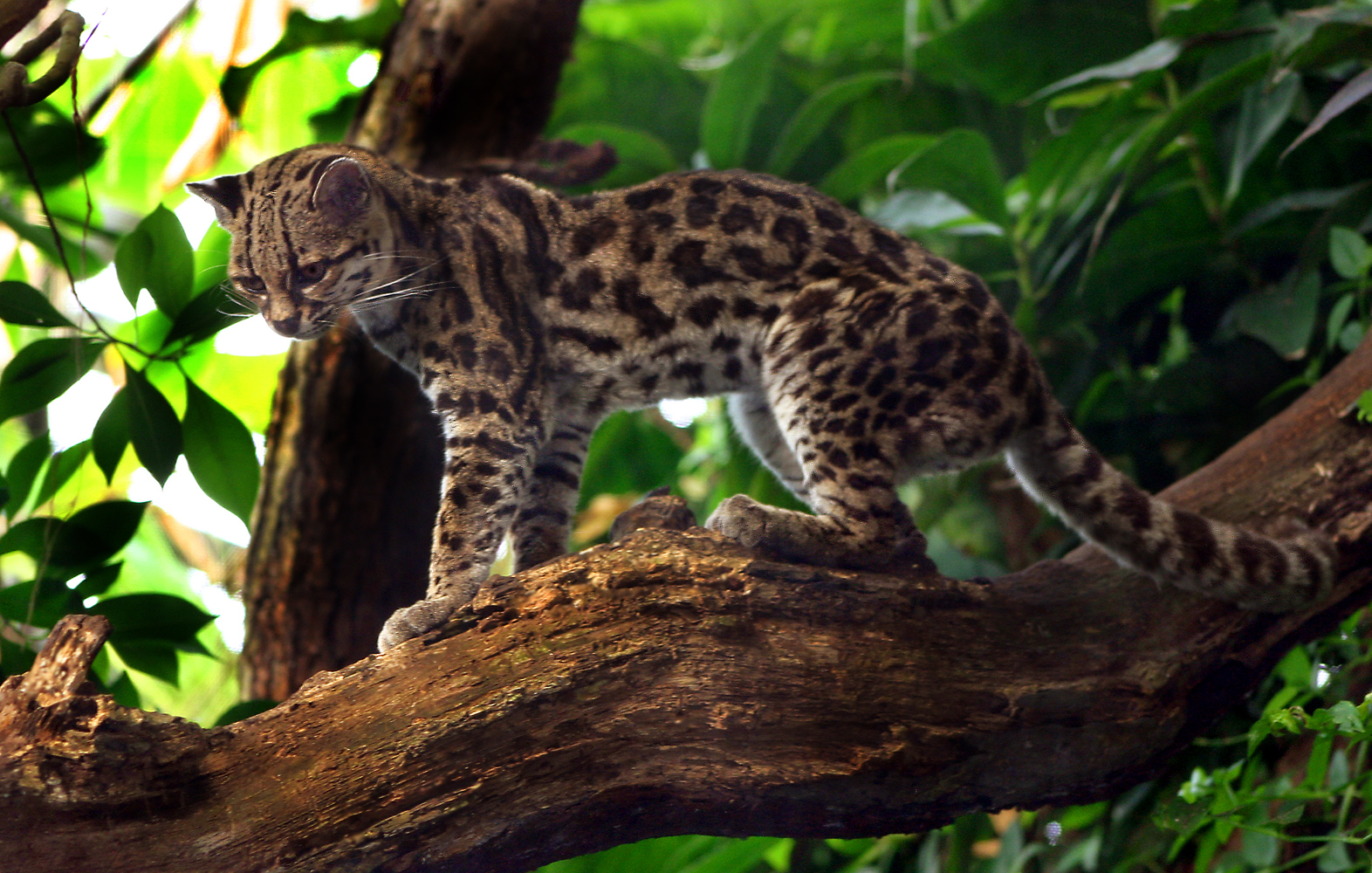
Margay
Leopardus wiedii
Characteristics
Temperament
Solitary, nocturnal and shy, rarely seen because it lives high up and by night. It is the most arboreal cat in the Americas: superbly agile among branches, descending trunks head-first thanks to ankles that rotate 180°. Territorial and specialized on intact forest. A curious, skilled hunter, even able to mimic prey calls. Not a pet: a delicate small wild cat dependent on the forest.
Diet
A carnivore that hunts largely in the trees. Eats small arboreal mammals (rodents, squirrels, opossums), birds and eggs, tree frogs, lizards and other reptiles, invertebrates and occasionally fruit. It chases prey through the canopy leaping branch to branch, ambushes by night using its large eyes, and can even mimic prey calls (documented imitating a tamarin pup's call to lure the adults).
The Margay (Leopardus wiedii) is a small spotted cat of the tropical forests of the Americas, a kind of miniature Ocelot specialized for life in the trees. Famous for:
- The most arboreal cat in the Americas: it spends much of its life in the canopy, where it hunts, rests and moves with extraordinary agility
- Ankles that rotate 180°: a very rare adaptation among cats that lets it climb down trunks head-first, like a squirrel
- An extremely long tail: often more than half the body length, used as a balancing pole among the branches
- Huge eyes: large and dark, for excellent night vision
- Its "mini-ocelot" look: a tawny coat covered in dark rosettes and spots, much like its larger cousin's
- Prey mimicry: it has been documented mimicking a monkey's call to lure the adults
IUCN status: Near Threatened (NT), with a declining population due to forest destruction and, historically, fur hunting. It is a close relative of the Ocelot (same genus Leopardus), sharing much of its range but not its lifestyle: where the Ocelot hunts mainly on the ground, the Margay rules the trees.
Classification and category
Order Carnivora, family Felidae, subfamily Felinae, genus Leopardus — the genus of small spotted New World cats, which also includes the Ocelot (Leopardus pardalis), the oncilla, Geoffroy's cat and the pampas cat. The species most easily confused with it is the Ocelot, but the differences are clear: the Margay is smaller and slimmer (2.6-4 kg versus the Ocelot's 8-15 kg); it has proportionally larger eyes and a much longer tail (adapted for balance in the trees); and it is markedly more arboreal — the Ocelot hunts mostly on the ground, the Margay among the foliage. Etymology: "Leopardus" refers to the leopard-like coat; "wiedii" honours the German naturalist Maximilian zu Wied-Neuwied, who explored Brazil in the early 1800s; the common name "margay" comes from a South American indigenous (Tupi-Guaraní) word. Parameters: Body 48-79 cm. Tail 33-51 cm (very long, often over half the body length). Weight 2.6-4 kg (a little more than a house cat, but more slender). Longevity about 10-12 years in the wild, over 20 in captivity. The female usually bears a single kitten (rarely two) after a gestation of ~80 days; this very low reproductive rate makes populations especially vulnerable.
Habitat and distribution
The Margay is almost exclusively tied to the forests of Central and South America: from northern Mexico, through all of Central America, to northern Argentina and Uruguay in South America. Preferred habitats — almost always with tree cover: tropical and subtropical rainforests (its prime habitat); deciduous and evergreen forests; and montane cloud forests and, occasionally, shaded plantations (such as coffee and cacao). Unlike many other small cats, the Margay depends on intact forest and tolerates open or heavily altered environments very poorly. It is solitary, nocturnal and territorial, spending most of its time high up among the branches, where it finds prey, shelter and escape routes. IUCN: Near Threatened. The main threat is deforestation: the fragmentation and loss of tropical forests, together with the low reproductive rate (one kitten per litter) and historic fur hunting, put this highly specialized cat under pressure.
Diet
A carnivore that hunts largely in the trees, with a diet based on small prey: small arboreal mammals (rodents, squirrels, opossums and other American marsupials); birds and their eggs (caught among the branches); tree frogs, lizards and other reptiles; and invertebrates and, occasionally, fruit. Hunting strategies: hunting aloft (unlike most cats, the Margay can chase prey directly through the canopy, leaping from branch to branch); nocturnal ambush (using its large eyes and keen hearing to find prey in the dark); and vocal mimicry (in a case documented in Brazil, a Margay was seen mimicking the call of a pied tamarin pup to lure the curious adults — the first documented case of a Neotropical predator mimicking its prey's call). Crucially, it is the ability to hunt in the forest's "third dimension", among the branches, that sets the Margay apart from other small American cats and reduces direct competition with its more ground-bound cousin, the Ocelot.
Physical features
An elegant, slender cat equipped for arboreal life. Coat: ground colour from tawny to golden-brown, with a white belly; covered in dark rosettes and spots arranged in rows along the body, much like the Ocelot's; tail ringed with dark bands. Climbing adaptations — its most remarkable traits: hind ankles that rotate up to 180° (letting it grip and climb down trunks head-first, an almost unique ability among cats, shared only with the Asian marbled cat); an extremely long tail (a perfect balancing pole for moving among branches); broad feet with mobile toes and an exceptional grip; and the ability to hang from a branch by a single hind foot. Other features: large dark eyes (for night vision in the forest gloom); a light, flexible body (ideal for moving on thin branches); and a powerful leap (covering considerable distances from tree to tree).
Behaviour and curiosities
A solitary, nocturnal, shy animal, rarely seen precisely because it lives high up and by night. Each individual holds a territory it defends from its own kind, and encounters happen mainly in the breeding season. Its entire biology revolves around life in the trees.
The forest acrobat: the Margay is often called the world's most "squirrel-like" cat. Thanks to hind ankles that rotate 180°, it can descend a vertical trunk head-first, run along the underside of branches and hang in midair held by a single hind foot — very few cats in the world have this three-dimensional freedom of movement. The monkey mimic: in 2005, in the Brazilian Amazon, researchers documented for the first time a Margay mimicking the call of a pied tamarin pup to lure the adults of the group; although the attempt failed (the monkeys grew suspicious), it was the first scientific evidence of a New World predator using vocal mimicry of prey as a hunting tactic, confirming anecdotes long told by Amazonian peoples. The Ocelot's "little twin": Margay and Ocelot look so alike they are often confused and were once hunted indiscriminately for their spotted fur; they coexist across much of their range through a clear division of resources — the larger, heavier Ocelot dominates ground hunting, while the lighter, more agile Margay specializes in arboreal life, avoiding direct competition, a classic example of how two similar species can coexist by partitioning space. The single kitten: unlike many small cats that have large litters, the Margay almost always bears a single kitten at a time; this "slow" reproductive strategy, combined with its dependence on mature forest, makes it especially fragile in the face of deforestation. Eyes in the night: the Margay's large dark eyes are not just striking but an adaptation to nocturnal hunting in the gloom of the understory and canopy; like many cats it has a tapetum lucidum, the reflective layer behind the retina that makes the eyes "shine" and multiplies sensitivity to the little available light.
Pros
- Felino più arboricolo delle Americhe, con adattamenti unici (caviglie a 180°)
- Controlla roditori e piccoli animali nelle foreste tropicali
- Strettamente imparentato con l'Ocelot, ne completa il quadro neotropicale
- Animale affascinante e dal grande valore educativo e di conservazione
Cons
- IUCN Quasi Minacciato: popolazione in calo per la deforestazione
- Bassissimo tasso riproduttivo (di norma un solo cucciolo): ripresa lenta
- Dipende da foreste integre: non tollera ambienti aperti o degradati
- Non è un animale domestico (piccolo felino selvatico protetto)