Photo: Rufus46 · CC BY-SA 3.0
Markhor
Capra falconeri
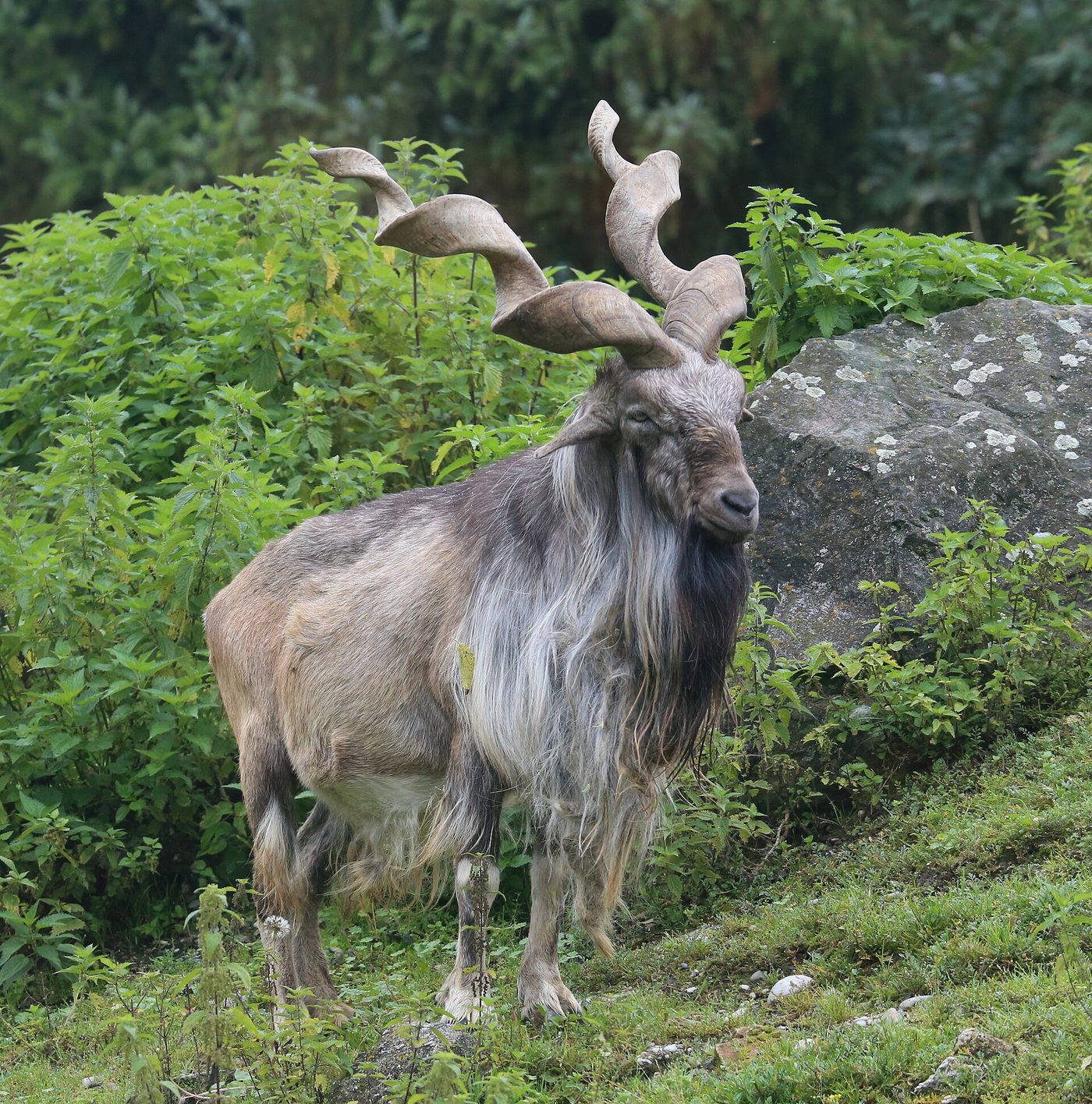
With its spectacular corkscrew horns, the markhor is a large wild goat of the mountains of Asia, an extremely agile climber of rocky walls.
Characteristics
Temperament
Social, an extremely agile climber, shy
Diet
Herbivore: grasses, leaves, shoots, shrubs
The goat with spiral horns
The markhor is one of the largest and most majestic wild goats in the world, a relative of the mountain goats. Its most spectacular feature is its horns, present in both sexes but imposing in the males: they twist upon themselves in a spiral, like a huge corkscrew, and can reach considerable lengths. Adult males also have a long coat and a thick beard hanging from the neck and chest, which makes them particularly imposing. The colour of the fur varies from greyish-brown to reddish depending on the season.
Habitat and distribution
It lives in the mountainous regions of central and southern Asia, across Pakistan, Afghanistan, India and neighbouring countries, on steep rocky slopes and in high-altitude forests. It is an animal perfectly adapted to a vertical life: it climbs with extraordinary agility on sheer walls and rugged slopes, where few predators can follow it. It also makes seasonal migrations in altitude, going up in summer and down in winter.
Behaviour
The markhor is a herbivore feeding on grasses, leaves, shoots and shrubs, grazing even in difficult positions. It generally lives in groups, with the females and young separated from the males for much of the year. During the mating season, the males challenge each other in spectacular duels, crossing their great horns in trials of strength to win the right to reproduce.
Curiosities
The markhor is the national animal of Pakistan, where it is deeply rooted in local culture and symbolism. Its spiral horns make it one of the most recognisable animals of the Asian mountains and an object of admiration since ancient times.
Conservation
The markhor is classified as a near-threatened species. In the past it was brought into decline by overhunting and habitat loss. Thanks to conservation programmes that have involved local communities, regulating hunting sustainably and protecting the species, the populations have partly recovered, in an encouraging example of wildlife management.
Pros
- Spectacular, unmistakable spiral horns
- Extraordinary climber of rocky walls
- National animal of Pakistan
- Encouraging example of recovery through communities
Cons
- Near-threatened species
- In the past reduced by hunting and habitat loss
- Tied to specific mountain environments