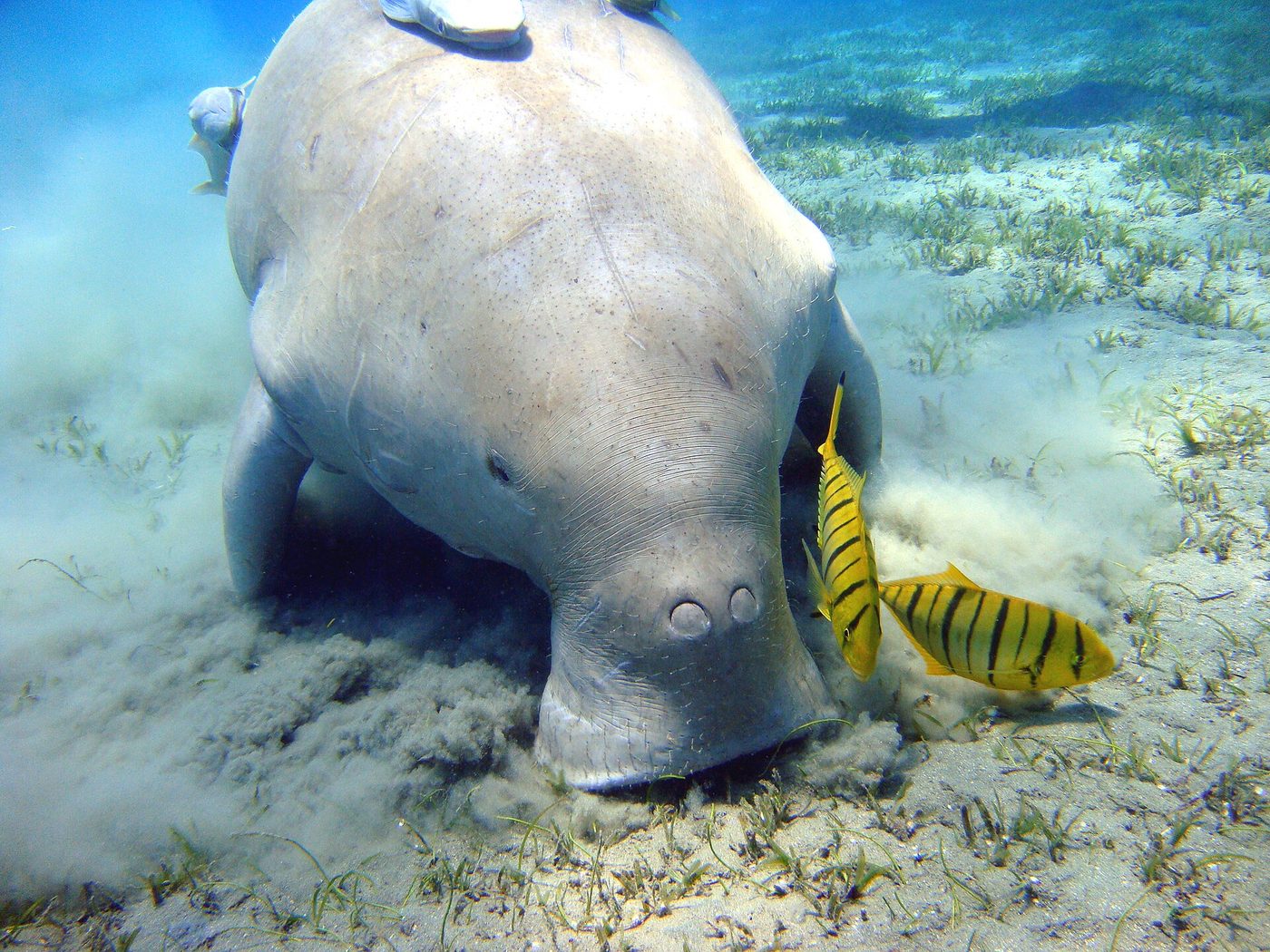
Photo: Julien Willem · CC BY-SA 3.0
Dugong
Dugong dugon
The dugong is a placid herbivorous sea mammal of tropical waters, the sole survivor of its family and an inspiration for mermaid legends.
Characteristics
Temperament
Placid, slow, solitary or in small groups
Diet
Herbivorous: exclusively seagrass
The sea cow
The dugong is a large marine mammal of the order Sirenia, with a streamlined grey body, a broad down-turned snout and a fluked, dolphin-like tail that sets it apart from the paddle-tailed manatees. It is the only living species of the family Dugongidae; its closest relative, Steller's sea cow, was hunted to extinction in the 18th century. Unlike manatees, it lives almost entirely in salt water.
Habitat and range
It frequents the warm coastal waters of the Indian Ocean, the western Pacific and the Red Sea. It favours sheltered bays and shallow lagoons rich in seagrass meadows, which are its only source of food. The largest populations live along the coasts of northern Australia.
Behaviour and diet
It is a slow, gentle grazer: it spends much of the day cropping the aquatic plants on the seabed, uprooting them with its mobile, sensitive snout. It can dive for several minutes before surfacing to breathe. It lives alone or in small groups, but where food is abundant dozens of individuals may gather.
Notable facts
Together with the manatees, the dugong is thought to lie behind many mermaid myths: sailors of old, glimpsing these animals nursing their young at the surface from afar, mistook them for creatures half-woman, half-fish.
Conservation
The species is listed as Vulnerable by the IUCN. It is threatened by the destruction of seagrass meadows, coastal pollution, accidental capture in nets and collisions with boats. In some areas, such as the coasts of China, it is now considered functionally extinct.
Pros
- Long-lived, can reach 70 years
- Key 'gardener' of underwater seagrass meadows
- Entirely harmless and peaceful
Cons
- Vulnerable, with declining populations
- Wholly dependent on seagrass meadows