Photo: Paulmaz · CC BY-SA 3.0
Sable antelope
Hippotragus niger
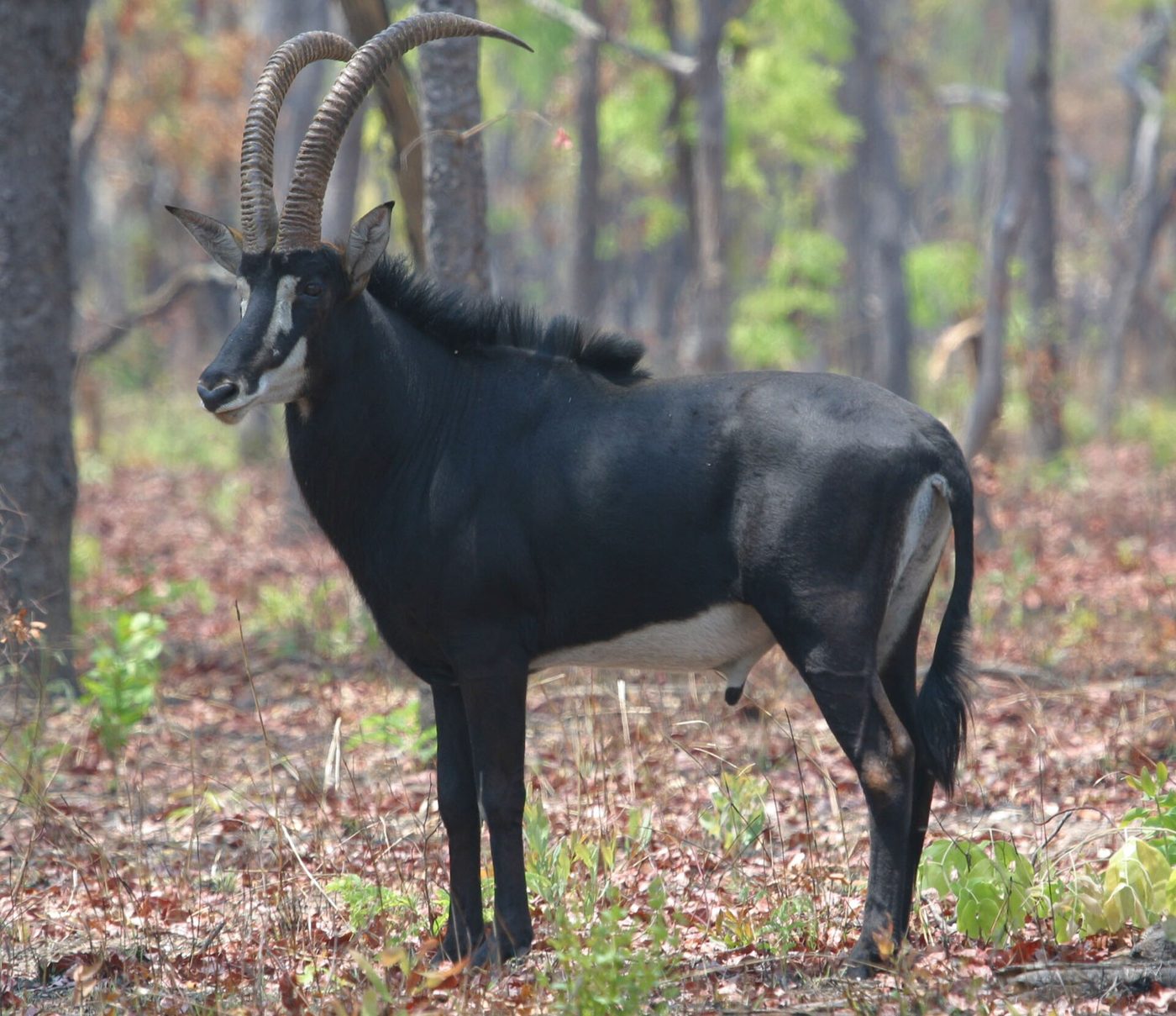
An elegant antelope of the African savanna, the sable antelope's male has a glossy jet-black coat and long sabre-like curved horns, among the finest on the continent.
Characteristics
Temperament
Social, alert, combative if threatened
Diet
Herbivore: savanna grass and leaves
An antelope with sabre horns
The sable antelope is a large, slender African antelope, considered one of the most elegant on the continent. Its most spectacular feature is the long, ringed horns curving backwards like sabres, present in both sexes but more imposing in the males. The coat shows marked dimorphism: adult males are a glossy, brilliant black with white belly and facial mask, while females and young have a chestnut-brown coat. The sturdy neck and erect mane recall a horse, hence the genus name, 'horse-goat'.
Habitat and distribution
It lives in the wooded savannas of East and Southern Africa, from southern Kenya to South Africa, with an isolated and particularly threatened population in Angola (the giant sable antelope). It favours a mosaic of woodland and grassland, where it finds fresh grass and trees for shade.
Behaviour
It is herbivorous and lives in herds of females and young led by a dominant male; younger males form separate groups. It is a vigorous, combative antelope: when threatened by predators it does not hesitate to defend itself with its horns, and even lions can be injured in the attack. It grazes in the morning and afternoon, resting during the hottest hours.
Curiosities
The giant sable antelope of Angola is a national symbol of the country and was for years feared extinct because of the civil war, before being rediscovered and placed under strict protection.
Conservation
The species overall is listed as Least Concern by the IUCN, but some subspecies, such as the Angolan one, are severely threatened by hunting and habitat loss.
Pros
- Sabre horns among the finest in Africa
- Glossy black coat in adult males
- Not threatened overall
Cons
- Some subspecies severely threatened
- Not a pet: a wild herbivore
- Can defend itself with its horns if cornered