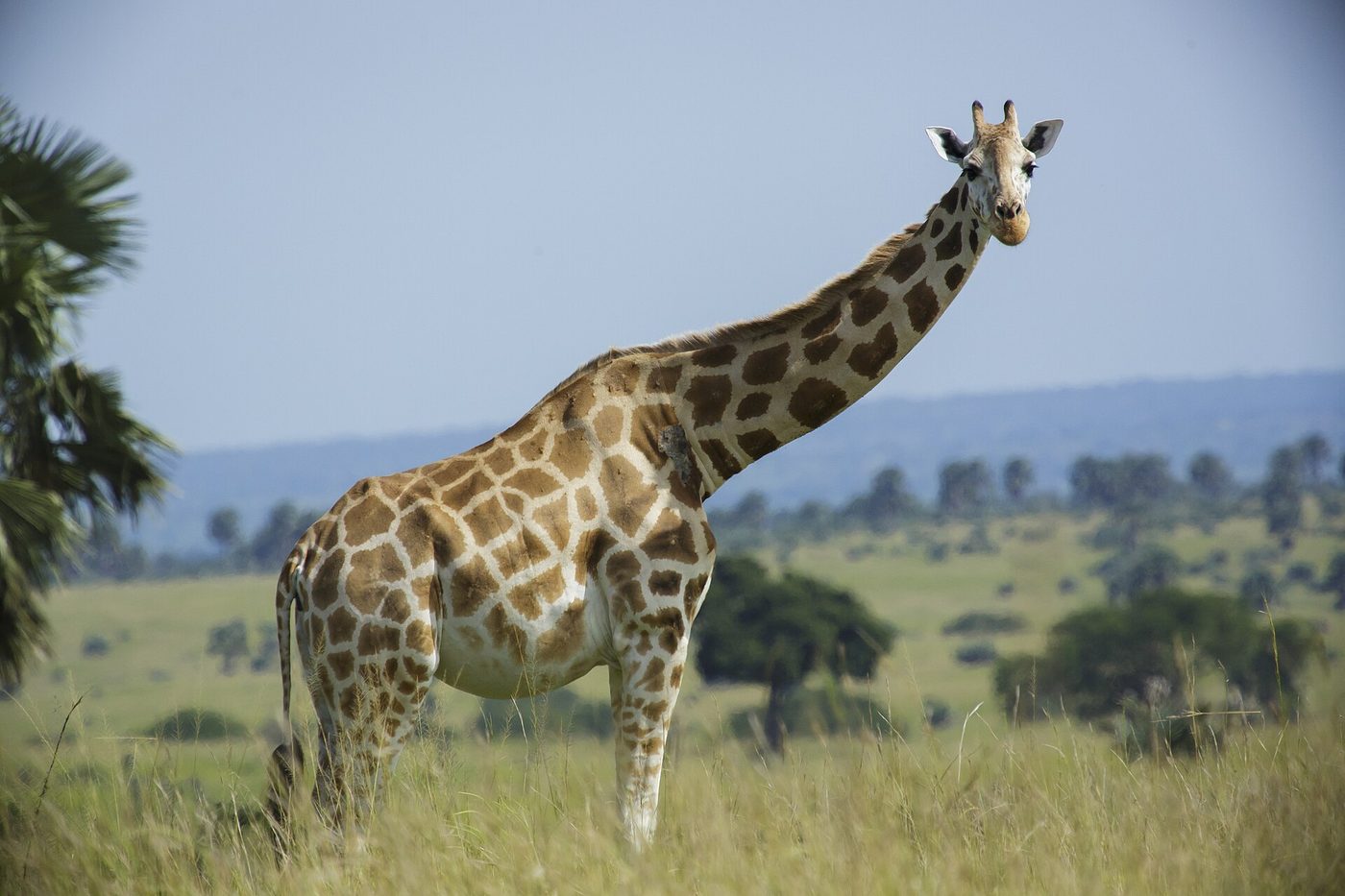
Photo: Thomas Fuhrmann · CC BY-SA 4.0
Giraffe
Giraffa camelopardalis
The tallest animal in the world, with its towering neck and spotted coat, the giraffe dominates the African savanna with elegance and extraordinary adaptations.
Characteristics
Temperament
A peaceful, social herbivore, living in groups of changing composition. Placid but able to defend itself with very powerful kicks; males compete with blows of the neck.
Diet
Herbivore: mainly leaves, particularly acacia, reached thanks to the long neck and grasped with the prehensile tongue.
The tallest giant on Earth
The giraffe is the tallest land animal in the world: an adult male can exceed five metres in height. Its most famous feature is of course its very long neck, which lets it reach the leaves at the top of trees, out of the reach of almost all other herbivores. The coat is covered with a characteristic spotted pattern, unique to each individual, which offers partial camouflage among the light and shade of the vegetation. The head bears two or more skin-covered horns, called ossicones.
An extraordinary neck
Despite its length, the giraffe's neck contains the same number of vertebrae as the human neck: seven, but hugely elongated. This neck poses considerable challenges to circulation: the giraffe's heart is very powerful and must push blood all the way up to the brain, while a special system of valves prevents dangerous pressure drops when the animal lowers its head to drink. Drinking is indeed a vulnerable moment for the giraffe: it must splay its long legs and bend down, exposing itself to predators.
Life in the savanna
The giraffe lives in the savannas and open woodlands of Africa. It is a herbivore that feeds mainly on leaves, particularly acacia, which it grasps with a long, prehensile tongue, dark and resistant to thorns. It lives in groups of fluid composition and communicates also with very low-frequency sounds, largely imperceptible to the human ear.
Behaviour
Despite its placid appearance, the giraffe can defend itself: a kick from its powerful legs can seriously injure even a lion. Males compete in a particular form of combat called 'necking', dealing powerful blows with the neck and head to establish hierarchy.
Conservation
The giraffe is classified as a vulnerable species. Its populations have declined over recent decades because of habitat loss, poaching and conflict. Some subspecies are in particularly critical condition. Its conservation requires the protection of the great spaces of the African savanna, an effort often overlooked for an animal at once so iconic and so surprisingly threatened.