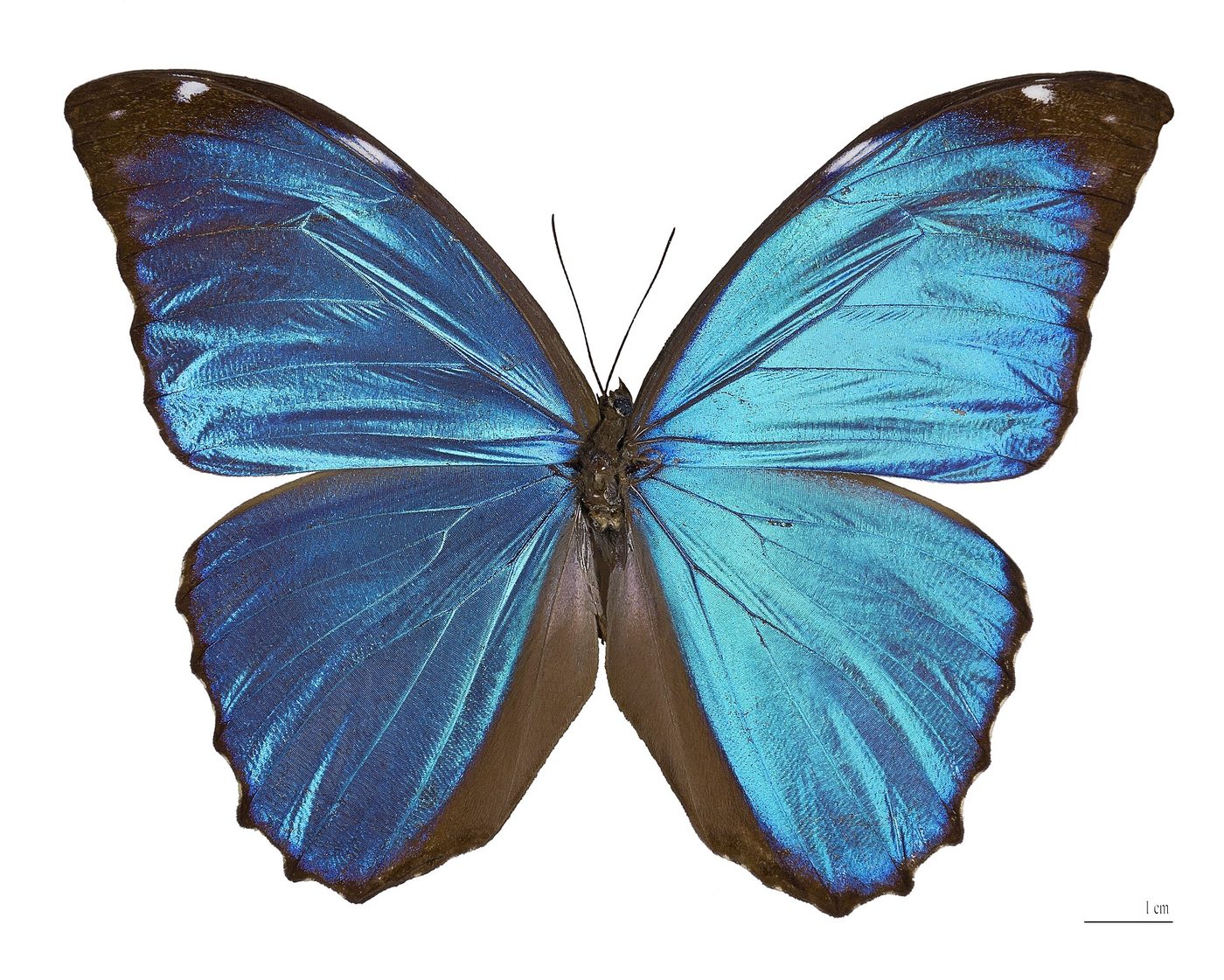
Photo: Didier Descouens · CC BY-SA 4.0
Menelaus blue morpho
Morpho menelaus
The Menelaus blue morpho is a large tropical butterfly of South America, famous for wings of metallic blue that shimmer in the sun thanks to nanostructured scales.
Characteristics
Temperament
Diurnal and shy; flies in bobbing bursts through understorey and clearings.
Diet
Adults: juices of ripe fruit and organic matter; caterpillars: leaves.
A flash of blue in the forest
The Menelaus blue morpho (Morpho menelaus) is one of the most spectacular butterflies on the planet, a member of the family Nymphalidae. Its wingspan is about 12 cm; the upper surface of the wings is a bright, iridescent blue edged with black, while the underside is brown with prominent eyespots. The blue does not come from pigment but from the microscopic structure of the scales, which refracts and scatters light — so-called structural colour. At rest the butterfly folds its wings, showing only the cryptic brown underside, then flashes open in flight to reveal bursts of blue.
Habitat and range
It lives in the rainforests of Central and South America, particularly the Amazon basin. It favours the understorey and clearings, often flying along trails and watercourses during the brightest hours of the day.
Behaviour and diet
Unlike many butterflies, the adults do not feed mainly on nectar; instead they suck the juices of ripe and rotting fruit, sap and fluids from organic matter. The caterpillars, by contrast, feed on the leaves of various plants and are reddish with markings. The morpho's bobbing, unpredictable flight, alternating flashes of blue and brown, confuses predators.
Did you know?
The nanostructure of its wings is studied by scientists to develop materials, fabrics and displays with structural colour and no pigments. Because of their beauty, these butterflies were widely collected in the 20th century for collections and ornaments.
Conservation
The species has no major species-specific IUCN assessment, but like many tropical insects it depends on the health of the rainforest. Habitat destruction and overcollection remain the main potential threats.
Pros
- Spectacular metallic-blue wings
- Structural colour studied by materials science
- Large and unmistakable in flight
Cons
- Depends on intact rainforest
- Historically collected in large numbers
- Sensitive to deforestation