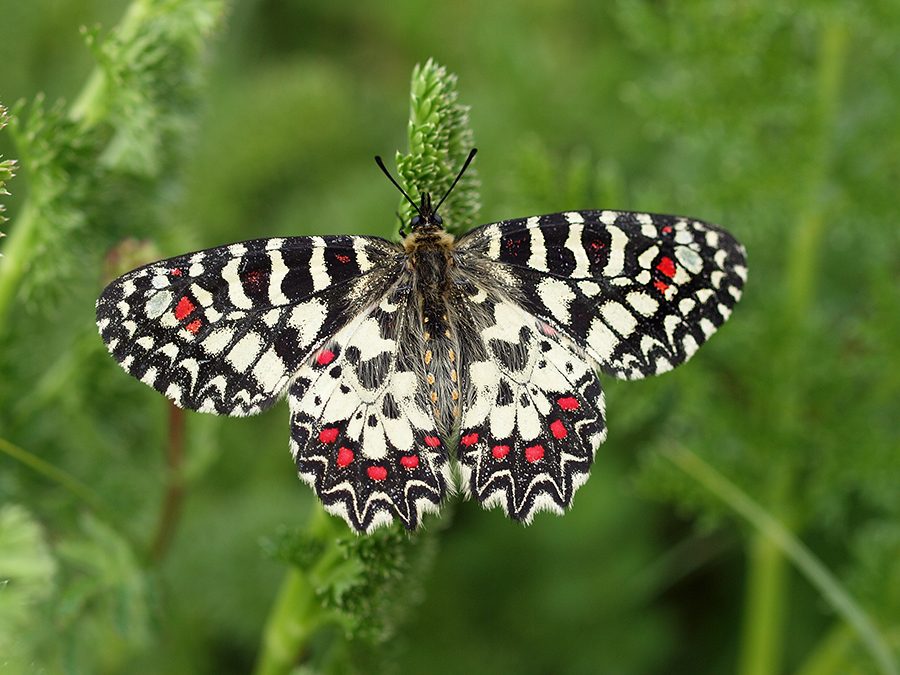
Spanish festoon
Zerynthia rumina
The Spanish festoon is a small, brilliantly coloured Iberian butterfly with wings mottled in red, yellow and black, recalling a harlequin's costume.
Characteristics
Temperament
Diurnal, tied to open, sunny habitats
Diet
Caterpillars: birthwort only; adults: nectar
The harlequin butterfly
The Spanish festoon is a small, lively butterfly of the swallowtail family, Papilionidae. Its scalloped-edged wings are a mosaic of red, yellow, white and black spots, with rows of scarlet eyespots along the margin — a combination so striking that in Spanish it is called "arlequín", the harlequin. It is one of the most distinctive butterflies of the Iberian Peninsula.
Habitat and range
It is widespread across much of Spain and Portugal, as well as North Africa and southern France. It frequents a wide range of sunny habitats: garrigue, rocky slopes, clearings and waste ground, always where its caterpillars' host plants grow.
Life cycle and diet
It is a specialist insect: its caterpillars feed exclusively on certain species of birthwort (Aristolochia), plants that contain toxic substances. By eating them, the caterpillars accumulate these compounds, becoming distasteful and poisonous to predators — a defence that the adult's bright colours advertise. The adults fly in spring, feeding on flower nectar.
Notable facts
The genus name, Zerynthia, recalls an ancient Greek place, while the epithet rumina refers to Rumina, a Roman goddess protecting nursing. The chequered colours are not merely ornamental: they are a clear signal of aposematism, a warning of toxicity aimed at birds.
Conservation
The species is not considered globally threatened, but its populations depend closely on the presence of birthworts and traditional open habitats. Habitat destruction and herbicide use can locally reduce its range.
Pros
- Spectacular harlequin colouring
- Pollinator of spring flowers
- Chemical defence derived from host plants
Cons
- Depends closely on birthworts
- Sensitive to loss of open habitats