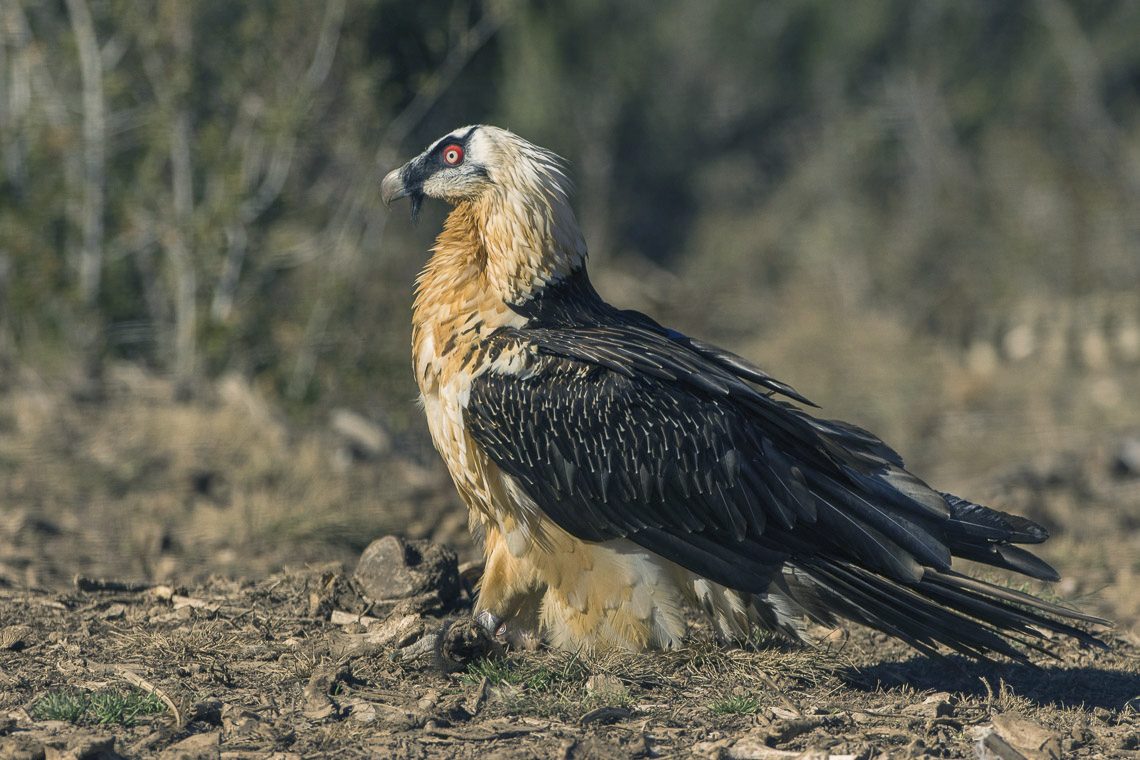
Bearded vulture
Gypaetus barbatus
The bearded vulture is the largest vulture breeding in Europe, a mountain raptor with a unique diet: it feeds almost entirely on bone, which it breaks by dropping it from height.
Characteristics
Temperament
Solitary and shy; a great mountain soarer.
Diet
Bone-eating scavenger: 70–90% bone, marrow and carcass remains.
The vulture that eats bones
The bearded vulture (Gypaetus barbatus), also known as the lammergeier, is a large raptor of the family Accipitridae, the largest vulture breeding in Europe, with a wingspan approaching three metres. It usually weighs between 4.5 and 7 kg. (Note: the body-mass value listed on Wikidata, 224 kg, is clearly an error — this is a bird of only a few kilograms.) It looks elegant and slender, with a pale head, red-ringed eyes and a tuft of black bristles beneath the bill resembling a beard, hence its name. Its breast plumage is often stained orange-rust, a colour the bird acquires by rubbing itself in soils rich in iron oxides.
Habitat and range
It lives in the great mountain ranges of southern Europe, Africa and Asia: the Pyrenees, Alps, Corsica, Balkans, Himalayas and the highlands of East Africa. It frequents cliffs and peaks, nesting on inaccessible ledges.
Behaviour and diet
It has an extraordinary diet, unique among vertebrates: 70–90% is bone. The bearded vulture is the last to visit carcasses, when only skeletons remain. Bones too large to swallow are carried up and repeatedly dropped from great height onto stone slabs until they shatter; it then swallows the fragments and marrow, digested by extremely strong stomach acids.
Did you know?
The rocks used to smash the bones are called "ossuaries" and are used for generations. In many mountain cultures the bearded vulture was long feared and persecuted, wrongly accused of carrying off lambs — hence its old name of lammergeier, "lamb-vulture".
Conservation
The IUCN lists it as Near Threatened. In Europe it had almost vanished through persecution and poisoned baits; thanks to major reintroduction programmes it once again breeds in the Alps and other ranges. Poisoning and disturbance of nest sites remain threats.
Pros
- The largest vulture in Europe
- A diet unique among vertebrates (bone)
- A symbol of Alpine wildlife recovery
Cons
- Near Threatened
- Very sensitive to poisoned baits
- Slow breeding and sensitive nest sites