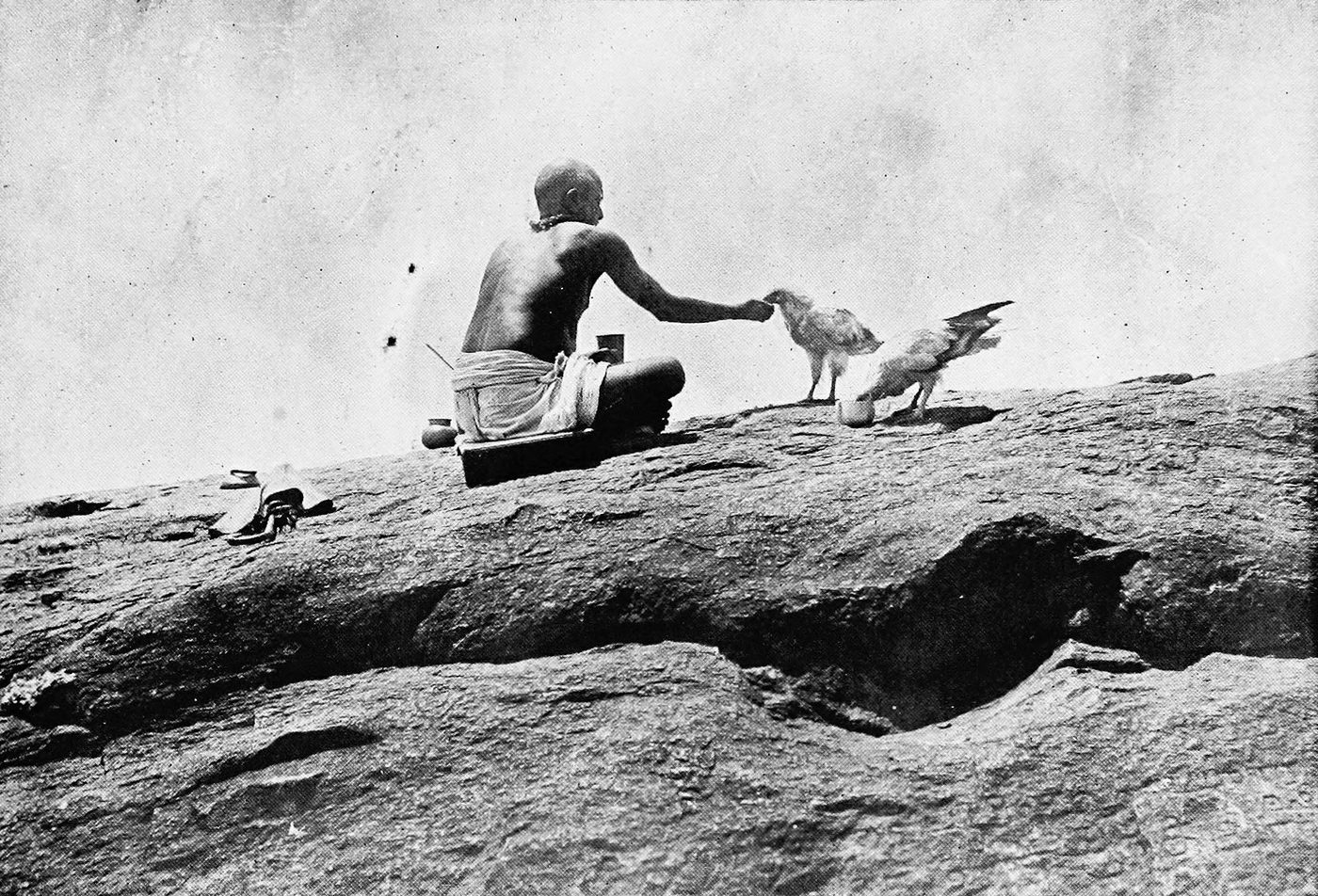
Photo: Edgar Thurston, Madras Government, India · Public domain
Egyptian vulture
Neophron percnopterus
The Egyptian vulture is a small black-and-white Old World vulture, famous for using stones as tools to break open ostrich eggs.
Characteristics
Temperament
Opportunistic and ingenious; uses tools to open eggs.
Diet
Opportunistic scavenger: carrion, small animals, eggs, refuse.
The little vulture that uses tools
The Egyptian vulture (Neophron percnopterus) is a small Old World vulture, the only species of the genus Neophron. It has mostly dirty-white plumage, black flight feathers, a bare face of bright yellow and a ruff of shaggy feathers on the head. In flight it is unmistakable for the contrasting black-and-white pattern of its underwing and its wedge-shaped tail. It usually weighs between 1.6 and 2.4 kg. (Note: the body-mass value listed on Wikidata, 94 kg, is clearly an error — this is a bird of a few kilograms.)
Habitat and range
It occupies a vast range, from the Iberian Peninsula and North Africa to West Asia and India. It frequents open, arid and hilly country, where it soars on thermals during the hottest hours.
Behaviour and diet
It feeds mainly on carrion but is an opportunist: it also takes small mammals, birds and reptiles, and eats organic refuse and eggs. It is famous for a rare tool-using behaviour: to open the large, tough eggs of ostriches, it grasps a stone in its bill and hurls it repeatedly onto the egg until it breaks.
Did you know?
In ancient Egypt it was regarded as a sacred bird, protected and associated with the goddess Nekhbet; its English nickname "pharaoh's chicken" recalls that reverence. By feeding on carcasses and refuse, it provides a valuable "cleaning" service to the environment.
Conservation
The IUCN lists it as Endangered. Populations are declining sharply due to poisoning (including veterinary drugs in carcasses), toxic baits, collisions with infrastructure and a reduction in available food.
Pros
- Uses stones as tools (rare among birds)
- A valuable scavenger that cleans the environment
- A vast range across three continents
Cons
- Endangered
- Very sensitive to poisoning and toxic baits
- Populations declining sharply