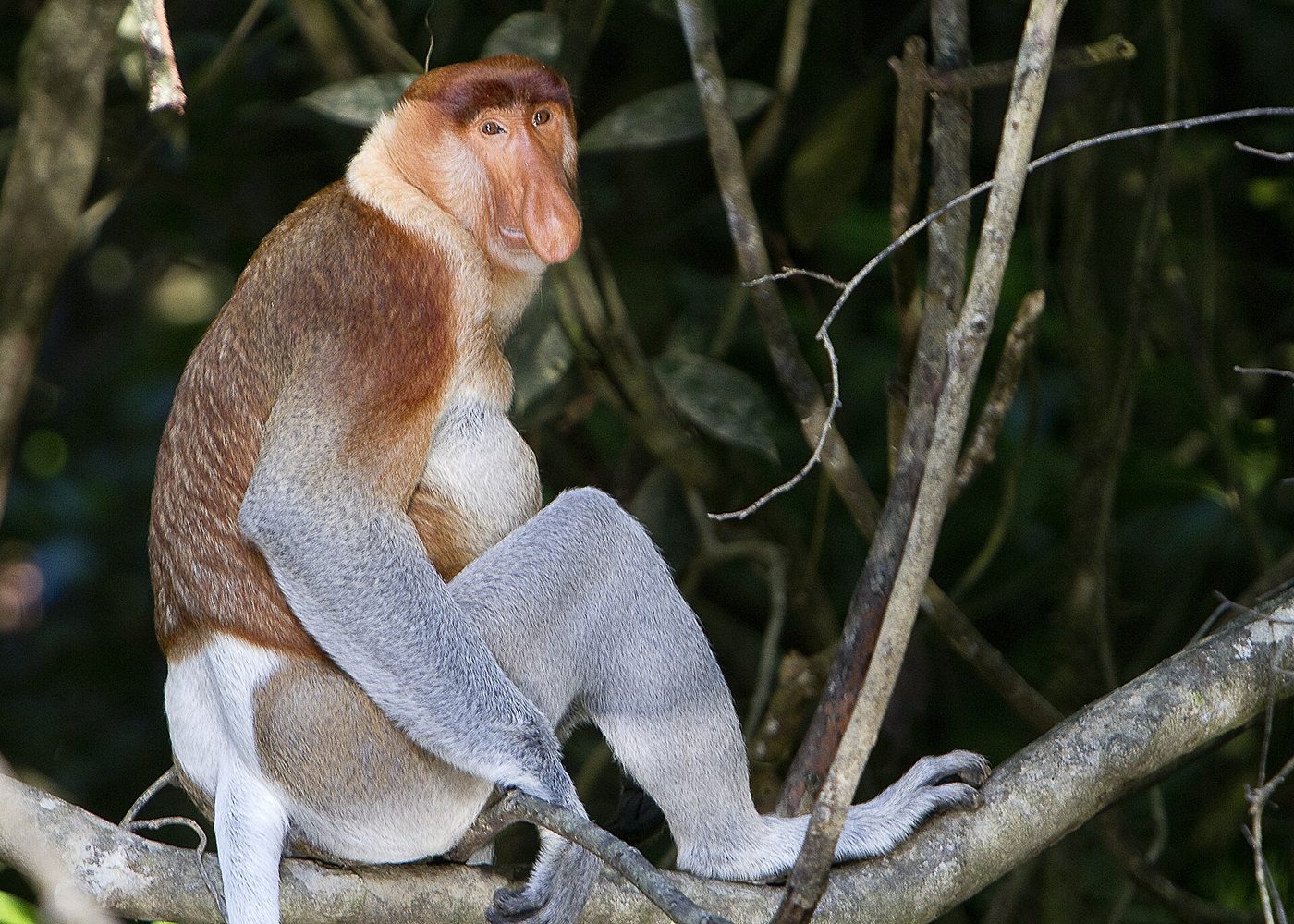
Photo: David Dennis · CC BY-SA 2.0
Proboscis monkey
Nasalis larvatus
With its enormous nose and prominent belly, the proboscis monkey is an unmistakable monkey of Borneo, a skilful swimmer among the mangrove forests.
Characteristics
Temperament
Social, arboreal and an excellent swimmer
Diet
Herbivore: mainly leaves, unripe fruit and seeds
The big-nosed monkey
The proboscis monkey is one of the most curious and recognisable primates in the world, famous above all for its nose. In adult males this becomes enormous, long and pendulous, so much so that it partly covers the mouth: it is thought to serve to amplify calls and attract females, a sign of strength and maturity. Another distinctive feature is its very bulky belly, due to a complex, specialised stomach. Its fur is of reddish-brown tones, lighter on the underside.
Habitat and distribution
The proboscis monkey is endemic to the island of Borneo, in Southeast Asia, which means it lives only there and nowhere else in the world. It frequents moist forests near water: mangroves, riverine and swampy forests along rivers and coasts. It is an animal deeply tied to the aquatic and forest environment of this great tropical island.
Behaviour
It lives in social groups, often made up of a dominant male and several females with their young. It feeds mainly on leaves, but also on unripe fruit and seeds: its complex stomach, similar in function to that of ruminants, allows it to digest foliage thanks to specialised bacteria, and it is this that gives it its characteristic swollen belly. It is also an exceptional swimmer: it does not hesitate to dive into rivers and even has partially webbed fingers that help it in the water.
Curiosities
The proboscis monkey is one of the few monkeys genuinely skilful in water: it can swim for long stretches and sometimes leaps from trees directly into rivers to escape predators or to move about. The males' large nose, besides its role in courtship, helps make their calls louder and more recognisable.
Conservation
The proboscis monkey is classified as an endangered species. The main threats are the destruction of Borneo's mangrove and rainforests, caused by logging and the expansion of plantations, as well as hunting. Protecting the island's coastal and riverine forests is essential for the survival of this extraordinary and unique primate.
Pros
- Unique, unmistakable appearance
- Exceptional swimmer among primates
- Specialised digestion of leaves
- Natural symbol of Borneo
Cons
- Endangered species
- Endemic: lives only in Borneo
- Threatened by the destruction of forests