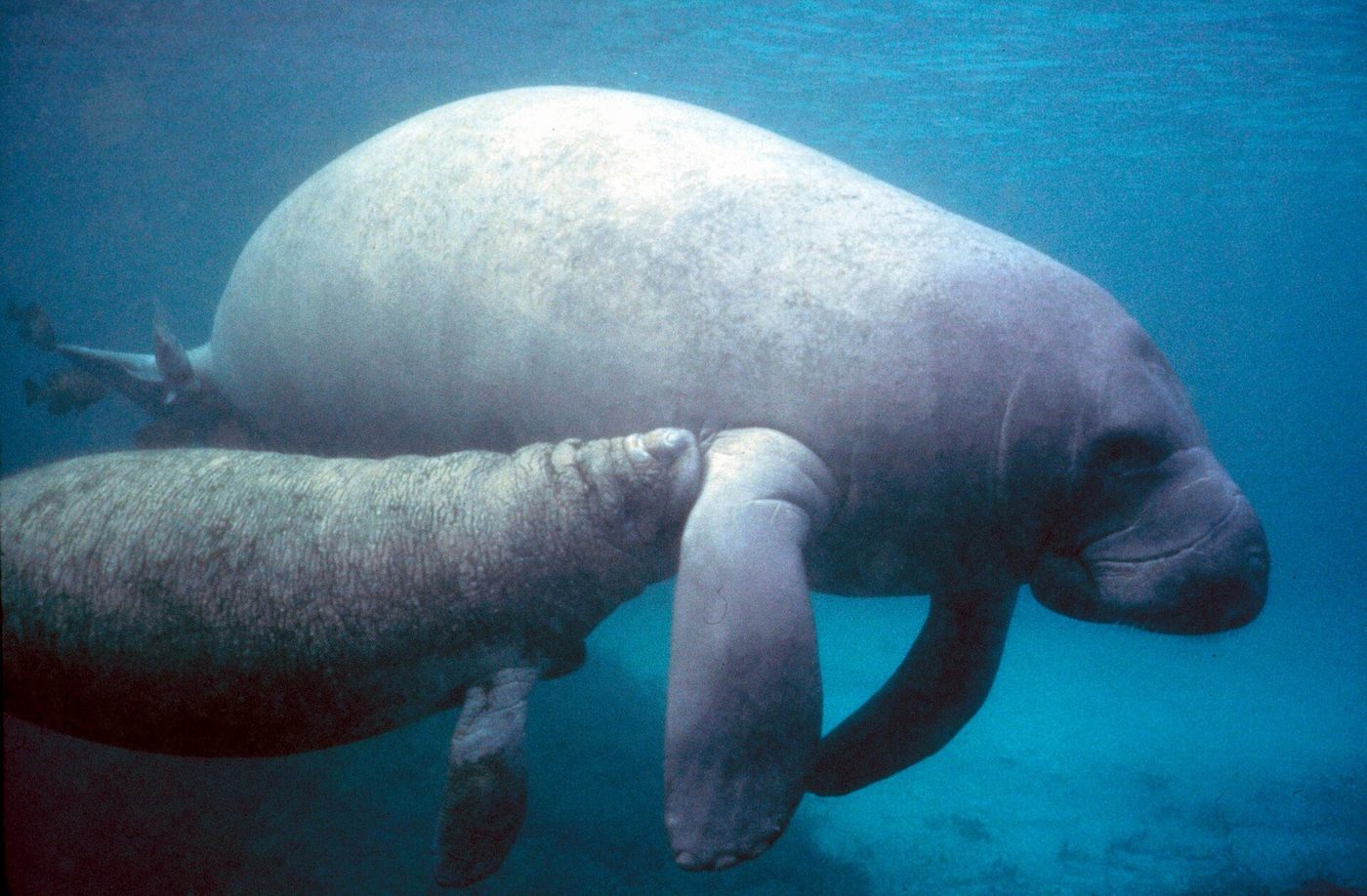
Photo: Galen Rathbun · Public domain
West Indian manatee
Trichechus manatus
Enormous, placid and entirely herbivorous, the West Indian manatee is the 'sea cow' of the warm tropical waters, the largest of the living sirenians.
Characteristics
Temperament
Placid, slow, peaceful
Diet
Herbivore: exclusively aquatic plants
A gentle giant of the sea
The West Indian manatee is a large aquatic mammal with a massive, tapering body ending in a broad, rounded paddle-shaped tail. It has thick, greyish skin, often covered with algae, a fleshy muzzle with prehensile, mobile lips, and paddle-shaped front flippers that help it move and bring food to its mouth. On its muzzle it bears sensitive whiskers, which it uses to explore its surroundings. It is the largest of the living sirenians, the group that also includes the dugong.
Habitat and distribution
It lives in the warm coastal waters of the Caribbean region, from the eastern United States to northern Brazil. It frequents lagoons, estuaries, rivers and shallow coastal areas, moving between fresh and salt water. It needs warm water: it does not tolerate cold, and in the colder periods it gathers near warm springs or warm-water outflows.
Behaviour and feeding
It is a placid, slow animal that spends much of its time grazing. It feeds exclusively on aquatic plants, browsing the bottom vegetation with its mobile lips: for this reason it is nicknamed the 'sea cow'. It lives alone or in small groups, is not territorial and is entirely peaceful. Surprisingly, its closest relatives on land are not other marine animals, but elephants.
Conservation
The West Indian manatee is classified as a vulnerable species. Its populations are threatened by habitat loss, pollution and above all collisions with boats, which injure or kill many individuals in busy coastal waters. The protection of its warm waters and the reduction of boat traffic are essential for its future.
Pros
- The largest of the living sirenians
- Placid and peaceful animal
- Very long-lived
- Valuable 'gardener' of the underwater meadows
Cons
- Vulnerable species
- Injured or killed by collisions with boats
- Does not tolerate cold water