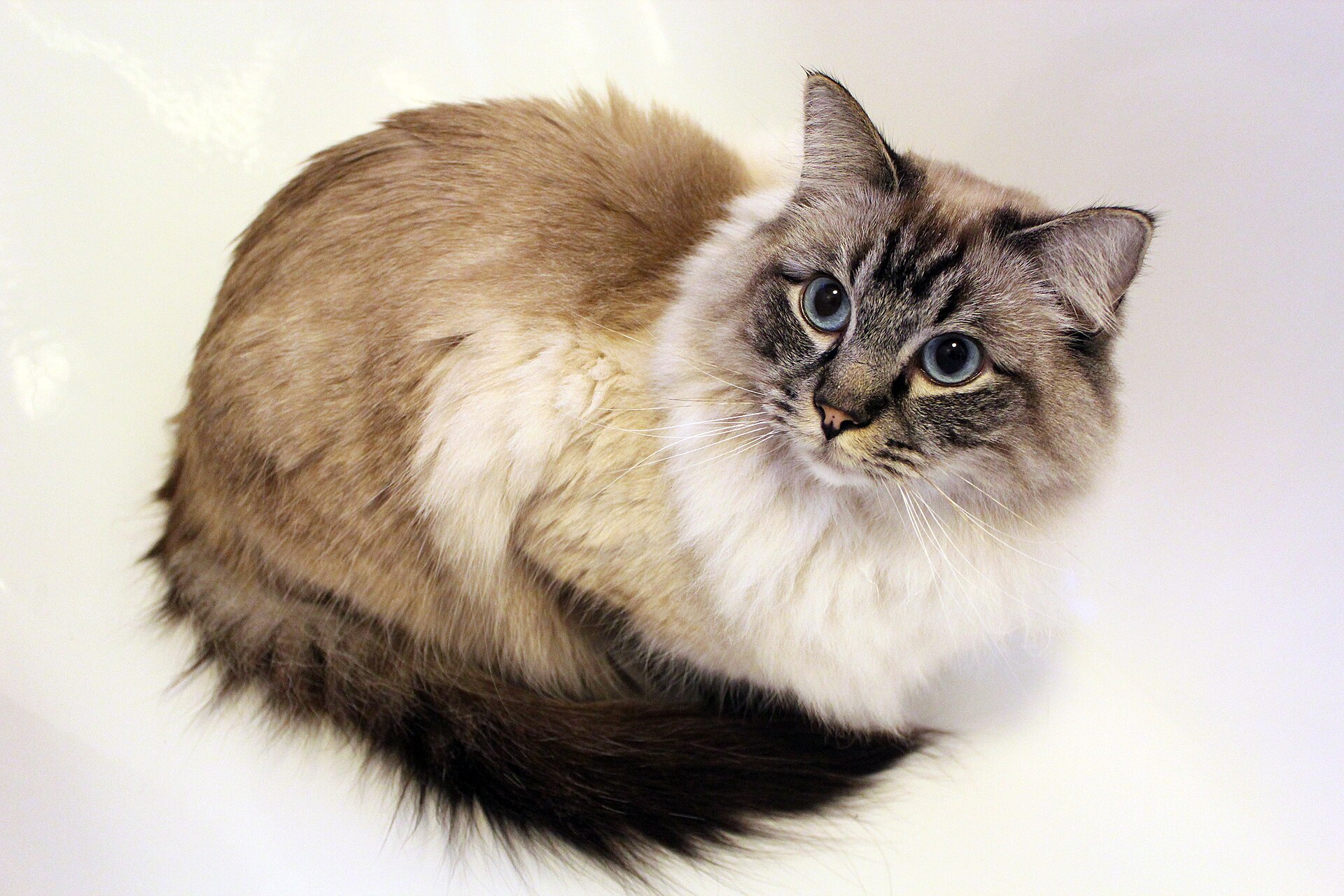
Ragdoll
Characteristics
Temperament
Extremely docile, calm, affectionate. "Goes limp" when picked up. Follows owner like a dog. Suffers solitude: best kept in pairs.
Diet
Obligate carnivore: large-breed kibble (32-38% protein, wide pellet) + wet food. Slow growth (4 years): high caloric intake until age 3, then watch for post-neuter weight gain.
The Ragdoll is an American cat breed developed in California in the 1960s. Its name derives from its most distinctive trait: when picked up, the Ragdoll fully relaxes, going limp like a rag doll. It combines impressive size, silky semi-long fur, sapphire-blue eyes and an exceptionally docile temperament that makes it one of the most family-friendly cats in the world.
Classification and category
The Ragdoll is a domestic breed of the species Felis catus (Mammalia, order Carnivora, family Felidae). It was created by Californian breeder Ann Baker starting in 1963 by crossing a semi-feral cat called "Josephine" with Birman and Persian-type males. Cat associations recognised it progressively: TICA in 1979, CFA in 1993, FIFe in 2008. It is one of the largest domestic cats: males weigh 6-9 kg, females 4-6 kg, with a body length of 50-65 cm excluding the tail. Development is slow: it reaches adult size only at 3-4 years.
Habitat and distribution
As a domestic breed, the Ragdoll is today found worldwide, with the highest concentrations in North America, the United Kingdom, central Europe, Australia and Japan. In recent years it has consistently ranked among the top three cat breeds in the UK according to the Governing Council of the Cat Fancy.
The ideal habitat is the indoor home environment: the Ragdoll is neither an instinctive hunter nor an explorer, and its trusting nature makes it vulnerable outdoors (risks from cars, predators, theft, getting lost). It adapts very well to apartment life, even in modest spaces, provided it has scratching posts, raised shelves and quiet resting zones. It is not a breed that enjoys going outside: if placed on a balcony, it tends not to jump down — another consequence of its exceptional muscular relaxation.
Diet
Like all cats, the Ragdoll is an obligate carnivore: its diet must be rich in animal protein (at least 35%), high-quality fats, taurine and arachidonic acid. Due to its size and slow growth, it needs above-average caloric intake for the first 3-4 years of life: large-breed kibble (wider pellet shape, 32-38% protein) supplemented with wet food to ensure hydration is recommended.
A characteristic of the breed is a tendency to gain weight after age 5, especially in neutered individuals: metabolism slows down notably and portions must be recalibrated. The long coat also needs a good supply of Omega-3 and Omega-6 fatty acids to remain glossy and healthy. Water always available, preferably in a fountain to encourage drinking.
Physical features
The Ragdoll has a large, muscular, elongated body with a broad chest and medium-long legs. The head is wide, wedge-shaped with rounded angles, and the eyes are one of its hallmarks: large, oval and deep sapphire blue, present in all pure-bred specimens. The ears are medium, slightly rounded and carried wide apart.
The coat is semi-long, silky, dense but with little undercoat — a feature that makes it less prone to matting than the Persian. All Ragdolls are born completely white: colouration develops progressively over the first 8-10 weeks of life and reaches full intensity only at 3 years. The three recognised patterns are colourpoint (light body, dark extremities), mitted (with white gloves on the feet and a white chin), bicolor (with inverted mask and broad white zones). Base colours are seal, blue, chocolate, lilac, red and cream. The tail is long, bushy and carried horizontally when moving.
Behaviour and curiosities
The Ragdoll is famous for its exceptionally docile, calm, affectionate and sociable character. It is often described as a "puppy cat" because it follows its owner around the house, greets anyone who enters without wariness, happily plays fetch and lets itself be touched anywhere — including the paws and belly, areas most cats defend. Its phlegm is so marked that behavioural studies have investigated whether it is a genetic trait or simple selection: it is now considered a combination of both.
The famous "go limp" (total relaxation when picked up) does not mean the Ragdoll feels no pain or does not react to dangerous situations: it is a simple character predisposition to trust. For this reason it should never be considered "unbreakable": it must be handled with care like any other cat. It is not a breed suitable to be left alone for many hours a day: it suffers from loneliness and tends to develop separation anxiety. It is strongly advised to keep at least two or pair it with another companion animal. Lifespan is 12-17 years, with documented cases of up to 20. Genetic predispositions include hypertrophic cardiomyopathy (HCM), now monitored through DNA testing (MYBPC3 mutation) in responsible breeding programmes.
Pros
- Carattere docile, ottimo con bambini
- Ideale per appartamento
- Occhi blu spettacolari
- Pelo lungo ma poco nodoso
Cons
- Soffre molto la solitudine
- Predisposto a HCM (cardiomiopatia)
- Sviluppo lento (taglia finale a 4 anni)
- Tendenza al sovrappeso post-castrazione