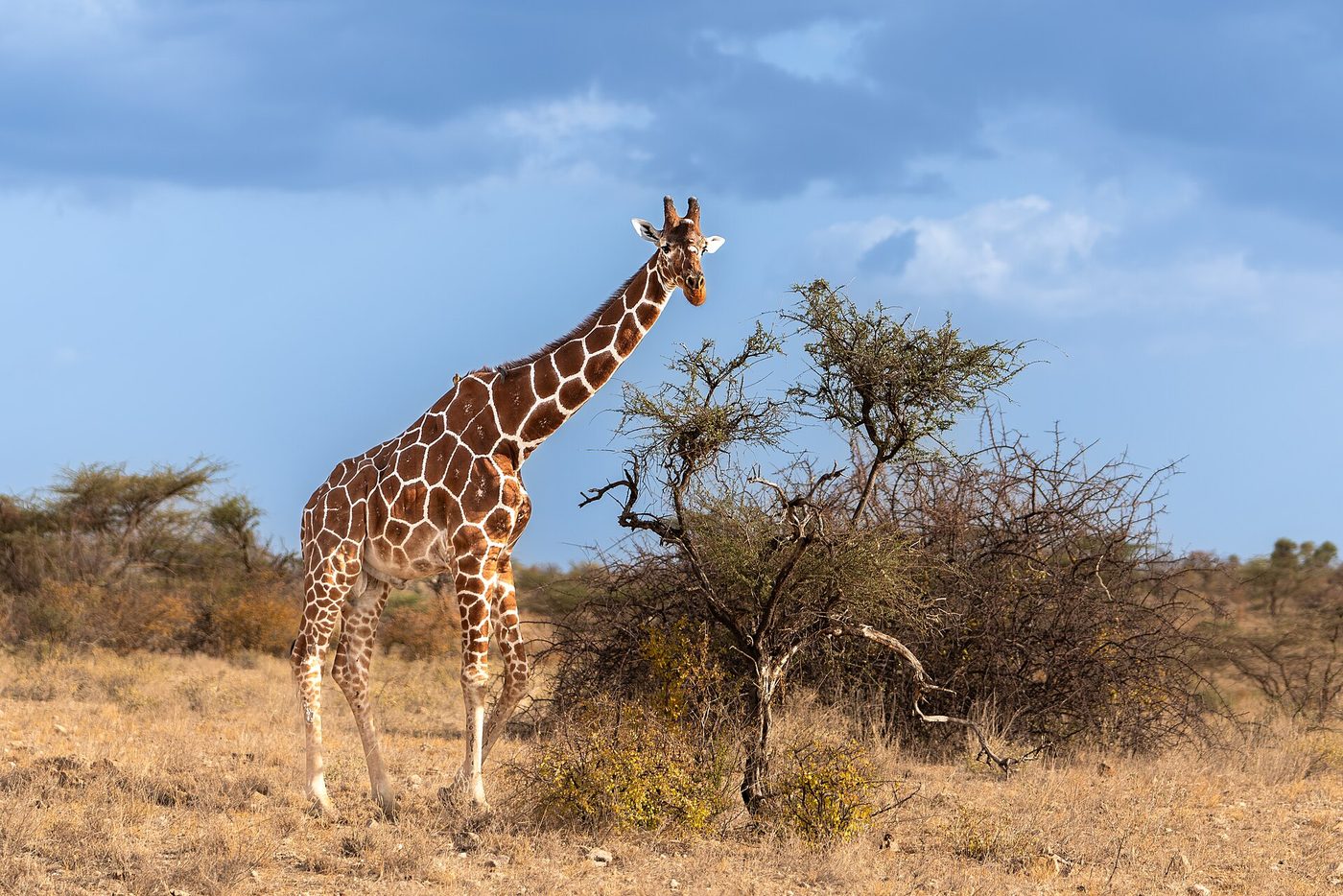
Photo: Payamfarahani · CC BY-SA 4.0
Reticulated giraffe
Giraffa reticulata
Recognisable by its coat of brown polygons edged with white forming a net, the reticulated giraffe is one of the most elegant and unmistakable giraffes in Africa.
Characteristics
Temperament
Social, placid but able to defend itself
Diet
Herbivore: leaves and shoots, especially acacia
The net-patterned giraffe
The reticulated giraffe is famous for its particularly sharp and ordered coat pattern: large polygonal patches of reddish-brown colour, separated by thin, well-defined white lines that form a true 'net'. It is this geometric pattern that distinguishes it from other giraffes and makes it one of the most beautiful and recognisable. Like all giraffes, it has the famous very long neck, extremely tall legs and small skin-covered horns, called ossicones, on its head.
Habitat and distribution
It lives in East Africa, in particular in the savannas, scrublands and semi-arid areas of the Horn of Africa, across Kenya, Somalia and Ethiopia. It prefers open environments dotted with trees, especially acacias, on which it feeds. It is an animal tied to wide open spaces, where it can move about and spot approaching predators from afar thanks to its extraordinary height.
Behaviour
The reticulated giraffe is a herbivore that feeds mainly on leaves, shoots and twigs gathered high among the branches, exploiting its very long neck and a dark, prehensile, very long tongue. It lives in social groups of flexible composition. Despite its placid appearance, it can defend itself with powerful kicks capable of deterring even a lion. The long necks of the males are also used in singular 'duels', in which they strike each other to establish dominance.
Curiosities
The coat pattern of each giraffe is unique, like a fingerprint: no two individuals have the same 'net'. Thanks to its very tall neck and a particularly powerful heart, the giraffe has one of the most extraordinary circulatory systems in the animal kingdom, able to pump blood all the way up to the head despite its great height.
Conservation
The reticulated giraffe is considered a threatened species, with declining populations. The main threats are habitat loss, poaching and the instability of some regions where it lives. Protecting the African savannas and combating poaching are essential to ensure a future for this elegant giant with its net-patterned coat.
Pros
- Elegant, unmistakable net-patterned coat
- Very long neck, an extraordinary adaptation
- Circulatory system unique in the animal kingdom
Cons
- Threatened species, declining populations
- Threatened by poaching and habitat loss
- Needs large open spaces