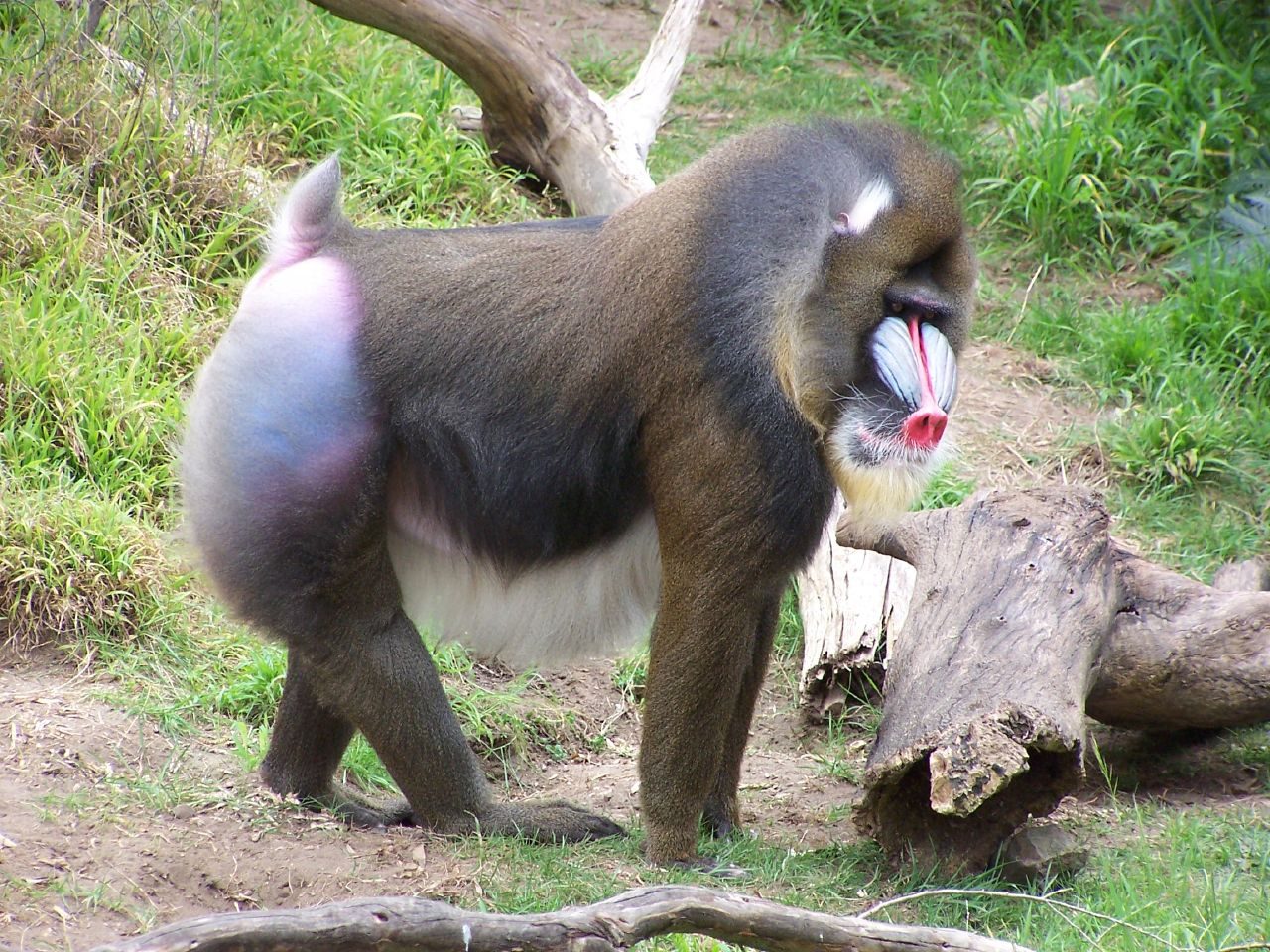
Mandrill
Mandrillus sphinx
With its brightly coloured face and large tusks, the mandrill is the largest of the monkeys, an imposing inhabitant of the African forests.
Characteristics
Temperament
Social, lives in very large groups
Diet
Omnivore: fruit, seeds, roots, insects, small animals
The primate of spectacular colours
The mandrill is one of the most spectacular and unmistakable primates in the world, and the largest of the true monkeys. Its most extraordinary feature is the face of the adult males: the elongated nose is bright red, flanked by two swollen lateral ridges grooved in brilliant blue, while the beard and mane complete an imposing appearance. Its rear also shows vivid colours. Females and young have much softer colours. The mandrill has one of the most marked sexual dimorphisms among mammals: the males can be much larger and heavier than the females.
Habitat and distribution
It lives in the dense rainforests of west-central Africa, in a region that includes Cameroon, Gabon, Equatorial Guinea and Congo. It is an animal tied to the forest floor, where it spends much of its time foraging, though it is able to climb trees, especially to sleep under cover.
Social behaviour
The mandrill is an extremely social animal: it lives in groups that can reach extraordinary sizes, sometimes of hundreds of individuals, among the largest known among primates. It is above all omnivorous: it feeds on fruit, seeds, roots, fungi, insects and small animals. The bright colours of the males' face and body play an important role in social communication, signalling strength and rank within the group.
Curiosities
The mandrill is sometimes confused with the baboon, to which it is related but from which it is clearly distinct. The vividness of its colours is directly linked to the condition and rank of the individual: in dominant males the hues are more intense, a true visual signal of their status.
Conservation
The mandrill is classified as a vulnerable species. The main threats are the destruction of forests, caused by logging and the expansion of human activities, and hunting. Protecting the rainforests of central Africa is essential for the survival of this extraordinary and highly colourful primate.
Pros
- The largest of the true monkeys
- Spectacular, unmistakable face and colours
- Social life in some of the largest groups
- A fascinating example of colour communication
Cons
- Vulnerable species
- Threatened by deforestation and hunting
- Dominant males can be aggressive