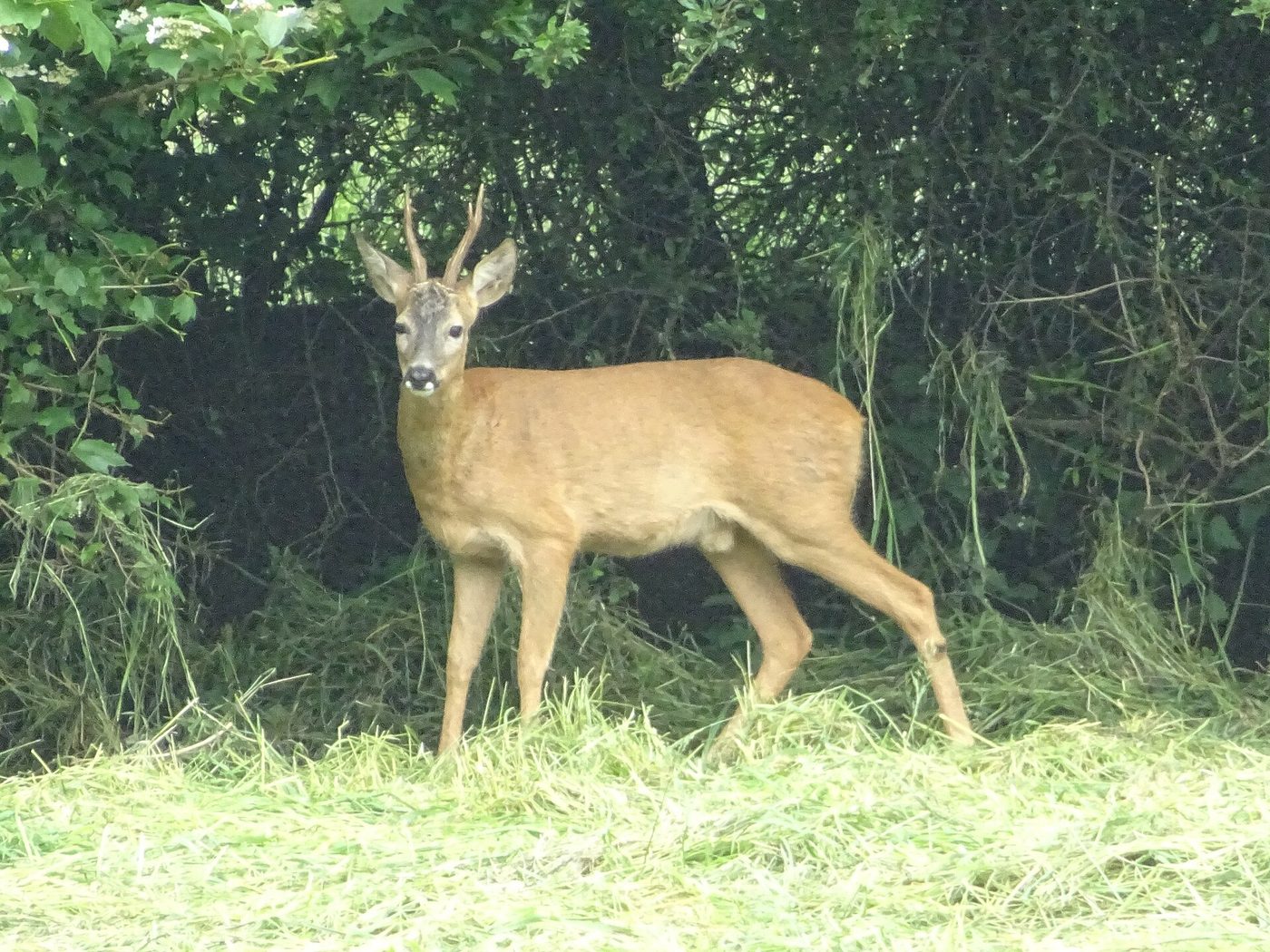
Photo: Karbohut · CC BY-SA 4.0
Roe deer
Capreolus capreolus
The smallest and most widespread of Europe's deer: elegant, shy and able to vanish into the thick of the wood in a few bounds.
Characteristics
Temperament
Shy, wary and nervous, active at dawn and dusk. Solitary in summer, more social in winter; at the slightest threat it flees in rapid bounds.
Diet
Selective browsing herbivore: shoots, leaves, buds, woodland fruits and tender herbs; in winter also twigs and bark.
A deer in miniature
The roe deer is the smallest of the deer living in Europe. It has a slender build, a thin neck and fine legs that give it a light, nervous gait. Its coat changes with the seasons: reddish and glossy in summer, grey-brown and thicker in winter to withstand the cold. An unmistakable feature is the pale patch on the rump, known as the rump patch, clearly visible when the animal flees among the trees.
Only the males bear antlers, branched bony growths shed and regrown each year. They are relatively small, with few points, and serve above all in the ritual fights of the rutting season.
Where it lives
The roe deer is found across almost all of Europe and much of Asia. It favours edge habitats, where woodland meets meadows and cultivated land: here it finds both the shelter of trees and the food of clearings. Adaptable, it has recolonised farmland and hill country from which it had vanished, and its presence is now common even near towns.
What it eats
It is a selective herbivore, described by scholars as a "browser": it does not graze indiscriminately but chooses the tenderest shoots, leaves, buds, woodland fruits and the most nourishing herbs. This refined diet keeps it constantly on the move in search of the best morsels, and in winter drives it to feed on twigs and bark when grass is scarce.
Behaviour
The roe deer is shy and mainly active at dawn and dusk. In summer it tends to be solitary and territorial, while in winter it may gather in small groups. When it senses danger it gives a bark-like call and flees in springy bounds, flashing its rump patch as an alarm signal to its kind. The rut falls in summer, but through a remarkable phenomenon the embryo's development pauses for months, so that the young are born the following spring.
Conservation
The roe deer is in excellent health and listed as least concern, with wide and expanding populations in many regions. It raises no conservation worries; if anything, its abundance can create friction with farming and forestry. The main local threats remain road collisions, particularly frequent in the twilight hours.