Photo: Aquaimages at en.wikipedia · CC BY-SA 2.5
Royal gramma
Gramma loreto
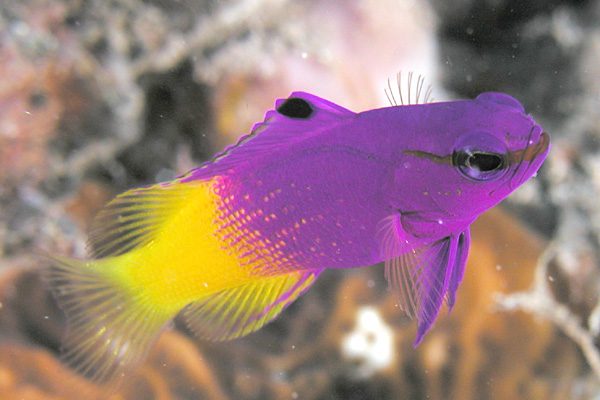
The royal gramma is a small, brightly coloured reef fish, purple-magenta in the front half and golden yellow in the rear.
Characteristics
Temperament
Territorial but calm, tied to crevices
Diet
Small crustaceans and zooplankton
Description
The royal gramma is a small marine fish of the family Grammatidae, just 8 centimetres long. It is unmistakable for its two sharply distinct colours: the front half of the body is an intense purple-magenta, while the rear half is a bright golden yellow. The transition between the two colours is abrupt, as if the fish were split in half. A small dark line runs through the eye.
Habitat and distribution
It lives on coral reefs of the tropical western Atlantic, particularly the Caribbean. It frequents rocky walls and reefs rich in crevices, caves and overhangs, where it finds refuge. It lives closely tied to the substrate, so it can quickly hide in crevices at the slightest danger.
Behaviour
It is a territorial but even-tempered fish, defending its cavity from intruders. It often swims upside down along rock faces, and is sometimes seen 'belly-up' against cave ceilings. It feeds on small crustaceans and zooplankton. It is also known as a cleaner fish, ridding other fish of parasites.
Aquarium care
It is one of the most popular and easy marine fish for the reef aquarium, prized for its vivid colours and good hardiness. It needs a tank with plenty of rocks and hiding places, where it can establish its territory. It is peaceful with most fish, but may vigorously defend its cave.
Conservation
It is classed as least concern. It is among the most exported fish from the Caribbean for the aquarium trade: collection should be managed sustainably so as not to affect local populations.
Pros
- Striking purple-and-yellow pattern
- Easy and hardy in a reef aquarium
- Peaceful with most fish
Cons
- Territorial towards its own kind and its cave
- Needs plenty of rocks and hiding places
- Among the most exported fish from the Caribbean