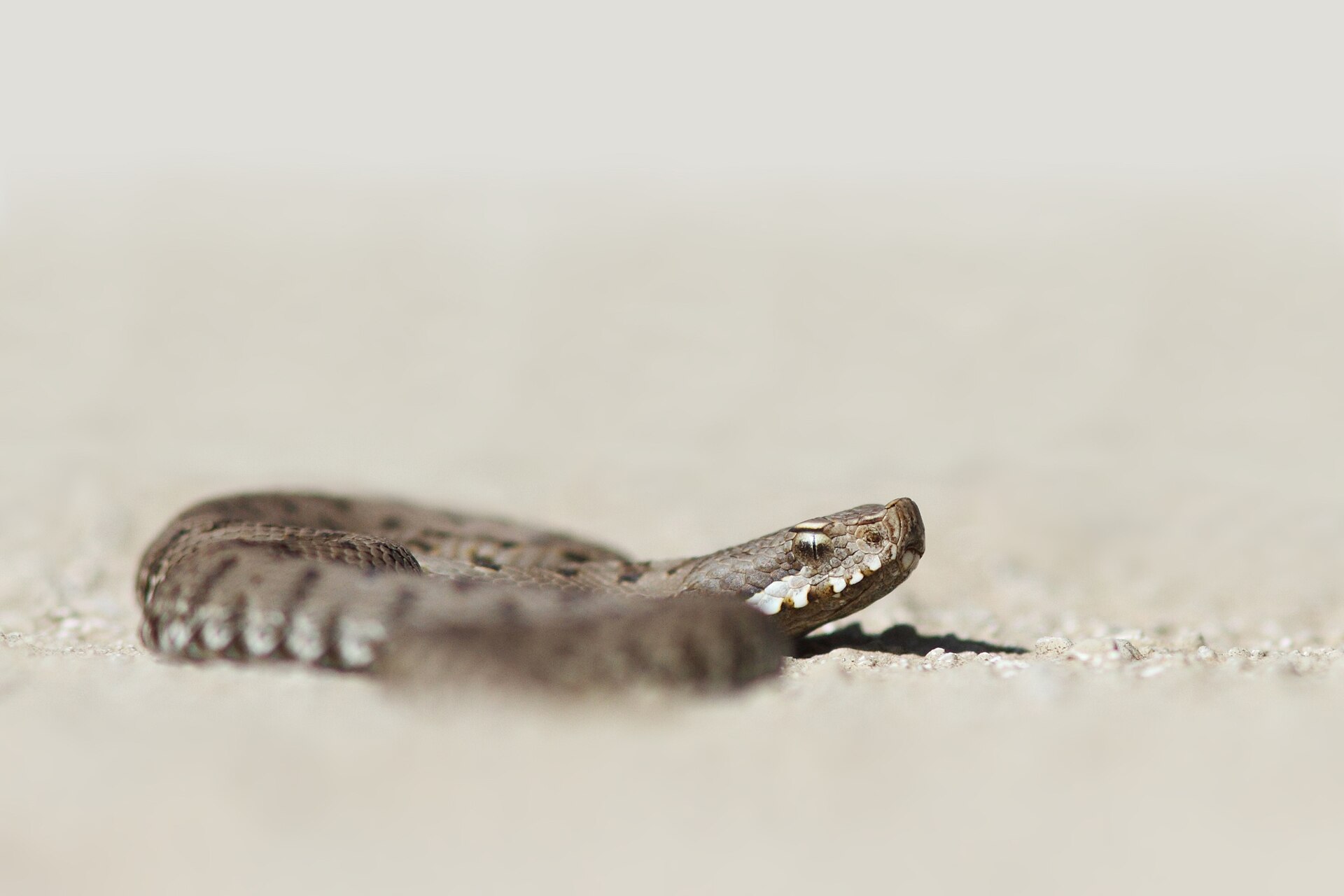
Asp Viper
Vipera aspis
Characteristics
Temperament
Shy, calm and not at all aggressive, contrary to its reputation. A diurnal/crepuscular ambush predator, it spends much time thermoregulating in the sun and hidden among stones. Faced with people it flees or stays still relying on camouflage, and bites only in defence if trodden on or handled. Ectothermic, it hibernates in winter. Ovoviviparous: the young are born already venomous. Not an animal to handle: a wild venomous snake to respect and observe from a distance.
Diet
A venomous ambush predator. Adults eat mainly small mammals (voles, mice, shrews); the young also many lizards; occasionally nestlings. It lies motionless and camouflaged along prey routes, strikes with a lightning bite injecting venom and often releases the prey to avoid injury, then follows its scent trail with the tongue and Jacobson's organ until it finds and swallows it whole. Lacking heat pits (unlike pit vipers), it relies on smell and sight.
The Asp Viper (Vipera aspis) is the most widespread and best-known venomous snake in Italy. Famous for:
- The only dangerous snake in much of Italy: the viper most commonly met on the peninsula, worth knowing in order to respect it
- Its viper look: a triangular head clearly distinct from the neck, a vertical (cat-like) pupil and a stocky body
- The zigzag pattern: a dark, wavy or barred band along the back, on a grey, brown or reddish ground
- The "upturned" snout: the tip of the snout slightly raised, a detail that sets it apart from other vipers
- A purely defensive bite: shy and calm, it bites people only if trodden on, grabbed or cornered
- Live-born young: it lays no eggs but gives birth to fully formed, independent baby vipers
IUCN status: Least Concern (LC), but declining in some regions and locally protected. It is an important link in ecosystems: as a rodent predator it helps balance woods and countryside. Unlike the exotic vipers already in this portal (such as the Gaboon viper), the asp is the "home" viper of Italy and southwestern Europe.
Classification and category
Order Squamata, suborder Serpentes, family Viperidae (the vipers), subfamily Viperinae — the "true vipers" of the Old World, which lack the facial heat-sensing pits typical instead of the pit vipers (rattlesnakes and relatives, like the Texas rattlesnake). In Italy the genus Vipera holds several species; the asp viper is the most widespread. Not to be confused with: the common adder (Vipera berus), more tied to the Alps and the north, lacking the asp's upturned snout; and harmless snakes (colubrids such as the western whip snake and grass snake), which have a slimmer, tapering body, a head little distinct from the neck and, above all, a round pupil, not vertical. Etymology: "Vipera" is Latin, probably from vivipara ("bearing live young"), for its reproduction; "aspis" is an ancient Greek word for "venomous snake" (the same that, in the Cleopatra legend, actually meant an Egyptian cobra). Parameters: Length usually 60-75 cm, exceptionally to ~85 cm. Weight modest, from a few tens of grams to ~300 g. Body stocky and robust, with a short tail; keeled (rough-feeling) scales. Longevity remarkable for a small snake, often 15-20 years. Reproduction: ovoviviparous — the eggs develop inside the female's body, and in late summer she gives birth to 5-15 young, already venomous and independent.
Habitat and distribution
The Asp Viper is found in southwestern Europe: France, Switzerland, northeastern Spain and most of Italy (present across almost the whole peninsula and Sicily, but absent from Sardinia, where no vipers live). Preferred habitats — sunny, dry places rich in shelter: rocky, sunny slopes, dry-stone walls and scree (where it can thermoregulate in the sun and hide quickly); woodland edges, clearings, scrub and dry meadows; and hilly and montane zones, up to high altitudes, and traditional farmland. It is an ectotherm ("cold-blooded"): it regulates its body temperature by moving between sun and shade, and in the cold months it hibernates, often in underground burrows or crevices. It is mainly diurnal or crepuscular, but on very hot days it may be active at dawn and dusk. It is shy and, faced with people, almost always tries to flee or stay still, relying on camouflage. IUCN: Least Concern. However, in many areas it is declining due to habitat destruction, intensive agriculture and, sadly, direct killing out of fear. In several regions it is a legally protected species.
Diet
A venomous ambush predator whose diet is based on small warm-blooded prey: small mammals (voles, mice and shrews are the staple of adults); lizards (important especially for young individuals); and occasionally nestlings and small birds. Hunting strategies: ambush (it lies motionless and camouflaged along prey routes — near burrows, walls, rodent paths — waiting for prey to come within range); bite-and-release (it strikes with a lightning bite injecting venom, then often lets the prey go to avoid being injured; the venom takes effect and the animal dies nearby); and scent-tracking (using its forked tongue and Jacobson's organ, it follows the poisoned prey's scent trail until it finds it, then swallows it whole). Crucially, unlike pit vipers, the asp viper has no heat pits on its snout; to find and follow prey it relies mainly on smell (via the tongue) and sight. The venom serves both to kill the prey and to begin digestion.
Physical features
The Asp Viper has the classic look of a European viper: small, stocky and "serious"-looking. Head and eyes (the traits to recognize it): a triangular head, broad and clearly distinct from the slender neck; a vertical (elliptical) pupil, like a cat's — a typical viper sign, against the round pupil of harmless snakes; and a snout tip slightly turned up, a detail distinguishing it from the adder. Body and livery: a stocky, robust body with a short tail (unlike the slimmer, long-tailed colubrids); keeled scales (each with a central "keel", giving the skin a dull, rough look); and a variable ground colour (grey, brown, reddish) with a dark zigzag or barred pattern along the back. The venom apparatus: long, folding venom fangs at the front of the mouth (folded back at rest, erected when striking); and a venom acting mainly on blood and tissues (haemotoxic).
Behaviour and curiosities
A shy, calm and far-from-aggressive animal, contrary to its reputation. It spends much time thermoregulating in the sun and hidden among stones, and actively avoids people: the vast majority of bites happen when the viper is trodden on inadvertently or, worse, handled. Knowing its appearance and behaviour is the best way to coexist with it safely.
The bite (fear versus reality): the asp viper's bite is painful and must always be taken seriously — it can cause swelling, intense pain and systemic symptoms — but it is rarely fatal for a healthy adult, especially with prompt medical care, which in severe cases includes antivenom; deaths are now very rare. If bitten, the rules are: stay calm, immobilize the limb, remove rings and watches, do NOT cut, do NOT suck and do NOT apply tourniquets, and reach a hospital as soon as possible. The pupil that gives the viper away: the most reliable way to tell a viper from a harmless snake at a glance is to look (from a safe distance!) at the pupil — in vipers it is vertical and elliptical, like a cat's, while in Italy's harmless colubrids it is round; the viper's triangular head and stocky body help too, against the tapering head and slender body of non-venomous snakes. "Cold blood" and hibernation: like all reptiles, the asp viper is ectothermic and depends on outside heat — it is often seen "basking" in the sun on walls or stones in the morning, to reach the temperature it needs to move and hunt; in winter, when the cold prevents activity, it hibernates in sheltered refuges, often underground, re-emerging in spring. Baby vipers already "armed": the asp viper does not lay eggs but is ovoviviparous, giving birth in late summer to fully formed baby snakes; the young are born already equipped with fangs and venom and able to hunt on their own from their first days, with no parental care, so they can bite and inject venom from birth. Cleopatra's asp: the name "asp" has ancient and somewhat confused roots — in legend, Queen Cleopatra is said to have taken her life with the bite of an "asp", but in that context the term most likely meant an Egyptian cobra (Naja haje), not the European viper; the Greek word aspis was used loosely for venomous snakes and later flowed into the name of our viper. The hidden usefulness: despite the fear it inspires, the asp viper plays a valuable ecological role — by hunting mice and voles it helps control rodent populations, including species harmful to agriculture and potential disease carriers; it is a discreet but important predator in the balance of our natural environments.
Pros
- Serpente velenoso più diffuso e iconico d'Italia: importante conoscerlo
- IUCN Least Concern; predatore utile che controlla i roditori
- Schiva e non aggressiva: morde solo per difesa
- Protetta dalla legge in diverse regioni
Cons
- È velenosa: il morso è doloroso e potenzialmente serio (cure mediche necessarie)
- Non va mai maneggiata né disturbata
- Spesso uccisa per paura, nonostante sia utile e protetta
- In declino locale per distruzione degli habitat