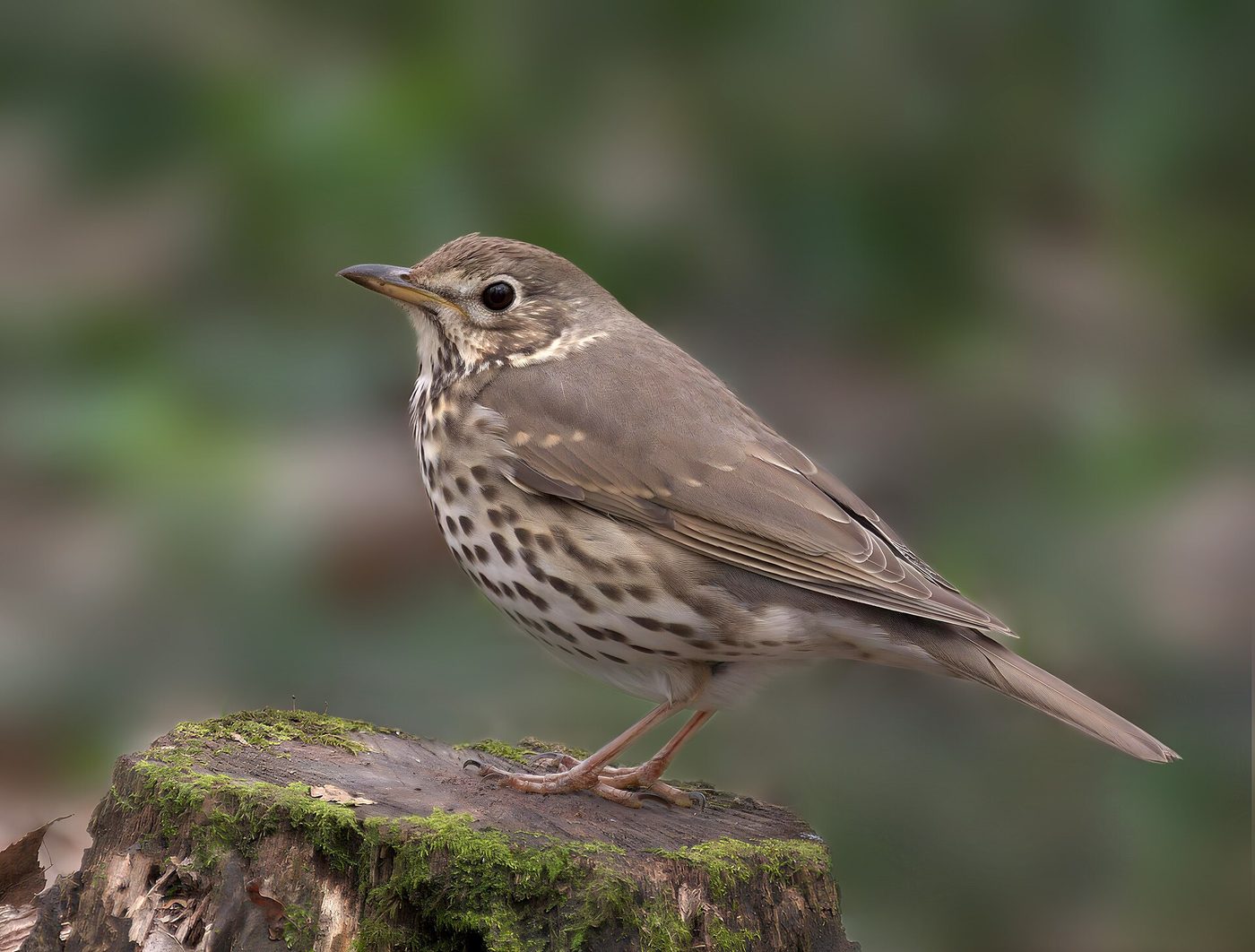
Photo: Dion Art · CC BY-SA 4.0
Song thrush
Turdus philomelos
The song thrush is a bird with a brown back and pale, heavily spotted underparts, famous for its melodious song of repeated phrases.
Characteristics
Temperament
Tuneful, shy, territorial
Diet
Earthworms, insects, snails, berries and fruit
Description
The song thrush is a passerine bird of the thrush family, the size of a blackbird but more slender. Its upperparts are a warm, uniform brown and its underparts pale, cream or buff, scattered with numerous dark drop-shaped spots. Males and females look alike. It is known above all for its song: a sequence of short, melodious musical phrases, each repeated several times.
Habitat and distribution
It breeds across much of the western and central Palearctic. It frequents woods, parks, gardens, orchards and hedgerows with trees. Northern populations are migratory and winter in western Europe and the Mediterranean. It has also been introduced to Australia and New Zealand.
Behaviour
It feeds on earthworms, insects, berries and fruit. It has a characteristic way of dealing with snails: it grasps them and hammers them against a hard stone, its 'anvil', to break the shell and eat the contents. Its powerful, varied song is delivered from high perches, especially at dawn and dusk.
Did you know?
The song thrush's song, with its repeated phrases, has inspired many poets and naturalists. Its habit of breaking snails on anvil-stones is a rare example of tool use among European birds.
Conservation
It is classed as least concern, but in some regions populations are declining, through the loss of hedgerows, agricultural intensification and pesticide use that reduce earthworms and insects.
(Note: the mass value given by Wikidata, 6 kg, is clearly wrong: the song thrush actually weighs about 65–90 grams.)
Pros
- Melodious song of repeated phrases
- Useful predator of snails and insects
- Uses stones as anvils to break shells
Cons
- Declining through loss of hedges and pesticide use
- Shy, easier to hear than to see
- Sensitive to the loss of earthworms and insects