Photo: User:Nino Barbieri · CC BY 2.5
Marabou stork
Leptoptilos crumenifer
Enormous, bald and severe-looking, the marabou stork is one of the birds with the largest wingspan in the world, a tireless scavenger of the African savannas.
Characteristics
Temperament
Scavenger, gregarious, adaptable
Diet
Omnivorous scavenger: carrion, fish, frogs, insects and waste
A giant of unusual appearance
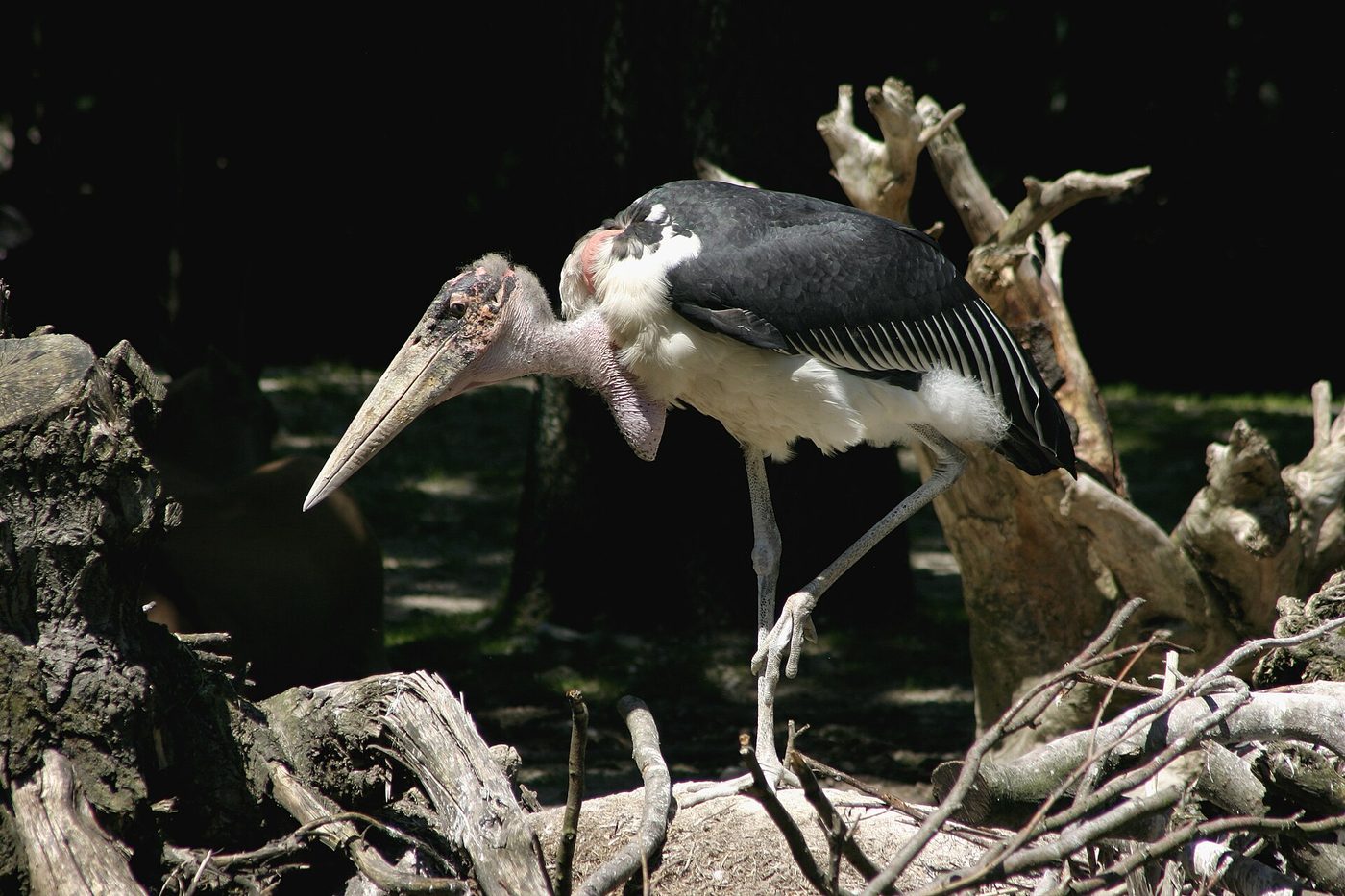
The marabou stork is a large bird of the stork family, of unmistakable and somewhat grim appearance. It has a head and neck almost entirely bare of feathers, of a mottled pinkish colour, and a long, massive bill. From its neck hangs a conspicuous inflatable pouch of bare skin. The plumage of the back and wings is dark, while the belly is white: seen from behind, with wings folded like a cloak and skinny legs, it vaguely recalls the figure of an undertaker, so much so that in English it is nicknamed the 'undertaker bird'. It is famous above all for its wingspan, among the largest of any land bird.
Habitat and distribution
It lives throughout sub-Saharan Africa, in a great variety of environments: savannas, marshy areas, river and lake banks. Thanks to its extraordinary adaptability, it has come very close to human settlements, where it frequents markets, abattoirs and landfills in search of food.
Feeding and behaviour
The marabou is above all a scavenger: it feeds mainly on carrion and animal remains, often in the company of vultures, with which it shares the role of 'cleaner' of the savanna. The bare head and neck are an adaptation to this way of life, because they stay cleaner when the bird thrusts its head into carcasses. It does not, however, spurn live prey: fish, frogs, insects, small mammals, birds and even food waste near towns. In flight it exploits rising air currents to glide for long periods with minimal effort.
Curiosities and conservation
Despite its inelegant appearance, the marabou plays a valuable ecological role, clearing the environment of carcasses and waste and limiting the spread of disease. It is classified as a species of least concern, with large, widespread populations, favoured precisely by its ability to exploit the waste produced by humans.
Pros
- Among the largest wingspans in the world
- Valuable scavenger of the savanna
- Very adaptable, even near humans
- Large, unthreatened populations
Cons
- Inelegant, grim appearance
- Depends on the availability of carrion and waste
- May concentrate at urban landfills