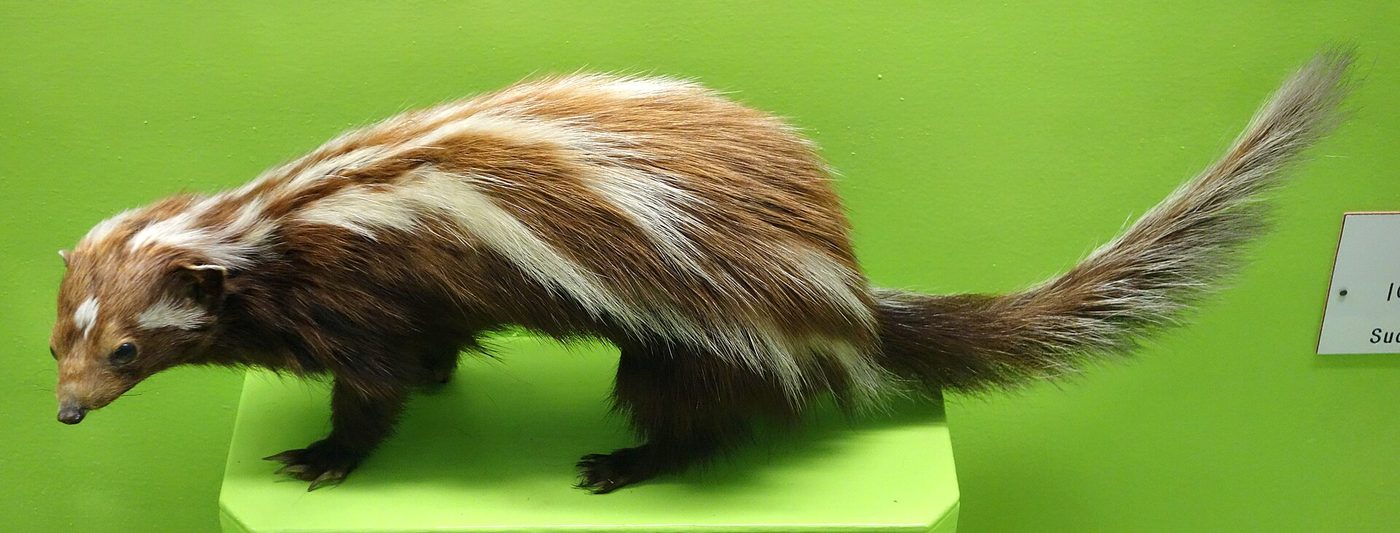
Striped polecat
Ictonyx striatus
The striped polecat is a small black-and-white African mustelid, resembling a skunk, able to spray a foul-smelling secretion to defend itself.
Characteristics
Temperament
Nocturnal, solitary and shy; chemical defence like skunks.
Diet
Carnivorous: small mammals, insects, reptiles and eggs.
Africa's 'false skunk'
The striped polecat (Ictonyx striatus), also called the zorilla or Cape polecat, is a small carnivore of the weasel family Mustelidae. In appearance it closely resembles an American skunk: its body, 30–38 cm long excluding the tail, is almost entirely black, marked with bold white stripes down the back and pale patches on its face and bushy tail. But this is only a likeness born of convergent evolution: skunks belong to a wholly different family. Males are larger than females.
Habitat and range
It lives in sub-Saharan Africa, mainly in savannahs and open habitats with sparse shrubs, from the plains to high elevations. It is a highly adaptable species, found in a wide variety of habitats.
Behaviour and diet
It is nocturnal and mostly solitary. It feeds on small mammals, insects, reptiles, eggs and other small animals, hunting under cover of darkness. Like skunks, its most effective defence is chemical: when threatened it adopts a warning posture and can spray a powerful, foul-smelling secretion from its anal glands, deterring even much larger predators.
Did you know?
Its black-and-white colouring is a classic example of aposematism: it warns predators to keep away. Its closest living relative is the African striped weasel.
Conservation
The IUCN lists it as Least Concern. Thanks to its adaptability, it is still widespread across sub-Saharan Africa and is not considered threatened.
Pros
- Striking black-and-white colouring
- Very effective chemical defence
- Least Concern, widespread
Cons
- Foul-smelling spray when threatened
- A wild animal, unsuited to captivity
- Nocturnal and hard to observe