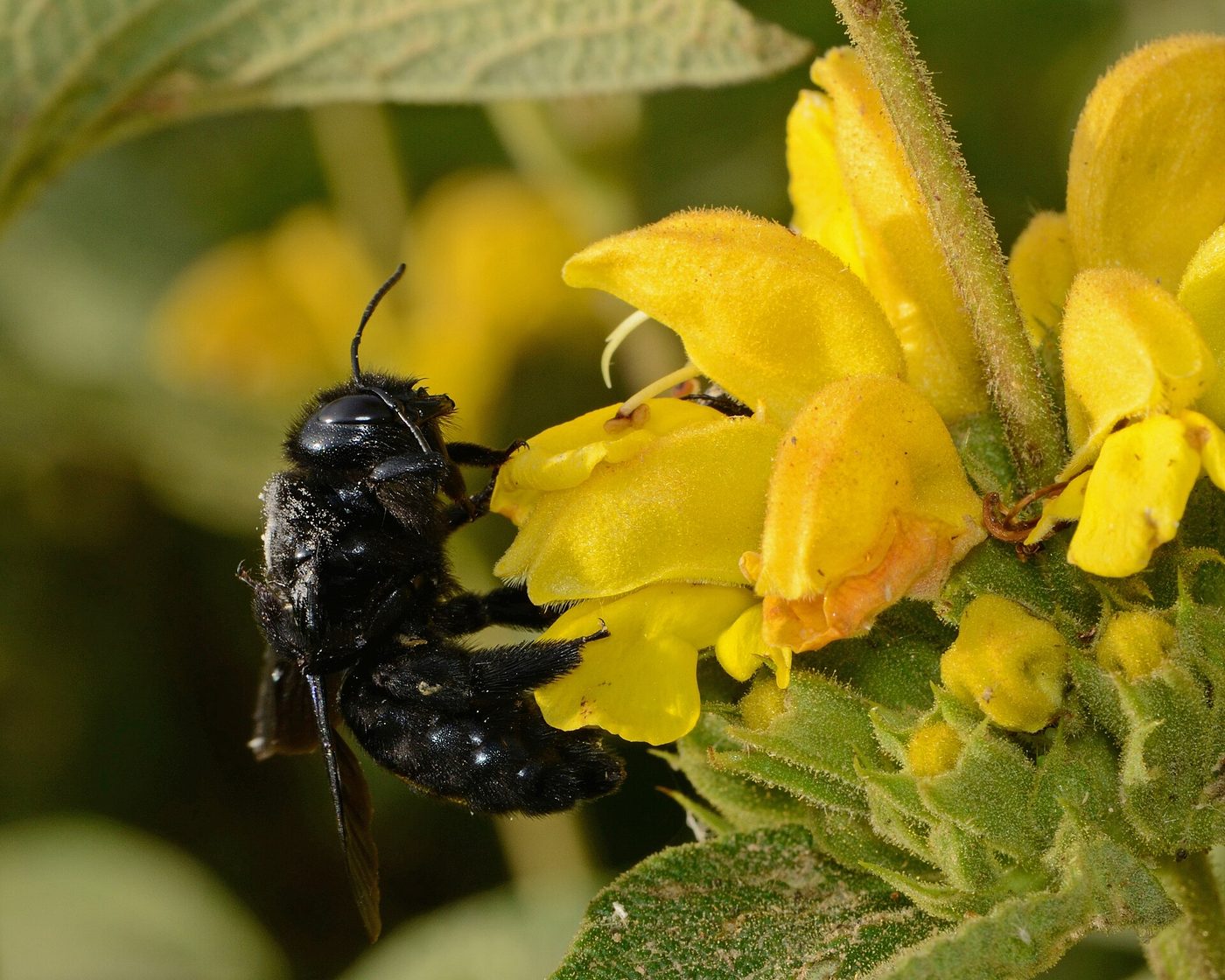
Violet carpenter bee
Xylocopa violacea
The violet carpenter bee is one of Europe's largest bees, with a black body and iridescent violet wings, which bores its nests into dead wood.
Characteristics
Temperament
Solitary, peaceful, with a noisy flight
Diet
Flower nectar and pollen
The black-and-violet jewel of gardens
The violet carpenter bee is one of Europe's largest bees, of imposing appearance: its body is black, stout and robust, and its large wings are an iridescent black-violet that catches the light with bluish glints. For its size and noisy flight it is often mistaken for a bumblebee or even a hornet, but it is entirely peaceful. The deep hum it produces is audible from a distance.
Habitat and range
It is widespread in central and southern Europe and in Asia. It frequents gardens, orchards, clearings and open sunny habitats, especially where dead wood is available for nesting. It loves warm climates and in recent decades has spread farther north.
Behaviour and nesting
Its name comes from the female's habit of boring tunnels into dead wood — dry branches, beams, posts, logs — where she makes the cells for her offspring. It is not a social insect like the honeybee: the females nest solitarily. It is an important pollinator, able to perform "buzz pollination" by shaking flowers to release the pollen. The adults overwinter and reappear in spring, among the first pollinators on the wing.
Notable facts
Despite its imposing look, the carpenter bee is very calm and stings only if handled or crushed. It bores dead wood and generally does not significantly damage structural timber. It was chosen as Germany's "wild bee of the year 2024".
Conservation
The species is not considered threatened and is expanding. It benefits from the availability of dead wood and flowery habitats; keeping dry branches and old trees in gardens encourages its presence.
Pros
- Among Europe's largest bees, spectacular
- Important pollinator, including buzz pollination
- Peaceful and useful in the garden
Cons
- Can bore tunnels into dead wood
- Often mistaken for a hornet and wrongly feared