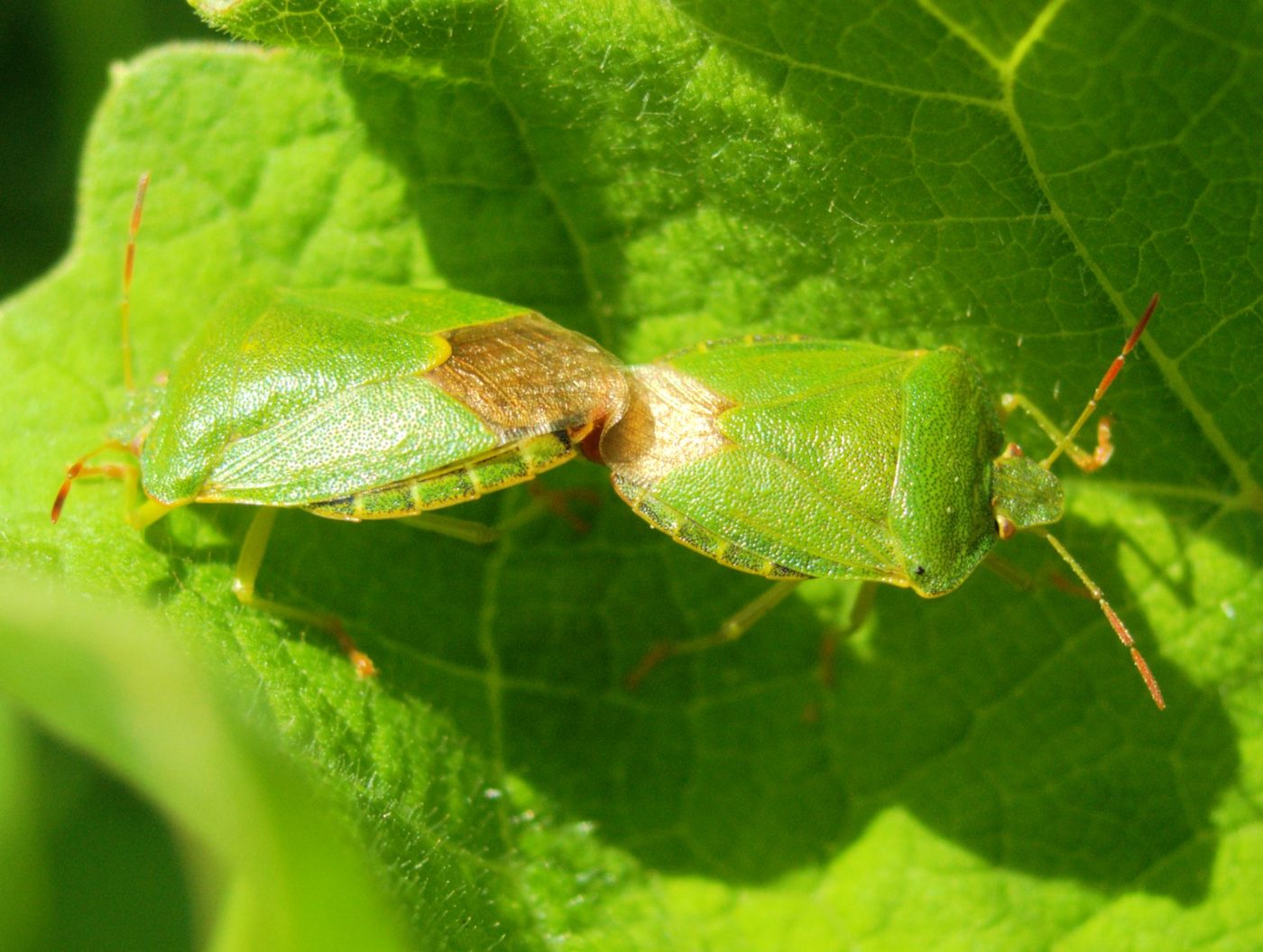
Photo: Guido Gerding · CC BY-SA 3.0
Green shield bug
Palomena prasina
Bright green in summer and bronze in autumn, the green shield bug is a small insect with a characteristic shield, famous for the unpleasant smell it emits in defence.
Characteristics
Temperament
Harmless, slow, tied to vegetation
Diet
Phytophagous: sap of leaves, shoots and fruit
A small shield-shaped insect
The green shield bug is one of the most common and widespread insects in the gardens and countryside of Europe. It belongs to the group of shield bugs, recognisable by their broad, flattened, shield-shaped body, with the back protected by sturdy hardened forewings. In spring and summer it has a lively bright green colouring, which camouflages it perfectly among the leaves. With the arrival of autumn, however, its colour gradually changes to bronze and brownish tones, an adaptation that helps it hide among the dry foliage.
Habitat and distribution
It is widespread across much of Europe and in other temperate regions, where it frequents meadows, hedges, woods, vegetable gardens and gardens. It is found on a wide variety of plants, on which it feeds. It is a very adaptable insect tied to vegetation, where it spends much of its life moving among leaves and stems.
Behaviour and feeding
The green shield bug is phytophagous: it feeds on the sap of leaves, shoots and fruit, which it sucks up thanks to a mouthpart shaped like a fine stylet. Its best-known feature is its defence: when disturbed or threatened, it releases from its glands a secretion with an intense, unpleasant smell, which serves to deter predators. It is precisely this smell that has earned it, along with its relatives, the popular nickname of 'stink bug'.
Life cycle
The green shield bug spends the winter sheltered in protected places, then becomes active again with the arrival of the warm season. Females lay their eggs on plants, from which small nymphs hatch and, through a series of moults, grow into adults. In autumn the adults seek shelter to overwinter, sometimes even entering homes.
Role and curiosities
Although sometimes considered a small nuisance for vegetable gardens and orchards, the green shield bug is an integral part of ecosystems and the food chain, being prey to birds and other animals. Its seasonal colour change is one of its most fascinating aspects, an elegant example of camouflage adapted to the rhythm of the seasons.
Pros
- Beautiful green colour, changing in autumn
- Harmless to humans
- Part of the natural food chain
- A fascinating example of seasonal camouflage
Cons
- Emits an unpleasant smell in defence
- Can damage gardens and orchards in large numbers
- In autumn it may enter homes to overwinter