Photo: Jonathan Hornung · CC BY-SA 2.0 de
Migratory locust
Locusta migratoria
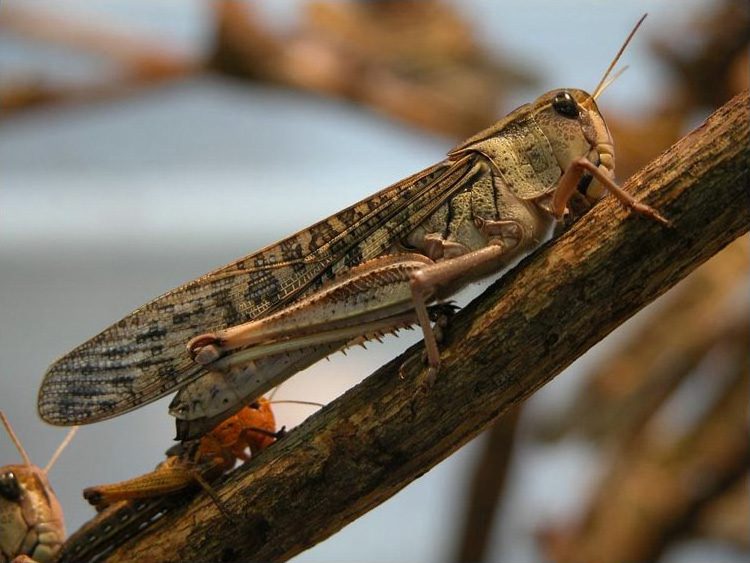
The migratory locust is a large grasshopper able to switch from solitary to gregarious, forming the devastating swarms feared since antiquity.
Characteristics
Temperament
Solitary or gregarious depending on density
Diet
Herbivore: grass, leaves and crops
Description
The migratory locust is a large orthopteran insect of the family Acrididae, the only species in the genus Locusta. It has a sturdy body, usually 4-6 centimetres long, with powerful hind legs adapted for jumping and broad wings that allow long flights. Its coloration ranges from green to brown depending on the environment and, above all, on the phase it is in.
The two phases
The most extraordinary trait of this species is its ability to change form and behaviour according to population density. In the solitary phase it lives alone, has camouflage colours and is harmless. When individuals become very numerous, however, they undergo a transformation (gregarious phase): they change colour, aggregate and form huge swarms that move en masse.
Habitat and distribution
It is the most widespread grasshopper in the world: present in Africa, Europe, Asia and Australia, in a great variety of open habitats. In southern Europe it occurs but is now of little economic importance, while in many tropical regions it remains a fearsome agricultural scourge.
Agricultural role
Locust swarms are among the oldest scourges of agriculture, able to devour entire harvests in a few hours. For this reason the species is monitored and controlled in many parts of the planet. The locust is also farmed as food and feed, being rich in protein.
Did you know?
The transformation from solitary to gregarious phase is triggered by chemical, visual and tactile signals linked to crowding. This phenomenon, long studied by scientists, is one of the most fascinating examples of plasticity in the animal world.
Pros
- Extraordinary plasticity between solitary and gregarious phases
- Rich in protein, farmed as food and feed
- Widely distributed and adaptable
Cons
- Forms devastating swarms in the gregarious phase
- Serious agricultural pest in many regions
- Hard to control during population explosions