Wompoo fruit dove
Ptilinopus magnificus
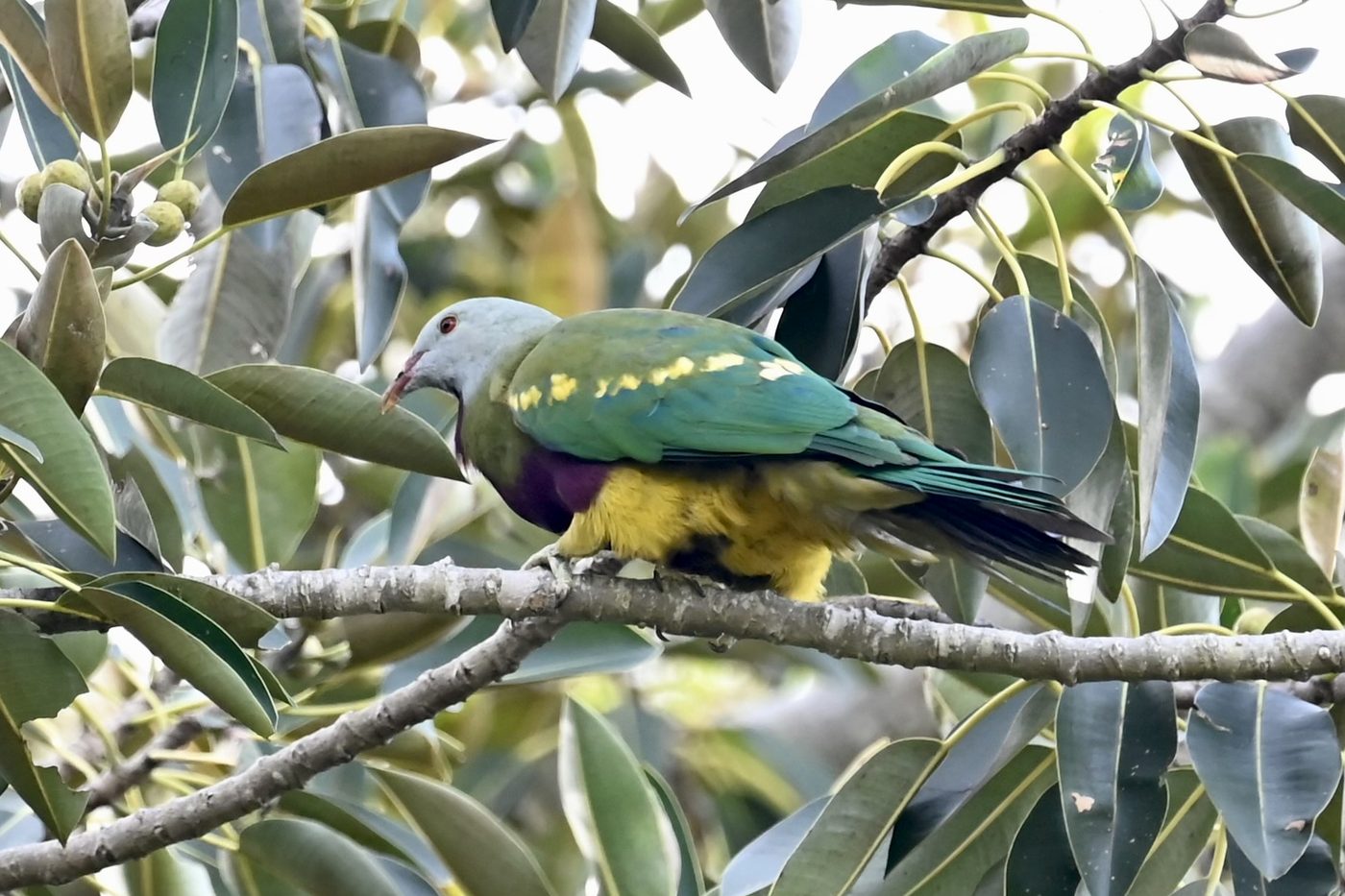
The wompoo fruit dove is a vividly coloured tropical dove — grey head, purple breast and yellow belly — that lives among the rainforest canopy.
Characteristics
Temperament
Quiet, sedentary, arboreal
Diet
Frugivorous: wild figs, berries and fruit
A rainbow among the leaves
The wompoo fruit dove, or magnificent fruit dove, is one of the largest and most colourful fruit doves. It has a spectacular livery: silvery-grey head and neck, a broad breast of intense violet-purple, green wings with a yellow band, and a bright yellow belly. Despite its bold colours, it blends surprisingly well into the sun-dappled foliage. (Note: the mass value reported by Wikidata, 21.7 kg, is clearly erroneous: this bird actually weighs about 300 to 500 grams.)
Habitat and range
It lives in the rainforests of New Guinea and eastern Australia, from Queensland to New South Wales. It frequents the canopy and mid-storey of the forest, rarely coming down to the ground. It occurs in numerous subspecies across its range.
Behaviour and diet
As its name suggests, it feeds almost entirely on fruit, especially wild figs and berries, which it swallows whole thanks to its expandable bill and gape. It is an important disperser of rainforest seeds. Its deep, rhythmic call, a characteristic "wollack-wa-hoo", resonates through the thickets and earned it its onomatopoeic name, wompoo.
Notable facts
It is a rather quiet, sedentary bird that spends much of its time sitting still, feeding among the fruit-laden branches. Its bold colouring, broken into sharp blocks, disrupts the animal's outline and makes it hard to spot in the play of light and shade in the canopy.
Conservation
The species is listed as Least Concern by the IUCN and remains widespread. It depends, however, on intact rainforest: deforestation and habitat fragmentation are its main threats.
Pros
- One of the most spectacular colourings among doves
- Important disperser of forest seeds
- Still widespread and unthreatened
Cons
- Depends on intact rainforest
- Hard to observe in the thickets