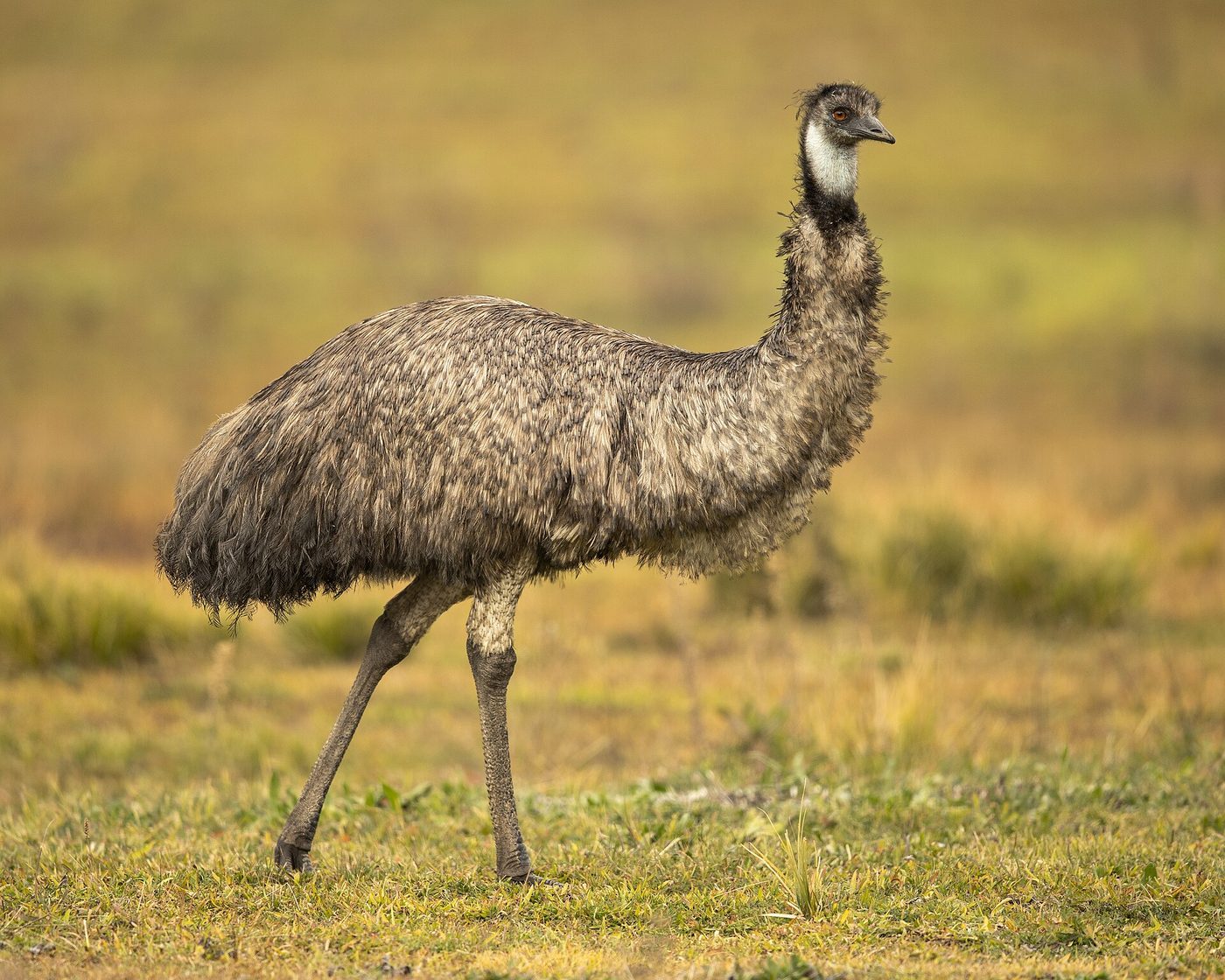
Emu
Dromaius novaehollandiae
Tall and flightless, the emu is the great running bird of Australia, second in height only to the ostrich, a fast and tireless traveller of the plains.
Characteristics
Temperament
Nomadic, curious, a tireless runner
Diet
Omnivore: shoots, seeds, fruit, insects
The running giant of Australia
The emu is the largest bird in Australia and, after the ostrich, the second tallest bird in the world. It is a flightless bird, with a massive body covered by soft, greyish-brown, almost hairy-looking plumage, a long neck and sturdy, powerful legs. Its wings are reduced to small stumps, almost invisible under the feathers: instead of flight, the emu has developed an extraordinary running ability, which allows it to reach high speeds and cover long distances.
Habitat and distribution
It is widespread across much of Australia, where it inhabits very varied environments: savannas, scrublands, grasslands and semi-arid areas of the interior. It is a nomadic animal, which often moves over long distances following the availability of food and water, appearing where conditions are favourable. It has adapted well to a continent of extreme and variable climates.
Behaviour and diet
The emu is omnivorous: it feeds on shoots, seeds, fruit, flowers and also on insects and small invertebrates. It also swallows small stones that help it grind food in its stomach. A surprising aspect concerns reproduction: it is the male that takes charge of incubating the large dark green eggs and raising the young. During the weeks of incubation, the father remains on the nest almost without eating or drinking, then guides and protects the striped chicks for several months.
Curiosities
Despite its bulk, the emu is a skilled runner and also a fair swimmer. Its voice is unusual: it produces deep drumming and booming sounds that resonate over a distance, produced by a special sac in the neck. It is a bird of great symbolic value for Australia, appearing among its national symbols.
Conservation
The emu is classified as a species of least concern, with large populations widespread throughout the Australian continent. It is a common and adaptable animal, also farmed for its feathers, meat and oil. Some island subspecies became extinct in the past, but the species as a whole is in good health today.
Pros
- Second tallest bird in the world
- Fast and enduring runner
- Surprising paternal care of the eggs
- Large, unthreatened populations
Cons
- Cannot fly
- Some island subspecies extinct in the past
- Powerful legs can be dangerous if provoked