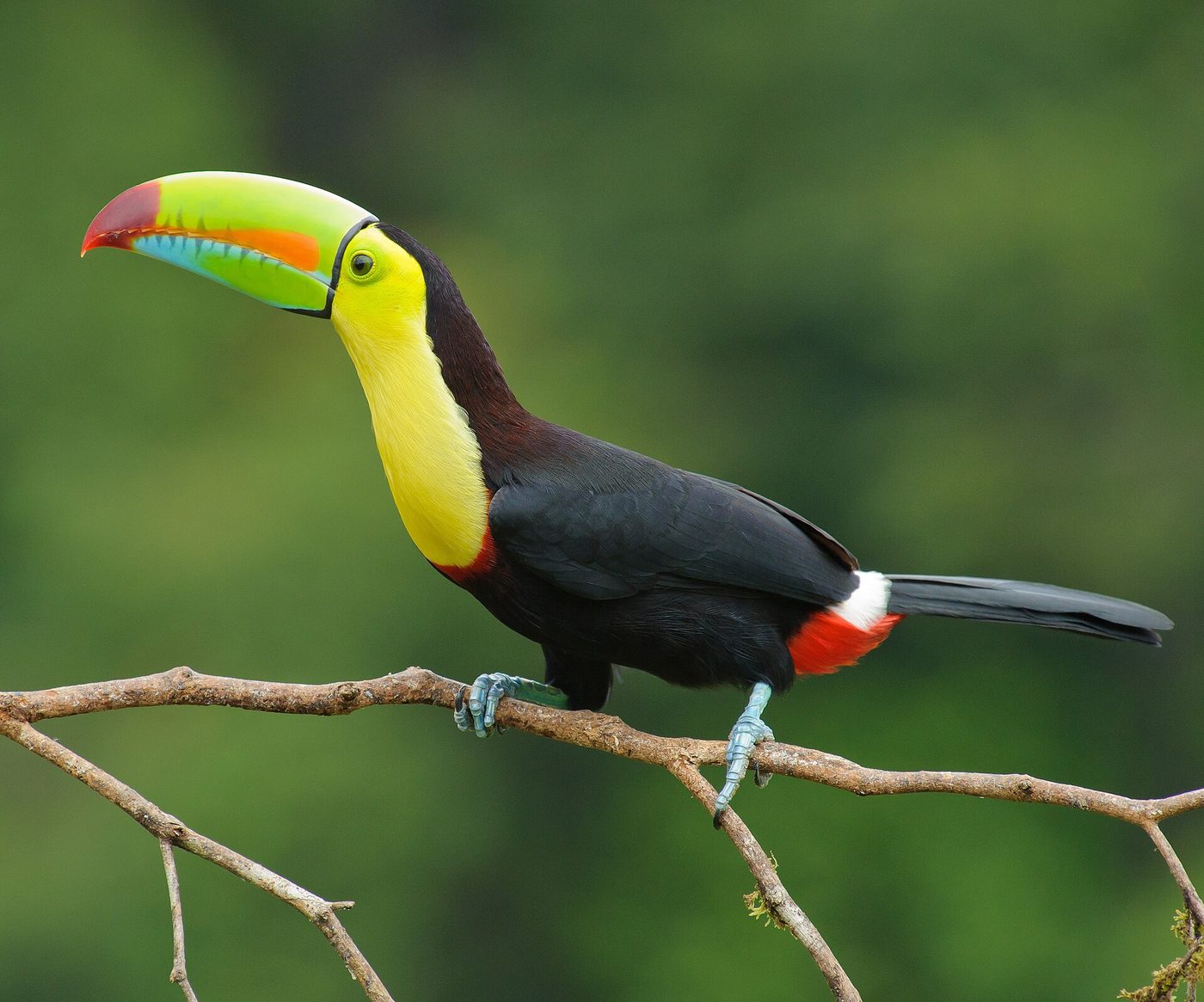
Photo: Ttschleuder · CC BY-SA 3.0
Keel-billed toucan
Ramphastos sulfuratus
With its huge bill painted in green, blue, orange and red, the keel-billed toucan is one of the most iconic birds of the tropical forests of Central America.
Characteristics
Temperament
Sociable, arboreal, lives in small groups
Diet
Omnivore: fruit, seeds, insects, small animals
The rainbow-billed bird
The keel-billed toucan is impossible not to recognise: its most famous feature is its huge, long, light bill, coloured like a rainbow with shades of pale green, blue, orange and a striking reddish-orange tip. The body is covered in black plumage, in sharp contrast with the bright yellow of the throat and breast. Around the eye the bare skin is green, while the iris is blue. Despite its size, the bill is very light, because it is built with a hollow, spongy internal structure.
Habitat and distribution
It lives in the tropical forests, from southern Mexico through Central America to the far north-west of South America. It prefers humid lowland forests, where it spends much of its time among the treetops. It is an arboreal bird, moving in small groups by hopping between branches rather than flying over long distances.
Feeding and behaviour
The keel-billed toucan is omnivorous: its diet is based mainly on fruit, but also includes seeds, insects, small reptiles, eggs and the chicks of other birds. Its large bill, with serrated edges, lets it reach and grasp fruit even on the thinnest branches, then toss it back into its throat with a quick movement of the head. By feeding on fruit, it disperses seeds and helps to regenerate the forest.
Curiosities
What is such a large, colourful bill for? Besides helping with feeding, the bill plays a role in regulating body temperature by dispersing excess heat, and serves in communication and courtship. The keel-billed toucan is the national bird of Belize, where it is a much-loved symbol.
Conservation
The keel-billed toucan is classified as near threatened. Although still widespread, it suffers from the progressive destruction of tropical forests and, in some areas, from capture for the exotic-pet trade. The protection of forests is essential to secure its future.
Pros
- One of the most spectacular multicoloured bills
- National bird of Belize
- Disperses seeds, regenerating the forest
- Huge yet surprisingly light bill
Cons
- Near threatened with extinction
- Depends on intact tropical forests
- Captured for the exotic-pet trade