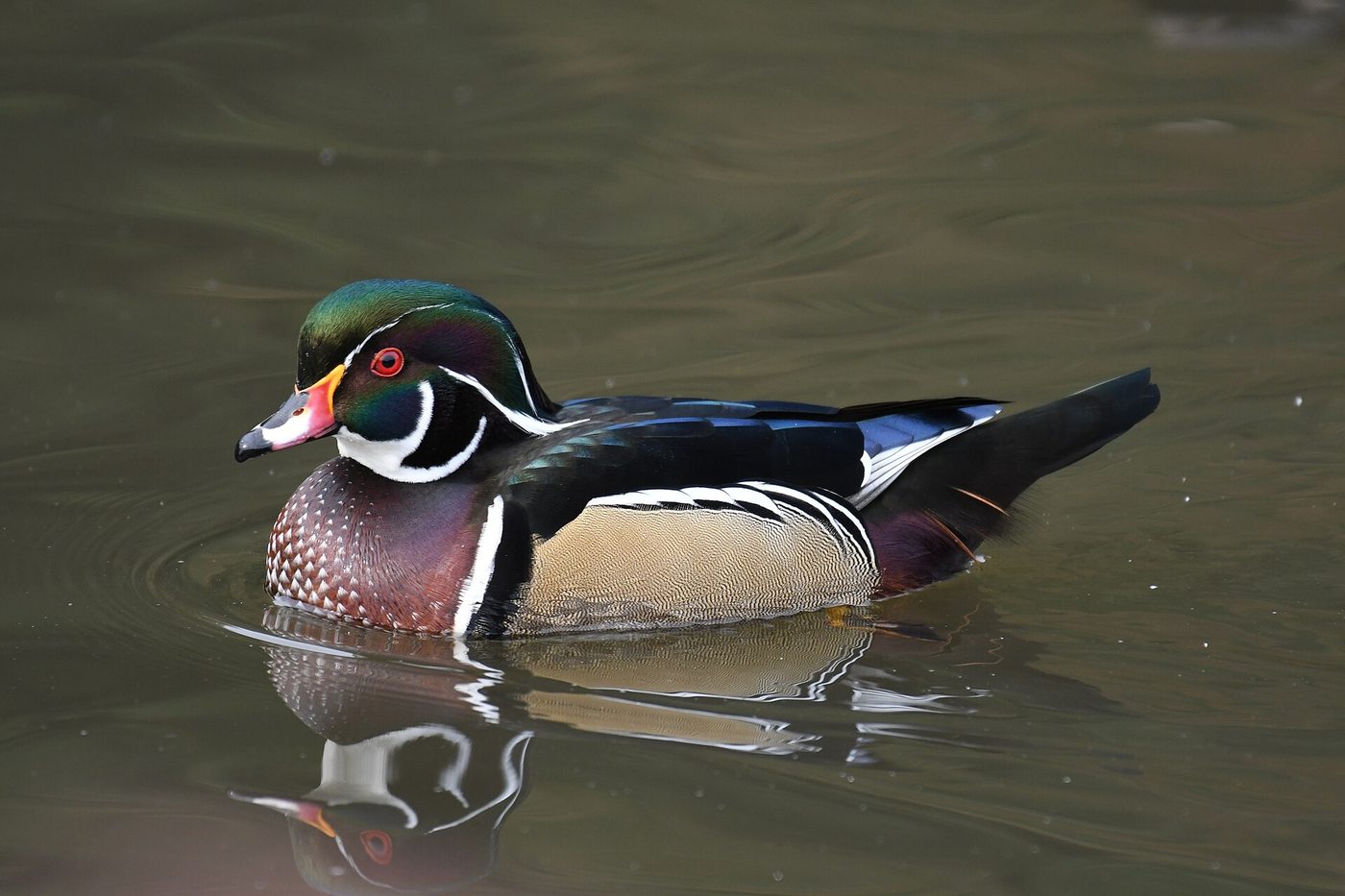
Photo: lwolfartist · CC BY 2.0
Wood duck
Aix sponsa
With its iridescent colours and elegantly crested head, the wood duck is one of the most beautiful ducks in North America, an inhabitant of woods and waters.
Characteristics
Temperament
Tied to woods, elegant, rather shy
Diet
Omnivore: seeds, acorns, aquatic plants, insects
An iridescent jewel
The wood duck is one of the most spectacular and beloved ducks in North America. The male in particular displays a livery of extraordinary beauty: its head is adorned with a striking crest of feathers with green and purple sheens, crossed by elegant white lines, its eyes are a bright red, and its breast and flanks show warm tones and finely drawn details. The female, as in many ducks, has more sober greyish-brown colours, with a characteristic white ring around the eye, a discreet and camouflaged livery.
Habitat and distribution
It lives across much of North America, preferring bodies of water surrounded by woods: ponds, marshes, small lakes and slow watercourses lined with trees. It is in fact a duck closely tied to wooded environments, much more so than many other species. Introduced populations are also found in some parts of Europe.
Behaviour and nesting
The wood duck nests in tree cavities, even at considerable heights above the ground, a behaviour it shares with its Asian relative, the mandarin duck. Shortly after hatching, the ducklings perform a surprising feat: they bravely leap from the nest set high up and glide unharmed to the ground or water, thanks to their very light weight, then follow their mother. It feeds on seeds, acorns, aquatic plants and small invertebrates.
A recovery story
The wood duck is also a symbol of conservation success. In the early twentieth century, due to overhunting and habitat loss, the species suffered a sharp decline and fears were held for its survival. Thanks to protection measures, the regulation of hunting and the spread of artificial nest boxes, the populations recovered remarkably, becoming abundant again.
Conservation
Today the wood duck is classified as a species of least concern, with numerous and stable populations. Its story shows how much conservation efforts can make a difference. It nonetheless remains important to protect the wooded wetlands it needs for nesting and feeding.
Pros
- Male plumage among the most beautiful in the world
- Nests in trees, an unusual behaviour
- A successful recovery and conservation story
- Numerous and stable populations
Cons
- The male loses its vivid colours out of season
- Depends on wooded wetlands
- Rather shy, not always easy to approach