Photo: Alvesgaspar · CC BY 2.5
Chicory
Cichorium intybus
Chicory is a robust perennial herb with sky-blue flowers, wild along roadsides and the ancestor of radicchio, endive and chicory coffee.
Characteristics
The blue flowers of the roadside
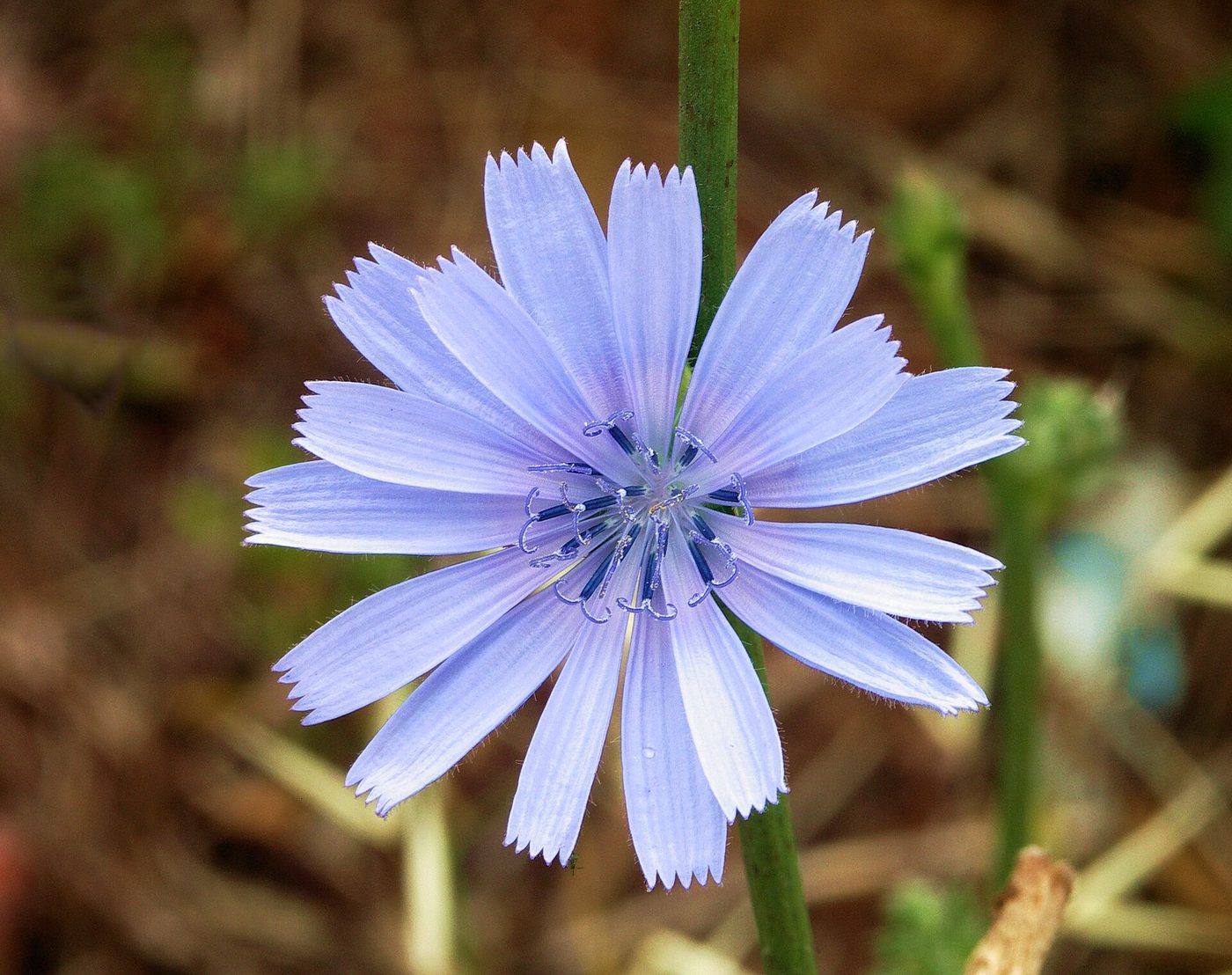
Chicory is a somewhat woody perennial herb of the family Asteraceae. It is easily recognised by its intense sky-blue flowers, with toothed petals, that open in the morning and tend to close in the hottest hours. The stems are upright and stiff, branching, with lobed basal leaves resembling those of the dandelion. It is a very common plant, colonising roadsides, waste ground and dry meadows.
Origin and habitat
It is native to Europe, North Africa and western Asia, and has naturalised in the Americas, Africa, Asia and Oceania. It is a cosmopolitan, hardy plant that favours well-drained soils and sunny spots, even on poor, chalky ground.
Culinary uses
Chicory is the ancestor of many cultivated vegetables: red radicchio, Belgian endive (or witloof), barbe de capucin and cutting chicories. The tender, bitter leaves are eaten raw or cooked. The roasted, ground root has for centuries been used as a coffee substitute or additive — the famous chicory coffee.
Cultivation
It is very easy to grow: it wants full sun and well-drained soil, and once established it is very resistant to drought and cold. Cultivated forms are sown according to the type of harvest desired (leaves, heads or roots). It also has ecological value, offering nectar to pollinators.
Properties
The root is rich in inulin, a prebiotic fibre, and its bitter parts have long been used in herbal tradition as tonics and digestives. It is non-toxic and entirely edible.
Flowering season
Practical tips
Water needs: Low, very drought-resistant — always check soil moisture before watering.
Prefers Full sun: provide the right light and rotate the plant for even growth.
Recommended soil: Well-drained, even poor and chalky. Refresh the substrate every 1-2 years.
Dust the leaves with a damp cloth to support photosynthesis.
Feed during the growing season (spring-summer) and stop in winter.
Pros
- Ancestor of radicchio, endive and chicories
- Decorative blue flowers, good for pollinators
- Hardy and drought-resistant
Cons
- Can become weedy on waste ground
- The leaves have a markedly bitter taste