Photo: Alvesgaspar · CC BY-SA 3.0
Common mallow
Malva sylvestris
Common mallow is a widespread herb with streaked pinkish-purple flowers, prized for centuries for its soothing, emollient properties.
Characteristics
Description
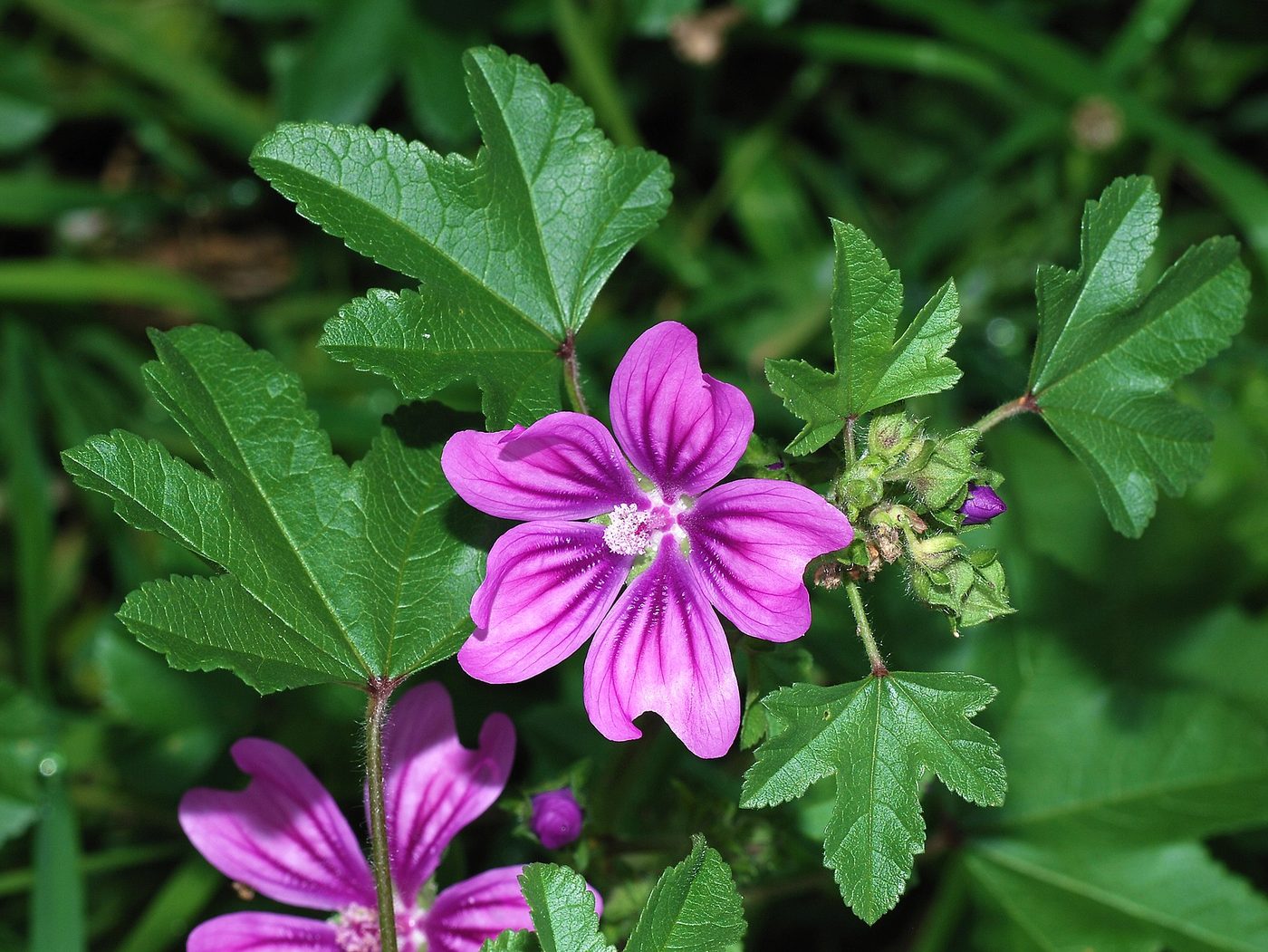
Common mallow is a herbaceous plant, often biennial or short-lived perennial, with erect or ascending stems that can exceed a metre. The leaves are palmate, with five to seven lobes, and the flowers, a few centimetres across, have five petals of a distinctive pinkish-purple marked with darker veins that converge toward the centre. Flowering is very long, continuing through the whole warm season.
Habitat and distribution
Native to Europe, North Africa and western Asia, it is now found across much of the temperate world. It is a typical ruderal plant, growing wild along roadsides, on waste ground, against walls and on disturbed soil, where it quickly colonises bare earth.
Properties and uses
It is one of the oldest and best-known medicinal plants. Flowers and leaves are rich in mucilage with emollient and soothing properties, traditionally used in infusions and decoctions to ease the throat and airways and to aid digestion. The young leaves and flowers are also edible, eaten in salads or cooked.
Cultivation
It is extremely easy to grow and needs almost no care. It grows in full sun or part shade, in any ordinary well-drained soil, and tolerates both drought and cold well. Sow in spring; it readily self-sows.
- Sow directly in place in spring
- Gather flowers just as they open for drying
- Cut back spent stems to prolong flowering
Did you know?
The small round, flattened fruits, rich in mucilage, resemble miniature cheeses, which is the origin of many folk names linked to bread and cheese. Its Latin name alludes to its soft, emollient nature.
Flowering season
Practical tips
Water needs: Moderate — always check soil moisture before watering.
Prefers Full sun or part shade: provide the right light and rotate the plant for even growth.
Recommended soil: Ordinary, well-drained, even poor. Refresh the substrate every 1-2 years.
Dust the leaves with a damp cloth to support photosynthesis.
Feed during the growing season (spring-summer) and stop in winter.
Pros
- Very long, generous flowering
- Edible flowers and leaves rich in soothing mucilage
- Extremely easy, hardy and good for wild gardens
Cons
- Can self-seed and become weedy
- Short-lived perennial, often grown as a biennial
- Prone to mallow rust on the leaves