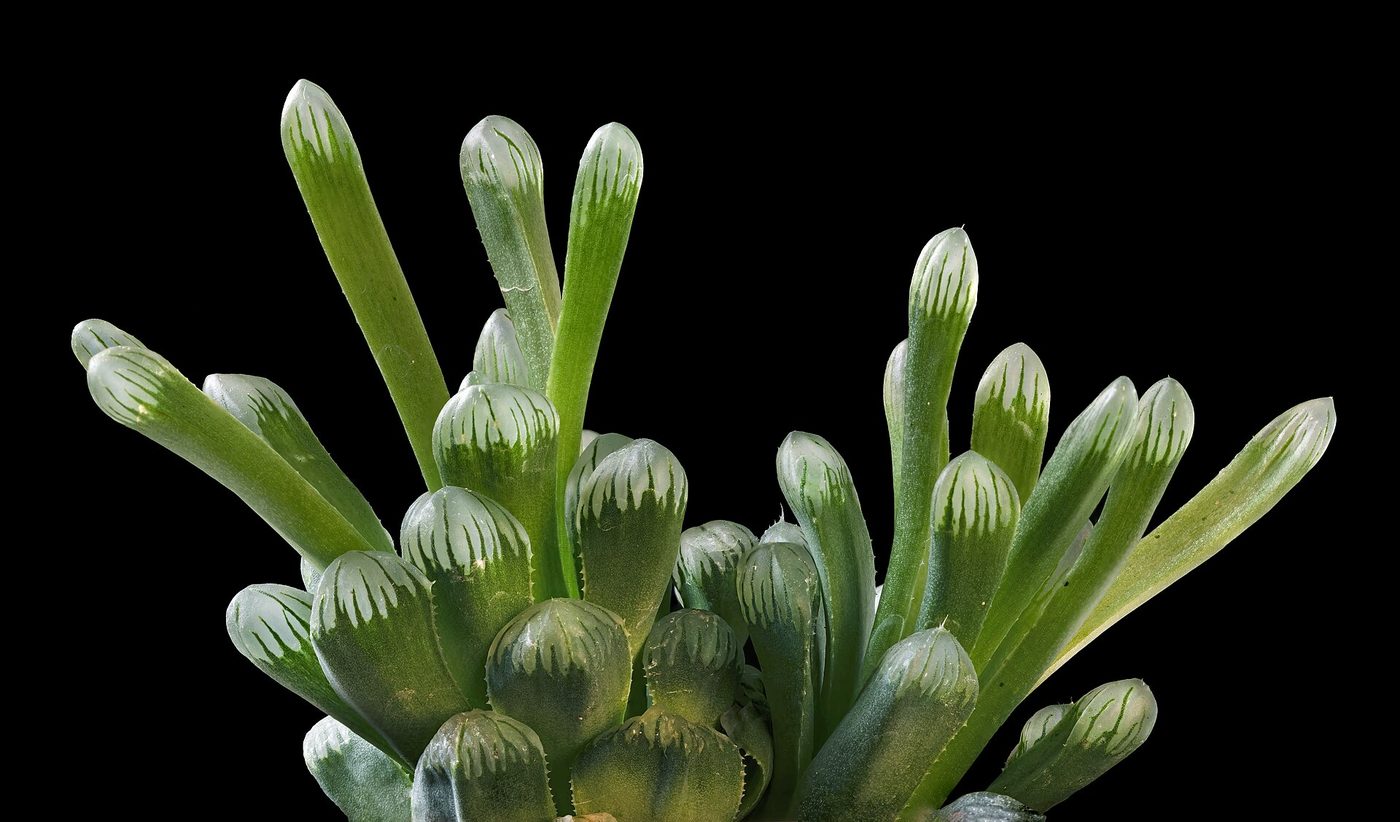
Photo: Didier Descouens · CC BY-SA 4.0
Cooper's haworthia
Haworthia cooperi
A small South African succulent with rounded, translucent leaves, Haworthia cooperi looks made of green jelly beads and is very easy to grow indoors.
Characteristics
A succulent with jelly-like leaves
Haworthia cooperi is a small succulent that forms compact rosettes of fleshy, swollen, rounded leaves of a pale translucent green. The leaf tips are transparent like little glass windows: held up to the light they look like beads of jelly. This structure, called a 'leaf window', is not just beautiful but functional. It is a highly variable species, with many different forms.
Origin and habitat
It is native to the Eastern Cape Province of South Africa, where it grows in arid habitats. In the wild it often almost buries itself in the soil, leaving only the transparent leaf tips exposed: light enters through these 'windows' and reaches the photosynthetic tissue inside, while the rest of the plant stays protected from scorching sun and dehydration.
Cultivation
It is one of the easiest and best-loved succulents as a houseplant. It wants bright but filtered light (strong direct sun can scorch its leaves), a very free-draining mineral substrate and sparing watering: let the soil dry out well before watering again, reducing water in winter. It resents waterlogging, which rots its roots, and frost.
Curiosities
It readily produces offsets at the base, which can be detached to make new plants. Its flowers are small and white, borne on a slender stalk, but the real charm of the plant lies in its jewel-like leaves.
Care
Perfect for bright windowsills and small pots, it needs very little attention. The commonest mistake is overwatering: like all succulents, it prefers drought to excess water.
Practical tips
Water needs: Low: let dry between waterings — always check soil moisture before watering.
Prefers Bright but filtered light: provide the right light and rotate the plant for even growth.
Recommended soil: Mineral and very free-draining. Refresh the substrate every 1-2 years.
Dust the leaves with a damp cloth to support photosynthesis.
Feed during the growing season (spring-summer) and stop in winter.
Pros
- Spectacular translucent 'window' leaves
- Very easy to grow indoors
- Multiplies on its own with offsets
Cons
- Rots with too much water or waterlogging
- Strong direct sun can scorch its leaves
- Frost-tender