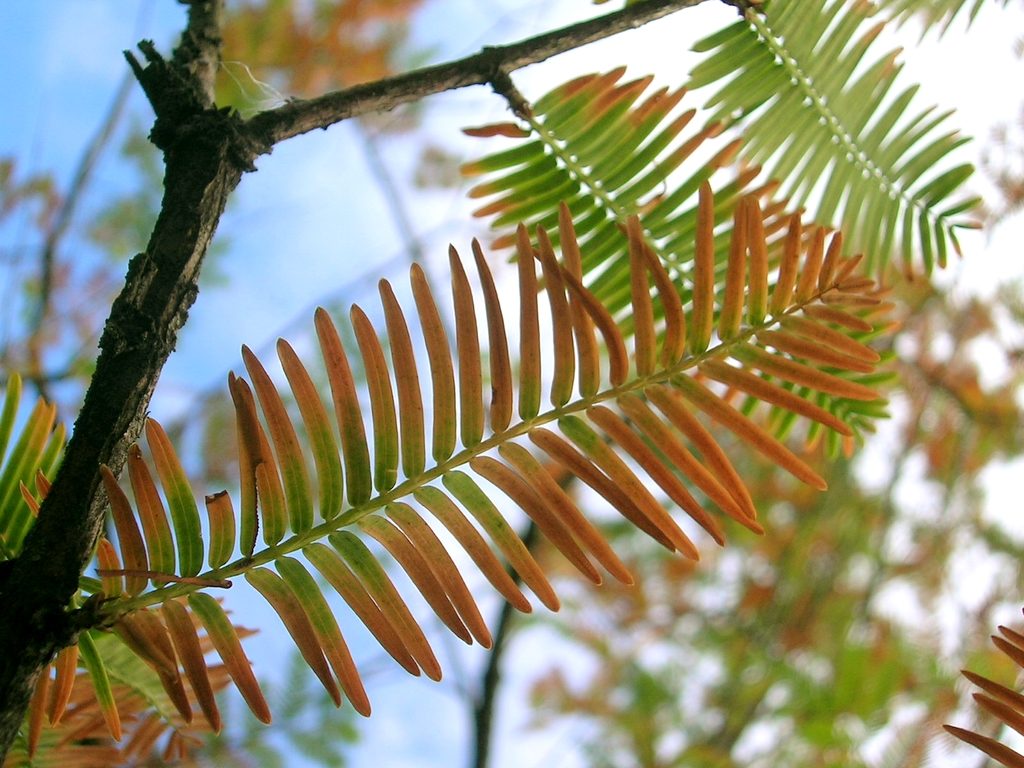
Photo: Philippe Semanaz · CC BY-SA 2.0
Dawn redwood
Metasequoia glyptostroboides
A conifer with a pyramidal crown and leaves that turn golden in autumn, the dawn redwood is a living fossil once thought extinct and then rediscovered in China.
Characteristics
A conifer with an extraordinary history
The dawn redwood is a large and fascinating tree, one of the most famous cases of a 'living fossil' in the plant world. It is a conifer of elegant appearance, with a straight trunk, often fluted at the base, and a conical, orderly crown. Its most singular feature among conifers is that it is deciduous: unlike most of its evergreen relatives, in autumn its soft, needle-like leaves take on splendid golden and coppery tones before falling, leaving the tree bare for the winter.
A sensational rediscovery
The story of the dawn redwood is among the most extraordinary in botany. For a long time the species was known only through fossils, and was believed to have been extinct for millions of years. In the mid-twentieth century, however, some living specimens were discovered in a remote region of China, to the great astonishment of scientists. The 'resurrection' of this plant, believed vanished and found alive, caused a sensation around the world, and since then the dawn redwood has been cultivated and spread in many countries.
Cultivation
Thanks to its beauty, rapid growth and hardiness, the dawn redwood is today much used as an ornamental tree in parks, gardens and avenues across much of the temperate world. It loves sunny positions and cool, moist soils, and tolerates cold well. Its spectacular crown, especially in autumn, makes it a prized choice where there is enough space for a large tree.
Curiosities
The dawn redwood is a living bridge to Earth's distant geological past: its form and appearance have remained similar to those of its ancestors that lived millions of years ago. To observe it is to look at a fragment of an ancient flora that dominated the planet in remote ages.
Conservation
Although widely cultivated all over the world, in the wild the dawn redwood is classified as an endangered species. The wild populations survive in a very restricted area of China and are vulnerable. Widespread cultivation helps to preserve the species, but protecting the few wild specimens and their habitat remains important.
Practical tips
Water needs: Regular, loves moist soils — always check soil moisture before watering.
Prefers Full sun: provide the right light and rotate the plant for even growth.
Recommended soil: Cool, moist, deep. Refresh the substrate every 1-2 years.
Dust the leaves with a damp cloth to support photosynthesis.
Feed during the growing season (spring-summer) and stop in winter.
Pros
- Living fossil with an extraordinary history
- Spectacular crown, golden in autumn
- Fast growth and good hardiness
- Excellent as an ornamental tree
Cons
- Endangered species in the wild
- Requires much space in adulthood
- Prefers cool, moist soils