Photo: H. Zell · CC BY-SA 3.0
Dragon tree
Dracaena draco
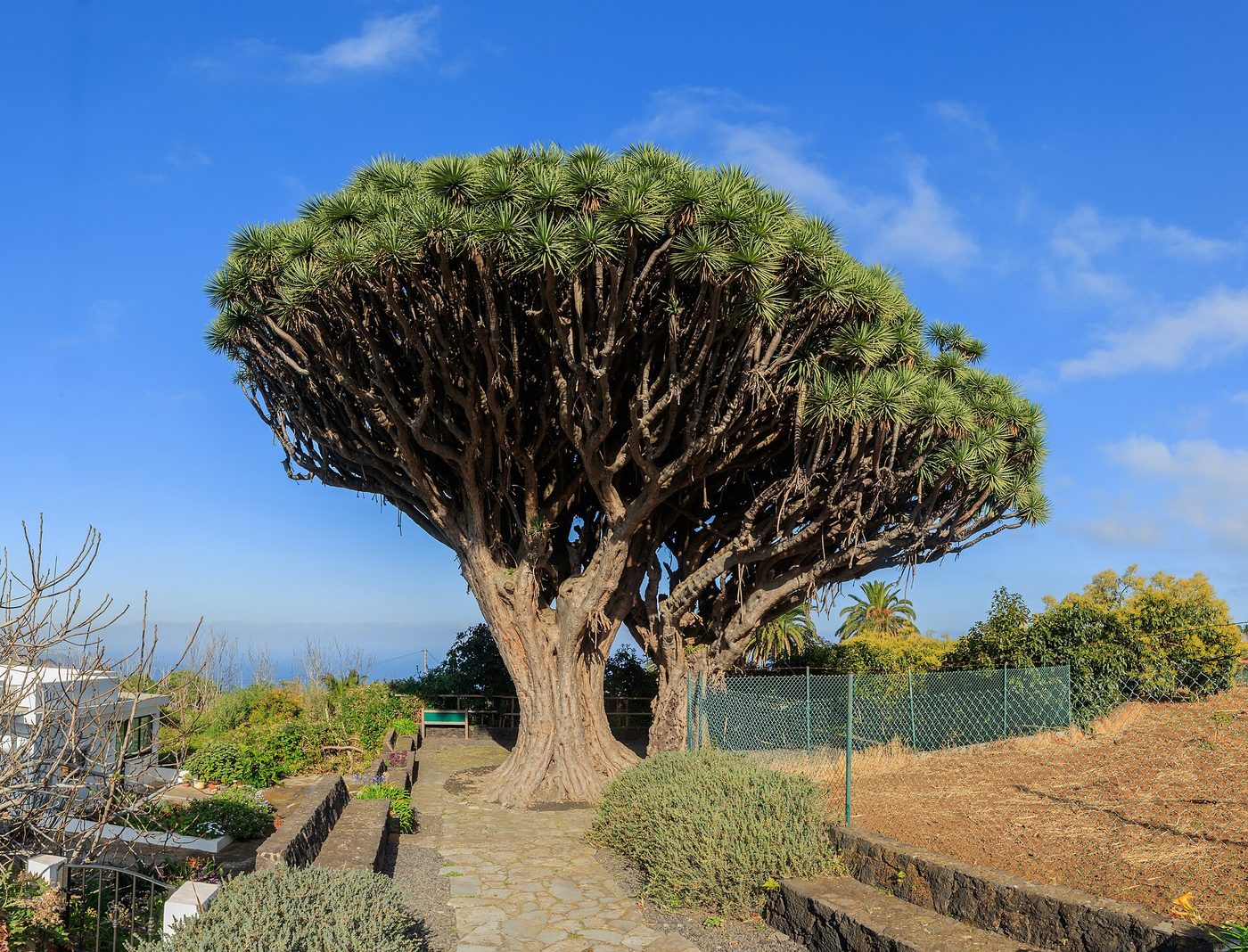
With its characteristic umbrella-shaped crown and red resin known as 'dragon's blood', the dragon tree is a legendary, long-lived plant of the Canary Islands.
Characteristics
A tree of legendary appearance
The dragon tree is a tree of unmistakable, almost fairytale appearance. Its trunk, sturdy and greyish, gradually divides into branches that fork repeatedly, forming a dense crown shaped like an umbrella or a great dome. At the tips of the branches grow tufts of long, stiff, pointed leaves, like swords, of a blue-green colour. With age the tree takes on sculptural, majestic forms, and the oldest specimens become veritable natural monuments.
Origin and distribution
It is native to Macaronesia, the group of Atlantic archipelagos that includes the Canary Islands, and to north-western Africa. It is the emblematic tree of Tenerife, where some centuries-old specimens are famous and protected. It grows in mild, dry subtropical climates, on rocky, well-drained soils, and is well adapted to scarcity of water.
Cultivation and care
The dragon tree is a hardy, undemanding plant, ideal for warm climates and Mediterranean gardens, where it can also be grown in large pots. It loves full sun and fears above all intense frost and waterlogging, which can rot its roots. It should be watered sparingly, as it tolerates drought well. Its growth is extremely slow: it takes many years to develop and can live for centuries.
Dragon's blood and curiosities
The tree's name comes from its resin, which when the bark is cut oozes out a bright red colour, recalling blood: for this reason it is known as 'dragon's blood'. Since antiquity this substance has been collected and used as a dye, varnish and in traditional preparations. Being a monocotyledon, the dragon tree does not form the normal growth rings of wood, which makes it difficult to establish its age precisely. It is classified as an endangered species in the wild, where its populations are reduced and fragmented.
Practical tips
Water needs: Scarce, tolerates drought well — always check soil moisture before watering.
Prefers Full sun: provide the right light and rotate the plant for even growth.
Recommended soil: Rocky, sandy and well-drained. Refresh the substrate every 1-2 years.
Dust the leaves with a damp cloth to support photosynthesis.
Feed during the growing season (spring-summer) and stop in winter.
Pros
- Sculptural, legendary appearance
- Extremely long-lived, lives for centuries
- Drought-tolerant and undemanding
- Emblematic tree of Tenerife
Cons
- Endangered species in the wild
- Extremely slow growth
- Fears intense frost and waterlogging