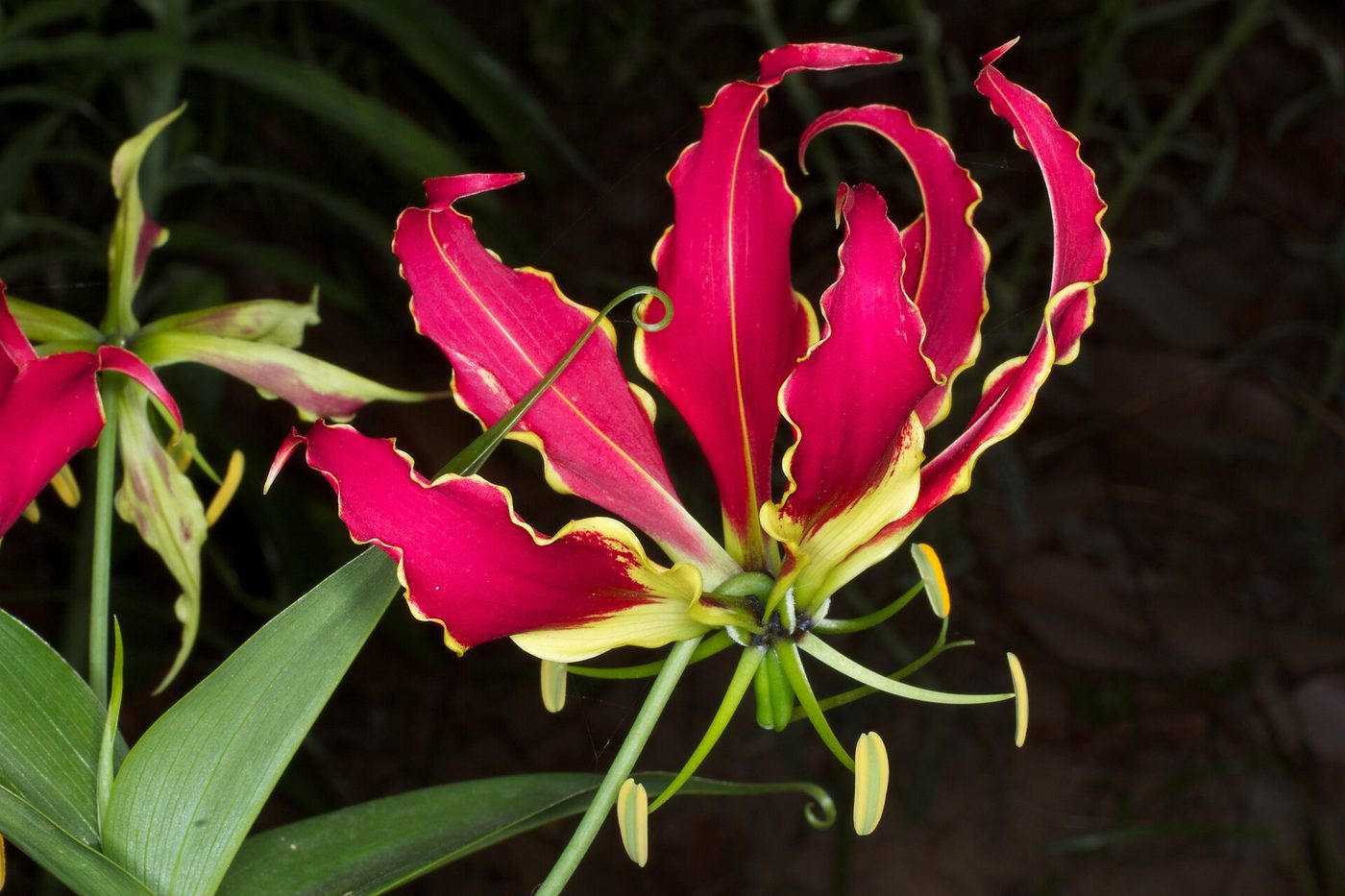
Photo: Brian Gratwicke · CC BY 2.0
Flame lily
Gloriosa superba
With its red and yellow petals curved backwards like flames, the flame lily is a spectacular but extremely poisonous climber, to be handled with caution.
Characteristics
A flower that looks like a flame
The flame lily is a climbing plant with unmistakable, spectacular flowers. The petals, long and wavy, fold conspicuously backwards and shade from bright red to yellow, giving the whole flower the appearance of a flickering flame or a coloured claw. The leaves, green and glossy, end in a small spiral tendril that the plant uses to grip supports and climb. It grows from an underground rhizome and produces its finest flowers in summer.
Origin and distribution
It is native to tropical Africa and Southeast Asia, where it grows in warm-climate areas with alternating seasons of humidity and drought. Thanks to its beauty it is cultivated as an ornamental plant in many parts of the world. It is the national flower of Zimbabwe.
Cultivation and care
The flame lily loves full sun or partial shade and a fertile, well-drained soil. It needs a support, such as a trellis or netting, on which the tendrils can climb. During the growing season it should be watered regularly, while in winter the rhizome goes into rest and watering should be suspended. It fears frost: in cold climates the rhizome can be dug up and kept in shelter until the following spring.
Warning: a highly poisonous plant
The flame lily is an extremely toxic plant: all its parts, and in particular the rhizome, contain colchicine, a poisonous substance that can be lethal if eaten, even in small quantities. It must therefore be kept absolutely away from children and pets, and handled with gloves to avoid irritation. Despite its undeniable beauty, its cultivation requires awareness and caution. It is classified as a species of least concern globally.
Flowering season
Practical tips
Water needs: Regular in growth, suspended when dormant — always check soil moisture before watering.
Prefers Full sun or partial shade: provide the right light and rotate the plant for even growth.
Recommended soil: Fertile and well-drained. Refresh the substrate every 1-2 years.
Dust the leaves with a damp cloth to support photosynthesis.
Feed during the growing season (spring-summer) and stop in winter.
Pros
- Spectacular flame-shaped flowers
- Elegant climber with tendrils
- National flower of Zimbabwe
- Easy to grow in a warm climate
Cons
- Highly toxic, potentially lethal
- Fears frost, needs shelter in winter
- Needs a support to climb on