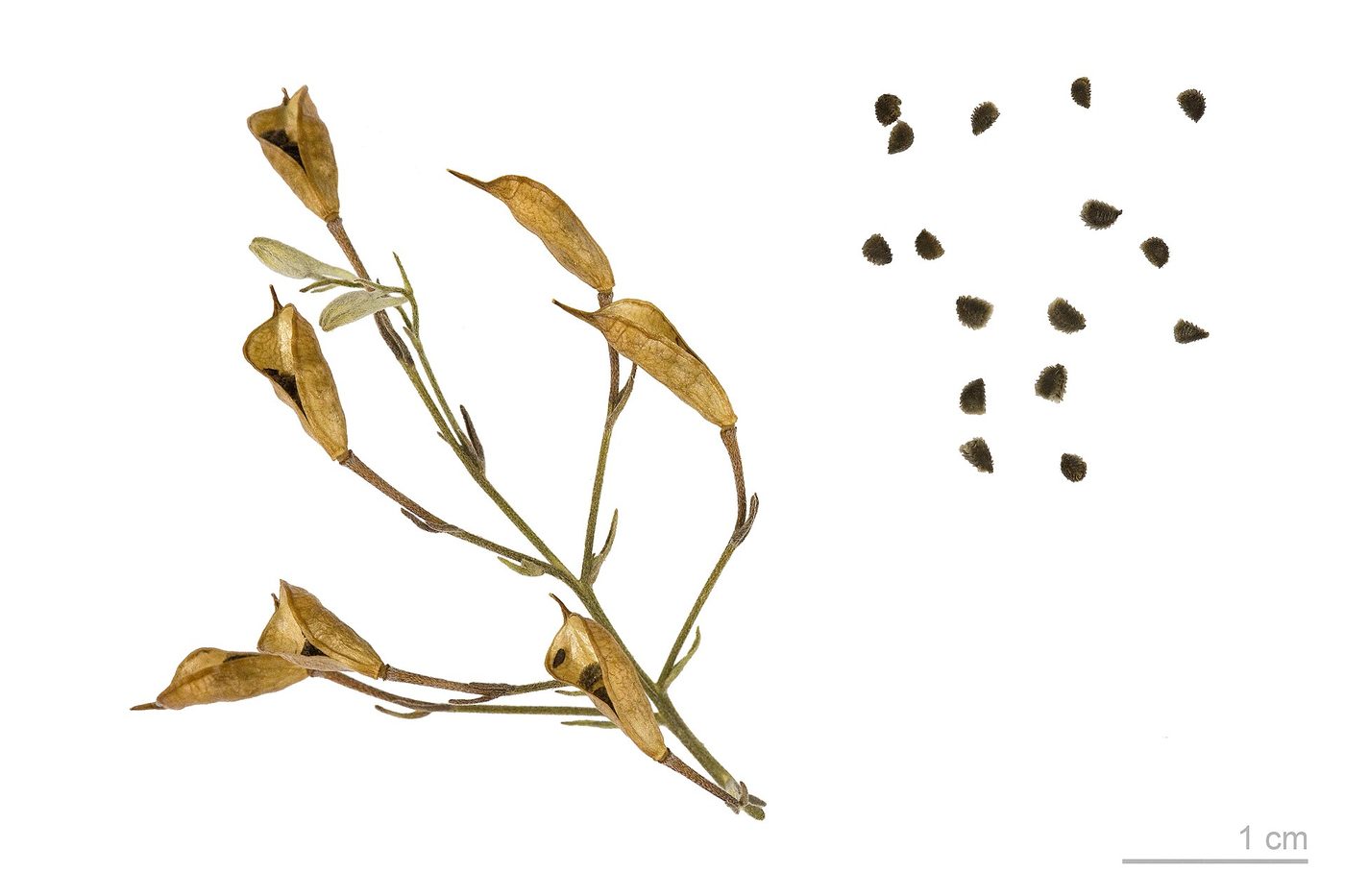
Photo: Roger Culos · CC BY-SA 3.0
Forking larkspur
Consolida regalis
The forking larkspur is a delicate annual with blue-violet flowers bearing a long spur, once common among cereal crops.
Characteristics
Blue flowers with a spur
The forking larkspur is an annual herb of the buttercup family, Ranunculaceae, the same as columbine and buttercup. It is related to the garden delphiniums. Its flowers, gathered in loose spikes, are an intense blue-violet and bear a characteristic long spur, formed by a petal extended backward. The stems are slender and branching, and the leaves finely divided into thread-like segments.
Origin and habitat
It is widespread in Europe and western Asia. It once grew abundantly as a weed in cereal fields, being one of the arable plants, now rare due to intensive agriculture. It favours well-drained, sunny, chalky soils.
Cultivation
It is easy to grow from seed, sown in autumn or spring directly where it is to grow, in full sun. It is hardy and resists cold and drought. It flowers in early summer and is appreciated by pollinators, especially long-tongued bees and bumblebees able to reach the nectar hidden in the spur.
Warning: a toxic plant
Like many Ranunculaceae, it contains alkaloids and is toxic if eaten, both to people and to livestock. Keep it away from children and animals that might chew its parts, and handle it with a little care.
Care
It needs little attention: sparing watering and no waterlogging. It self-seeds readily. It is a fine choice for flowery meadows and naturalistic gardens, where it recreates the look of the old wheat fields.
Flowering season
Practical tips
Water needs: Low, drought-tolerant — always check soil moisture before watering.
Prefers Full sun: provide the right light and rotate the plant for even growth.
Recommended soil: Well-drained, chalky, even poor. Refresh the substrate every 1-2 years.
Dust the leaves with a damp cloth to support photosynthesis.
Feed during the growing season (spring-summer) and stop in winter.
Pros
- Elegant spurred blue-violet flowers
- Useful to long-tongued pollinators
- Hardy, easy and self-seeding
Cons
- Toxic if eaten
- Annual and rare in the wild