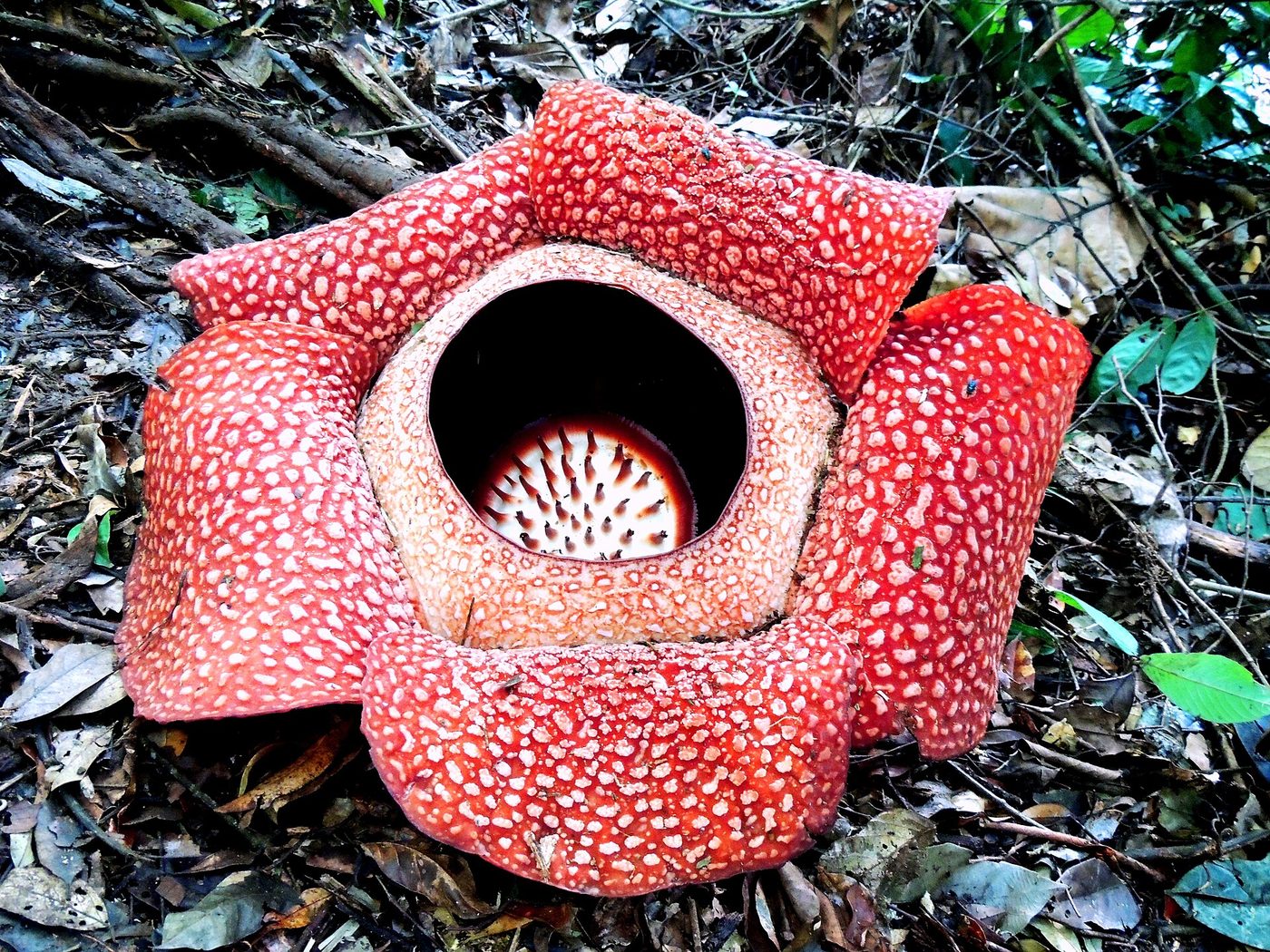
Photo: Lentera Merah · CC BY-SA 3.0
Giant rafflesia
Rafflesia arnoldi
The rafflesia produces the largest single flower in the world: a parasitic plant with no leaves or roots, famous for its stench of rotting flesh.
Characteristics
The largest flower in the world
The rafflesia (Rafflesia arnoldii) is famous for an absolute record: it produces the largest single flower in the plant kingdom, which can reach about a metre across and weigh up to eleven kilograms. It is a parasitic plant with no chlorophyll, leaves, stem or visible roots: it lives entirely inside certain vines of the genus Tetrastigma, from which it draws water and nutrients. The only part that emerges is the enormous flower, brick-red speckled with pale spots, with five large fleshy lobes arranged around a central cavity.
Habitat and range
It grows in the rainforests of Sumatra and Borneo, in Indonesia and Malaysia. It stays hidden inside its host plant for most of its life cycle; only when it flowers does a cabbage-like bud emerge from the vine and open.
Reproduction and pollination
The flower gives off a strong smell of decaying flesh, which has earned it the nickname "corpse flower". The stench attracts carrion flies, which pollinate the flower as they move from one specimen to another. The plant is dioecious — with separate male and female flowers — so pollination requires two flowers to be open close together at the same time, a rare event.
Did you know?
It was documented in Sumatra in 1818 by the expedition of Thomas Stamford Raffles and Joseph Arnold, hence the name. The flower stays open for only a few days before blackening and rotting away. It is impossible to grow outside its natural setting.
Conservation
It is considered rare and threatened: deforestation, destruction of the host vines and collection of the buds put its populations at risk. Its survival depends on the full protection of Southeast Asia's rainforests.
Practical tips
Water needs: Constantly humid environment — always check soil moisture before watering.
Prefers Shade: lives in the forest understorey: provide the right light and rotate the plant for even growth.
Recommended soil: None: an internal parasite of Tetrastigma vines. Refresh the substrate every 1-2 years.
Dust the leaves with a damp cloth to support photosynthesis.
Feed during the growing season (spring-summer) and stop in winter.
Pros
- The largest single flower in the world
- An extraordinary example of a parasitic plant
- An icon of Southeast Asian biodiversity
Cons
- Impossible to grow outside its habitat
- Nauseating smell of rotting flesh
- Rare and threatened by deforestation