Photo: association AMV · CC BY-SA 4.0
Round-leaved sundew
Drosera rotundifolia
A small carnivorous plant of European bogs, the round-leaved sundew catches insects with round leaves covered in sticky tentacles that glisten like dew.
Characteristics
The dew that traps
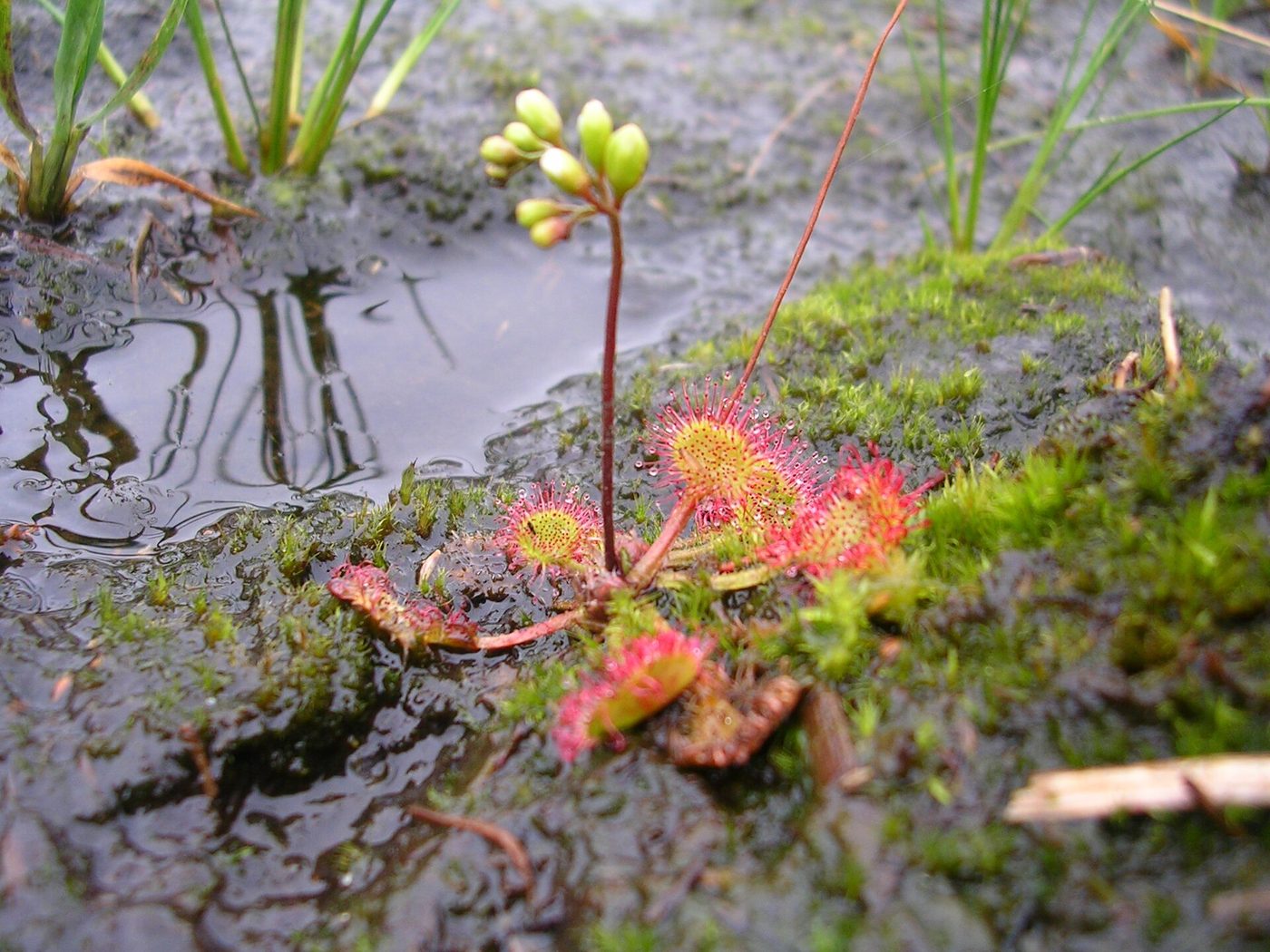
The round-leaved sundew is a small carnivorous plant that forms a rosette of rounded leaves pressed to the ground. Each leaf is covered in slender red tentacles, every one tipped with a droplet of sticky mucilage that glistens in the sun like a bead of dew — hence the name 'sundew'. From this rosette a slender stalk rises in summer bearing small white flowers.
Habitat and distribution
It is one of the most widespread sundews in the world, with a circumboreal distribution: it lives across much of Europe, Siberia and North America, as far as Korea, Japan and New Guinea. It grows in acidic bogs, marshes and sphagnum mats, nutrient-poor habitats where catching insects makes up for the scarcity of nitrogen.
How it catches prey
The sticky droplets attract insects, which become stuck. The leaf then reacts: the tentacles slowly bend towards the prey and, in the more mobile leaves, the whole blade curls to enfold it, while glands secrete enzymes that digest it. Within a few days only the insect's chitinous shell remains.
Cultivation and protection
In cultivation it needs full sun, an acidic peat-and-sphagnum substrate kept always soaked, mineral-free water and a cold winter rest, during which it withdraws into a compact bud. In the wild it is a protected species in many European countries: collection is banned.
Conservation
The IUCN lists the species as Least Concern globally, but many local populations are declining due to the drainage of bogs. Protecting these habitats is essential to its survival.
Flowering season
Practical tips
Water needs: High: bog kept always soaked — always check soil moisture before watering.
Prefers Full sun: provide the right light and rotate the plant for even growth.
Recommended soil: Peaty, acidic and poor (sphagnum). Refresh the substrate every 1-2 years.
Dust the leaves with a damp cloth to support photosynthesis.
Feed during the growing season (spring-summer) and stop in winter.
Pros
- Spectacular dewy tentacles
- Native carnivore, hardy to cold
- Very widespread in the northern hemisphere
Cons
- Declining locally from loss of bogs
- Protected in many countries: must not be collected
- Needs an always-wet acidic substrate and winter rest